
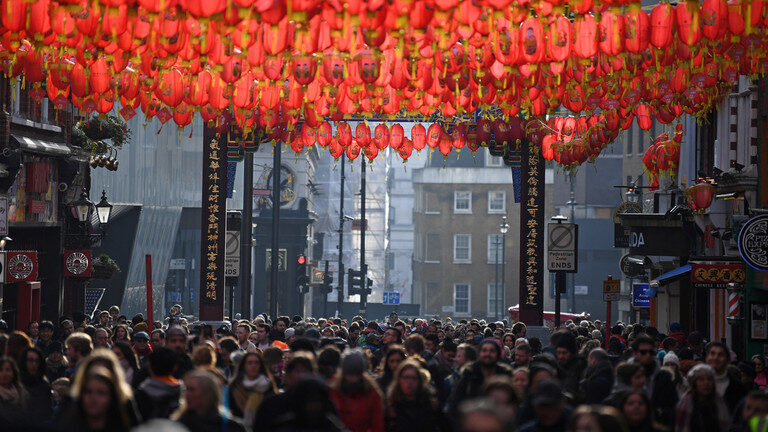
© Daniel LEAL / AFP
It's been a highly turbulent week in British politics, even by modern-day chaotic standards. Prime Minister Liz Truss resigned 45 days into her term, to be succeeded by her former leadership rival Rishi Sunak.
On the other side of the globe, China concluded its 20th national party congress, which saw leader Xi Jinping reappointed for an unprecedented third term. The mainstream media like to say that he is the "most powerful Chinese leader since Mao."
And not surprisingly, there has been a concentrated effort in the Western press to shine as negative a light on China as possible throughout the course of the event. This led to one extraordinary article being published in the Times of London by columnist Dominic Lawson, who, reflecting on recent events in both Britain and China, insisted: "Our chaos is healthier than China's 'harmony'," while his sub-title complained that "too many Britons would exchange messy democracy for dictatorship." The article cites a poll that shows that 46% of Britons would prefer "a strong leader who doesn't have to bother with parliament/elections" - in other words, "some form of dictatorship" - to the current tumultuous state of the country.
For him, and presumably many others, to stick to democracy over "China's model" is a matter of common sense. It has to be noted that China has offered no indication that it wants its model imposed on Britain, and in practice the idea of doing so is inconceivable. It is just a matter of fact that communism is incomprehensible in Britain's political culture where classical liberty takes precedence, and if you ask 90% of the population the answer will be the same.
But this focus on ideological preference avoids the elephant in the room, that is, does Britain's political system deliver for its people, in contrast to China's? When looked at it from this angle, the answer is a straight and resounding 'no', which makes one immediately question the notion of whether "Britain's chaos" is truly better than "China's harmony" even if one can advocate for the former on grounds of principle.
While it is true that China has had its own periods of 'chaos', such as Mao's Cultural Revolution, the post-Mao consensus of China since "reform and opening up" commenced in 1978 has been to preserve political stability with the aim of accelerating economic development, thereby placing pragmatism above ideological dogma. And whether you like the Communist Party or not, this has been a success when viewed from a historical perspective.
China has advanced from being one of the world's poorest countries, having a GDP per capita of a mere $60 in 1960, to nearly $12,000 by the start of 2022 (now overtaking some countries in Europe). Its GDP as a whole has grown to become the second largest in the world, and surpassed the entire total of the European Union in 2021. Similarly, its average life expectancy had increased from a shockingly low 34 years in 1950, to over 76 by 2021. This has also overtaken the United States, which has dropped due to the massive number of deaths inflicted by the Covid-19 pandemic.
Given this, supporters of the Communist Party will argue that China's model has worked best for China's circumstances, and, as the old saying goes, 'if it ain't broke, don't fix it'. Why would China need to consider a British model of democracy, when all indicators from the UK itself increasingly show that this system isn't working, even for its own circumstances? The British might be able to vote for their leaders, but the disastrous performance of the recent government, jumping from one leader to the next, making ill-conceived policy choices based on ideology and populism, and the fiasco of Brexit, does not offer a decent return to voters.
While China continues to grow, despite criticism over its zero-Covid policy, Britain on the other hand is facing severe economic turbulence and has reportedly officially entered a recession, being described again as "the sick man of Europe." The underlying theme of the past 50 years in British politics has been a question of how to avoid the word 'decline', which is precisely how the turn towards Thatcherism, anti-trade unionism, aggressive neoliberalism, and of course Brexit itself, can all be described in a long-term perspective. Britain's best days are arguably behind it, with all of the above having contributed to growing political instability and uncertainty.
But the same cannot be said about China, where there might not be freedom, but there is certainty. So if you ask the average Chinese person if "Britain's chaos" is preferable to China's "strict harmony" then the answer will be a resounding 'no', and one merely has to look at the trajectory in the two countries' fortunes to see that.



Reader Comments
ie
Serves public interest.
Makes Policies ( Liberty, rights, and provision of policies that show and give people a sense of safety, protection, and employment )
Equal Distribution of Resources
Provides security to People.
Promotes Rule of Common Law and not statute law
Delivery of Essential services.
Employment.
Building of Infrastructure
National Budgeting
and
Protects People Rights.
the rest of it can fuck off in my humble opinion!
Any Western leader elected for a third term (Thatcher, Blair, Merkel) are described a beacons of the free world
Which brings me to China’s Communist Party. My view is that the most important role of this ‘non-democratic’ ruling body is to keep out the many forms of destructive interference of the CIA/MI6 which is so prevalent in so called ‘democratic’ countries in the West’s sphere of influence. Russia under Putin has had to root out these foreign intelligence and fifth columnist bad actors and influences. If China were to become democratic it would be infiltrated and destroyed from within.
Democracy is in such a bad state in the UK that a spell of rule under a just man of the nature of Oliver Cromwell would be a revelation. Jeremy Corbin might have been the nearest to that ideal under the current system but due to the true nature of that system the UK didn’t get to find out.
It's like a form of torture, anything to make it stop....
Not that I think like that. Lots do though. And they still believe the Tory/Labour divide. And the author has an evident bias.
Then we have the problem of our "democratic" leaders being the equivalent to ignorant, deceitful kids that bear no comparison to the experts running countries such as Russia and China
No major corporation would allow itself to be run by an annual staff selected CEO ... how does "democracy" make it right to run a country in such an amateurish way