RTWed, 19 Oct 2022 21:14 UTC
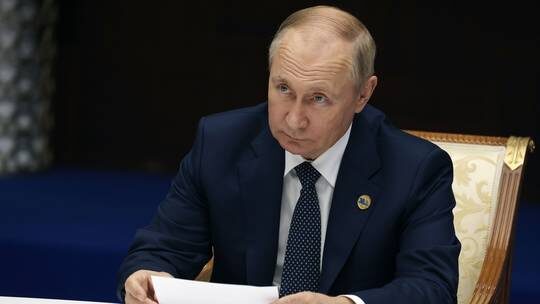
© Sputnik / Vyacheslav Prokofiev
Martial law has been imposed in the four regions that recently voted to become part of Russia amid the conflict with Ukraine. Russian President Vladimir Putin announced the decision on Wednesday.
The Donetsk and Lugansk People's Republics, as well as Kherson and Zaporozhye Regions,
already had martial law in place when they became parts of Russia, Putin explained. So, the decision provides the legal basis for it to remain in place under Russian sovereignty, he said during a meeting of the National Security Council.
The document signed by Putin introduces martial law starting midnight on Thursday. It also orders various parts of the Russian government to submit corresponding action plans within three days.
In a separate decree signed on Wednesday, the Russian president ordered a state of
'mid-level response' in several other parts of the country bordering Ukraine. These include the Crimean Republic, the city of Sevastopol, as well as Krasnodar, Belgorod, Bryansk, Voronezh, Kursk, and Rostov Regions. This is a special regime that gives officials additional authority to ensure security and rapid reaction to any emergencies.
People in the four former Ukrainian regions voted in referendums last month to ask Moscow to accept them as part of Russia. Kiev rejected the votes as illegitimate and pledged to use military force to seize the regions.
Earlier on Wednesday, officials in Kherson Region reported that Ukrainian troops appeared to be deploying for a large-scale offensive against the capital, Kherson.
The regional administration announced this week the relocation of residents from the city to the eastern side of the Dnieper River due to the threat posed by Kiev's forces.
Comment: The caretaker governor of Kherson has
announced an evacuation of civilians living on the right side of the Dnieper River:
"There is an immediate danger of flooding in the territories due to the planned destruction of the Kakhovskaya hydroelectric dam and release of water from a cascade of power plants upstream of the Dnepr River," Saldo said.
The decision comes as the Russian military is reinforcing its positions in the region, Saldo explained. The relocation will help avoid mass civilian casualties from the ongoing hostilities and enable "the Russian troops to perform their duties in defending Kherson Region."
"This decision has been prompted by the creation of large-scale defensive fortifications so that any attack may be repelled. Where the military operates, there is no place for civilians. Let the Russian Army carry out its task."
The civilian population will be now withdrawn to the left bank of Dnieper in "an organized, step-by-step fashion, and accommodated for free," Saldo explained. Residents of Kherson Region who are willing to move to somewhere else in Russia will be provided with real estate certificates, in accordance with guidelines announced earlier in the day by the Russian government, the governor added.
This comes as Ukrainian troops are reportedly gearing up for an
offensive in the region:
"After preliminary bombardment by the artillery, the group went on the offensive. There is a large number of enemy middle-range drones and reconnaissance Bayraktar drones keeping out of the reach of air defenses," he announced in a statement on social media.
"At this point of time, all attacks have been fended off. We are holding the defense line," the official added.
The regional and city authorities had earlier offered assurances that Russia had no intention of allowing Ukraine to capture Kherson. At the same time, Russian officials warned that the Ukrainian move posed an imminent threat to the people residing in the city.









Comment: The caretaker governor of Kherson has announced an evacuation of civilians living on the right side of the Dnieper River:
This comes as Ukrainian troops are reportedly gearing up for an offensive in the region: