
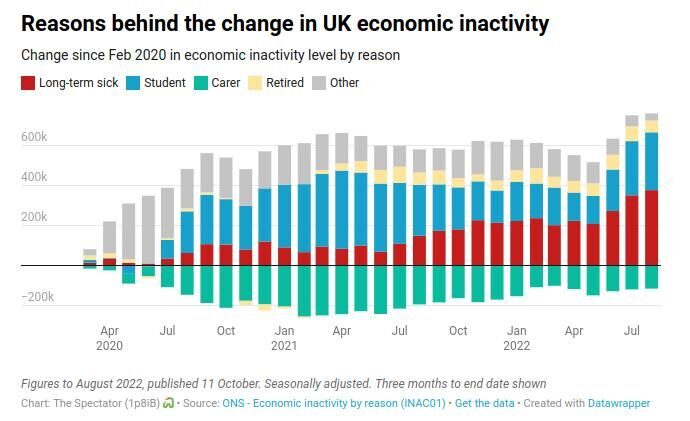
Rising inactivity has been driven by long-term sickness since the pandemic. Today's figures reveal those inactive due to illness hit a record high of two and a half million people. There's debate around what's causing this with some pointing to long Covid, the state of the NHS and poor mental health.
Comment: There's clear evidence that the experimental covid jabs, which over 92.9% of the population took (either voluntarily or via coercive measures), has had a variety of detrimental effects of people's health; including, but not limited to, those who 'died suddenly' of heart and clotting related issues, as well as those who suffered multiple and repeated infections of covid, along with other viruses, as well those whose immune systems were severely compromised. Taken together, along with the deadly disruption caused by the lockdowns, and it's becoming irrefutable that the response to covid will harm a great many more people than the virus itself.
Comment: A similar trick is being used by the US government. And the same issue can be seen in the US where labour participation is at record lows.
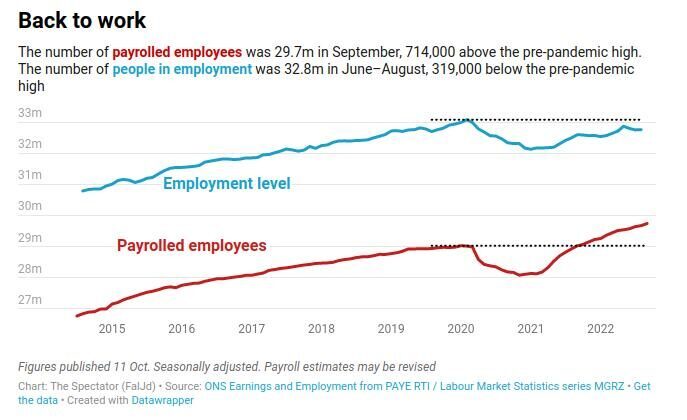
There are still nearly 320,000 fewer people in employment than before the pandemic. However, the number of employees on payroll has continued to climb to 29.7 million - some 730,000 higher than before the pandemic.
Michael Simmons is a data journalist at The Spectator


Reader Comments
They will no doubt, happily watch from the side lines ( obscene luxury ) whilst their ants are slowly terminated.
Our Sun would seem as if it's about to have a magnetic field flip, long before it's due and solar blasts are now increasingly becoming M class flares.
There's a lot of uncertainty that has no rational answers now happening within our Solar System and it seems Strange the relationship between Solar uncertainty and political uncertainty.
If they know something humanity doesn't know, then maybe? This is why their trashing everything.
Just a thought I thought I'd share.
Just a thought I thought I'd share as well.
Ken
Just another thought shared.
That so your not left out.
Party On, Garth!!