
© Adobe
Research from the University, published in the journal BMC Medicine, investigated the risk of hip fracture in occasional meat-eaters, pescatarians (people who eat fish but not meat) and vegetarians - compared with regular meat-eaters.
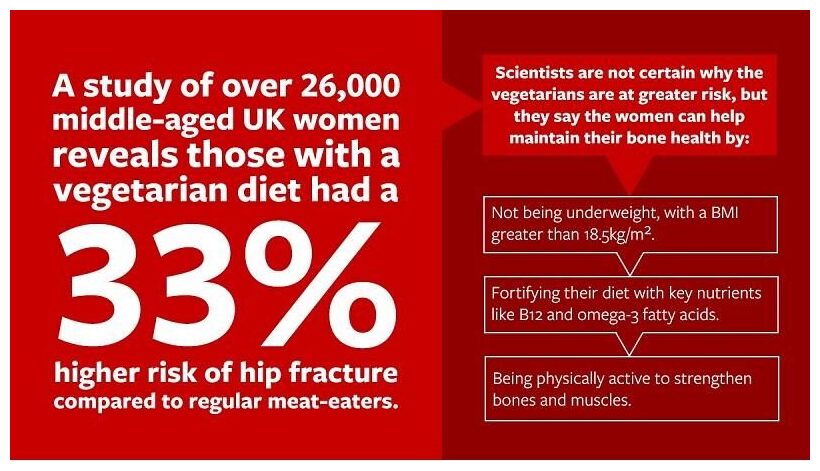
Among 26,318 women, 822 hip fracture cases were observed over roughly 20 years - that represented just over 3% of the sample population. After adjustment for factors such as smoking and age, vegetarians were the only diet group with an elevated risk of hip fracture.
This new study is one of very few to compare risk of hip fracture in vegetarians and meat-eaters where the occurrence of hip fracture was confirmed from hospital records.
The scientists stress the need for more research into the exact causes of why vegetarians were at a greater risk of hip fracture.
© University of Leeds
Study lead author James Webster, a doctoral researcher from the School of Food Science and Nutrition at Leeds, said: "Our study highlights potential concerns regarding risk of hip fracture in women who follow a vegetarian diet. However, it is not warning people to abandon vegetarian diets. As with any diet, it is important to understand personal circumstances and what nutrients are needed for a balanced healthy lifestyle.
"Vegetarian diets can vary widely from person to person and can be healthy or unhealthy, just like diets that include animal products.
"However, it is concerning that vegetarian diets often have lower intakes of nutrients that are linked with bone and muscle health. These types of nutrients generally are more abundant in meat and other animal products than in plants, such as protein, calcium, and other micronutrients.
"Low intake of these nutrients can lead to lower bone mineral density and muscle mass, which can make you more susceptible to hip fracture risk. This makes it especially important for further research to better understand factors driving the increased risk in vegetarians, whether it be particular nutrient deficiencies or weight management, so that we can help people to make healthy choices."
Plant-based diet increasingly popular
Vegetarian diets have gained in popularity in recent years, with a 2021 YouGov survey putting the size of the UK vegetarian population at roughly 5-7%. It is often perceived as a healthier dietary option, with previous evidence that shows a vegetarian diet can reduce the risks of several chronic diseases, including diabetes, heart disease, and cancer compared to omnivorous diets.
There is also a worldwide call for reducing the consumption of animal products in an effort to tackle climate change.
Understanding hip fracture risk in vegetarians is therefore becoming increasingly important to public health.
Study co-author Professor Janet Cade, leader of the Nutritional Epidemiology Group in the School of Food Science and Nutrition at Leeds, said: "Hip fracture is a global health issue with high economic costs that causes loss of independence, reduces quality of life, and increases risk of other health issues.
"Plant-based diets have been linked with poor bone health, but there has been a lack of evidence on the links to hip fracture risk. This study is an important step in understanding the potential risk plant-based diets could present over the long-term and what can be done to mitigate those risks."
The team used data from the UK Women's Cohort Study to investigate possible links between diet and hip fracture risk. The national cohort of middle-aged women was established at the University of Leeds to explore links between diet and chronic disease, encompassing a wide range of different eating patterns. Dietary information was collected using a food frequency questionnaire and was validated using a 4-day food diary in a subsample of women.
At the time they were recruited into the cohort study, the women ranged in age from 35 to 69 years.
Effect of low BMI
The research team found that the average body mass index (BMI) among vegetarians was slightly lower than the average among the regular meat eaters. Previous research has shown a link between low BMI and a high risk of hip fracture.
Lower BMI can indicate people are underweight, which can mean poorer bone and muscle health, and higher risk of hip fracture. Further investigation is needed to determine if low BMI is the reason for the observed higher risk in vegetarians.
Study co-author, Dr Darren Greenwood, a biostatistician in the School of Medicine at Leeds, said: "This study is just part of the wider picture of diet and healthy bones and muscles in older age.
"Further research is needed to confirm whether there could be similar results in men, to explore the role of body weight, and to identify the reasons for different outcomes in vegetarians and meat-eaters."
Further information
For further details, please contact David Lewis in the press office at the University: d.lewis@leeds.ac.uk
The full paper - Risk of hip fracture in meat-eaters, pescatarians, and vegetarians: results from the UK Women's Cohort Study - is available to download from the BMC Medicine website. The authors are: James Webster, Darren C Greenwood and Janet Cade. The url for the paper.


Reader Comments
The universe provides what we need. Only the ignorant think they can go against nature and push humanity to a highly processed diet of macro-nutrients (which the food pyramid was based on for so long and has made us fat and weak) as a sustainable solution to problems which could also be solved by going back to the old ways in the areas of agriculture, animal husbandry, and a thoughtful approach to meal time.
Next time you walk across a lawn, just imagine what's going on underfoot
Everything in this world lives by the death of another. No exceptions that I am aware. Air plants? I think even they draw nutrients from decaying matter.
One of the arguments gnostics have pointing to a deranged (called by itself) god with a little g. The creator we argue of this world is no sane entity but a created being. The chief archon whom some call Ialdaboth others Yah, Allah, Yahweh, and a host of other names like Jehovah which was a misspelling by the ignorant.
I'm convinced that many plants are more intelligent than humans... for one, they know how to survive anywhere, adapt, and make their entire surroundings more beautiful... Something human society is far from learning. Plants such as Ayahuasca, San Pedro, Liberty Caps, Amanita Muscara, Salvia Divinorum, all contain a transcendental intelligence that can teach us things 'beyond our imagination'. The plant is only the physical body, whereas its spirit lives in other worlds... In contrast to humans, our material bodies are animated by the spirit, since our role is to spiritualize matter... the plants are our magical aides.
It's a sign how unconscious we have all become when we can only perceive animals as being alive because they have eyes and ears and legs, but we perceive plants as being 'inert'... on the physical level, yes they are, but in other realms, they are spiritual beings, and influence life on the planet in many ways beyond our imagination.
The ancient legend of Ram is very eye-opening: he got expelled from a society which was dominated by sorceress' and evil witches that got involved in human sacrifice, so he went to the forest for refuge, where he received wisdom and got initiated by Deva Nahousha, the spirit of the Oak tree. The same spirit also was the guiding light behind the ancient Druid orders, Dru being the old Celtic name for the Oak tree.
Many mystics say that many plants, if not most, were brought to Earth from other planets... Hence, some plants have a relationship with the planets. The Rose from Venus, being an example. According to some people, there exist 'cosmic gardeners', beings who travel through space and 'plant' the planets.
The 'crimes that reach the stars' is akin to genetical modification of plant life. I would have genuine respect for vegans and vegetarians if they stood up for the plants and demanded the stop of GMOs... But, all are silent on that front!
You also reminded me of things forgotten by myself.
Knowing consciousness does not happen within the brain your illustration of the plants spirit in other realms is profound and makes perfect sense. Why that had not occurred to me before I know not.
Thank you. I value your gnosis very much.
Be well and thank you for being.
I also find it interesting that the US used to be the nation that was terrible about clear-cutting forests, but they now know to leave some trees, and Canada is the nation clear-cutting and struggling with reforestation. Worth noting that because of our hands-off approach for the last 100 years or so, there are more trees in the US now than since its founding (or so I've been told).
The Bible shows that after saving the animals, Noah and his descendants were allowed to eat meat of the animals they cared for. The Coran explains that there is a spiritual necessity in herding the flocks, cows, sheep, goats, as much for the animals as for the human being.
If the whole world went vegetarian, what would happen to all the sheep, pigs, cows in the world? Would they be let out into the wild?? I've visited 'Halal' communities where they care for the animals before sacrificing them for food, and it is very eye-opening... not just to see in internal organs and to realize that, deep inside, we are all very similar biologically speaking, but also the fact that there is a spiritual bridge between the animal kingdom and the human kingdom, and that bridge is kept active by animal farming... Destroy that bridge, make everyone vegetarian, and human beings could find themselves in some kind of 'spiritual quarantine'.
There is a cosmic law which states: everything eats everything. All of creation is constantly re-creating itself and devouring itself, in perfect harmony.
Some people have often noted the difference between 'Lucifer' and 'Satan'... Lucifer is the Bearer of the Light, whereas Satan is the Prince of Darkness. Lucifer resides in the blood, whilst Satan is trapped in the nerves. Wild bouts of hot passion are luciferic, whilst neurotic sessions of fear and nervousness are satanic in nature. What Satan needs, trapped inside the nerves, is contact with hot blood... hence blood letting is always a part of satanic practices.
It seems symbolic that the vegetarian Cain, who had no contact with blood, eventually murdered Abel the pastor, kind of like a sign and teaching that balance was required. Imagine: the first feud between meat-eaters and vegetarians happened between the children of Adam and Eve... It seems nothing has really changed since then!
The hardest elements to find in the bush is FAT and SALT. There are little to none natural mineral salt deposits in the tropics (with so much rain, I've never known a tropical region that has its own salt mines, but I've been told that occasionally one can find a rocky hills with salty rocks, but its rare). The easiest way to obtain salt and fat (vital for a healthy functioning brain, and also urgently required to replenish the body in the sweaty jungle) is to eat fish or animals.
But any proper STEM student learns in his very first lessons that correlations do not prove causation. No matter how much I liked it to be true, this statement is wrong.
"Risk" implies a cause-effect relation, which cannot be established by statistics, let alone epidemiology.
Sad what passes as science today ...
I had tried veganism about 10 years ago, for health raesons (and <before> the rise of vegan internet celebs. Not a year I could maintain it. At the moment, I eat about 90+% carnivore, for several years now.
Science and statistics is a totally different matter. As the saying goes "What's good for the goose is good for the gander."
Neither can epidemiology and statistics prove that red meat causes cancer, nor that vegetarism causes hip fractures.
I am pretty sure there <is> a link between vegetarian (mal-) nutrition, bone density, and probability of fractures. But it needs much more than cheap epidemiology to prove that.
I also tried going vegan a few times... One time, due to cultural guilt, but only lasted a week before I had problems in my throat... The next time, my girlfriend twisted my arm... until I got a sore throat... And then the last time, I was obliged because I living in the country with some Hare Krishnas who only cooked vegan... and I left with a sore throat! The longest bout was when I became special / vegan because of my girlfriend, and I must admit, during that time I developed all the traits of a neurotic blood-thirsty tyrant... I'm a firm believer that contact with 'blood' in the diet, on some level, makes the human being more humble, kind of reminds one that we too are a part of the foodchain...
I think Cain and Abel, representing the historical carnivore-herbivore question, shows that even the herbivore requires the heat of the blood, on some level. One of my childhood friends was a one of those fanatical radical eco-feminist vegan 'I'm-not-happy-with-everything'... before she left for university, she was kind of normal, with lots of insecurities, but someone you could invite to the pub without worrying about the consequences... A few months at uni, and suddenly she had a bee in her bonnet about everything. I still hung around with her because she was a childhood friend, and it took me many years to come to realize that her voluntary-brainwashing seminars at uni had turned her into a hate-filled vengeful little bag of poison... Only years later did I realize how utterly CRUEL she was with everyone, sticking astral spikes into everyone, various times achieving the tears of her male meat-eating friends, who she would humiliate and kick out onto the streets if they came to visit. She was a complete VAMPIRE, that required the emotional content of human blood, as a kind of nutritional supplement, to her otherwise holier-than-though life of fanatical veganism.
The side effects I experienced were not only a sour throat, though. Just check out any "ex vegan" YT video, and most of the reported health issues I had experienced myself. All during less than one year.
The "brain fog" and inability to concentrate is IMHO the main point here, caused by the drastic undersupply of saturated fats that nourish the brain. This is why grains and vegetables were historically used as slave foods, keeping them docile and obedient.
Yesterday, I made my first batch of peppa sauce with the following ingredients (not in any particular order)
1. Peppers consisting mainly of cayenne and tobasco with a bit a jalepino as well I think.
2. Tomatoes.
3. Vinegar
4. Sugar
5. Garlic
6. Salt
........oh yeah, I added just a bit of ghost peppa skin (7) to the mix.
Basically then run it through the food processor - seeds an all until everything is finely chopped/grinded and well mixed.
~~ Wa-La - easy peppa sauce
~~
Today, I added it to some chili I'm making and planning to freeze. This chili has a bit of "kick" to it, but not too much and it was so EASY to make - I did it in less than on hour with fresh tomato and other ingredients including meat and beans, and now it is simmering. It is good.
~~
I like veggies and meat. Fruit as well.
BK
I like grains in addition to meat, fruit, and veggies....pretty much everything edible - I like fungus in the form of mushrooms. Anyhow, there is so much food out there just waiting to be discovered is what I think, but for my body, I need a balanced diet.
BK