
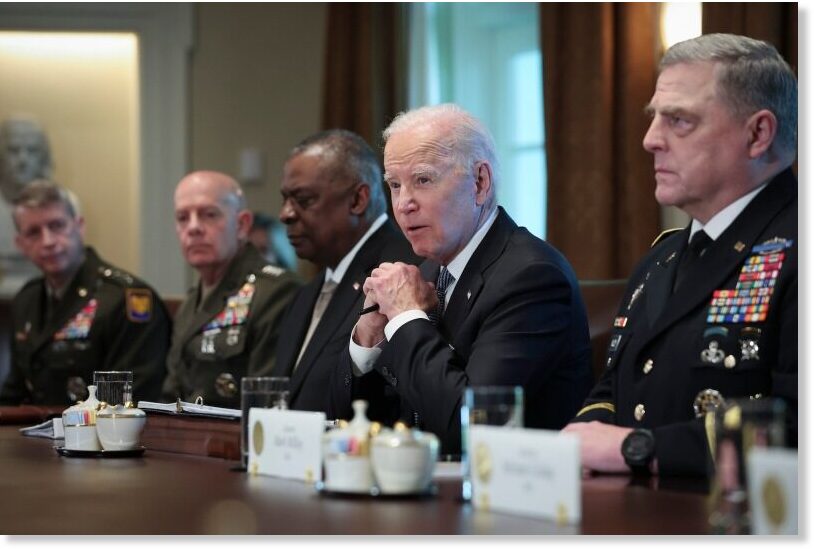
© Win McNamee/Getty ImagesU.S. President Joe Biden meets with Secretary of Defense Lloyd Austin, Chairman of the Joint Chiefs of Staff Mark Milley, members of the Joint Chiefs of Staff, and combatant commanders at the White House in Washington on April 20.
Comment: What makes this semi-objective article so remarkable is that it comes from a US-based geopolitical defense website. So while it leaves out a heck of a lot of context for Russia's operations in the Ukraine, it also points out how the Biden Administration (or those directing him) are essentially still playing with fire.
With his strategy to "weaken" Russia, the U.S. president may be turning the Ukraine war into a global one.
In a dramatic series of shifts this week, U.S. President Joe Biden and his NATO allies have escalated their policy of helping to defend Ukraine against Russian aggression into a policy of undermining the power and influence of Russia itself. In so doing, some observers fear, they are leaving Russian President Vladimir Putin little choice but to surrender or double down militarily, raising the possibility of widening his war beyond Ukraine.
On Thursday, Biden urged Congress to provide $33 billion in additional military, economic, and humanitarian assistance for Ukraine — more than double the previous amount — and said he was sending a clear message to Putin: "You will never succeed in dominating Ukraine." Beyond that, Biden said in remarks at the White House, the new policy was intended "to punish Russian aggression, to lessen the risk of future conflicts."
That followed an equally clear declaration this week from U.S. Defense Secretary Lloyd Austin, who after a meeting in Kyiv with Ukrainian President Volodymyr Zelensky said the U.S. objective is now to curtail Russia's power over the long term so it does not have the "capability to reproduce" its military assault on Ukraine. "We want to see Russia weakened to the degree that it can't do the kinds of things that it has done in invading Ukraine," Austin said in a stopover in Poland.
The shift may have been what prompted Russian Foreign Minister Sergey Lavrov to declare afterward that Washington and the West had entered a "proxy" war with Russia, risking another world war that, Lavrov warned, could go nuclear. "The danger is serious, real. And we must not underestimate it," Lavrov said. Putin also again suggested this week, as he has since the beginning of his invasion on Feb. 24, that he still had the option of using nuclear weapons against NATO, saying, "We have all the instruments for this [to respond to a direct threat to Russia] — ones nobody else can boast of. And we will use them, if we have to."
The newly aggressive U.S. approach won plaudits from many quarters — in particular from current and former NATO officials who insist the Russian nuclear counterthreats are only empty rhetoric.
"It's the only way to go forward," said former NATO Secretary-General Anders Fogh Rasmussen in an interview. "In Putin's thinking it doesn't make any difference, because he would only claim that the Western policy is to weaken Russia anyway. So why not speak openly about it? The mistake we made in the past was to underestimate the ambitions of Vladimir Putin, to underestimate his brutality. At the same time, we overestimated the strength of the Russian military."
The new U.S. and NATO strategy is partly based on Ukraine's continuing battlefield success against Putin, who has been forced to scale down his ambitions from a full takeover of Ukraine to a major new assault in its eastern and southern parts. NATO allies including Germany, which until this week had equivocated on sending heavy offensive weaponry to Ukraine, have ratcheted up their aid in response. German Chancellor Olaf Scholz, under political pressure at home and abroad, announced earlier this week that his country would provide 50 anti-aircraft tanks to Ukraine.
Comment: "Ukraine's continuing battlefield success against Putin"? Actually, Russia has been methodically and effectively wiping out Ukraine's military (and the unwise international mercenaries joining the war), for many weeks now.
Yet other Russia experts expressed worry that the United States and its Western allies are, in effect, crossing the very redlines they have avoided until now. For most of the two-month conflict, Biden has refused to authorize any military support, such as major offensive weapons or a no-fly zone, that might be perceived as putting U.S. or NATO forces in direct conflict with Russia. Now, some observers worry that with the additional aid and tougher economic sanctions, the U.S. president is forcing Putin into a corner in which he can only fight on or surrender. The latter course would mean relinquishing Putin's career-long aim of strengthening Russia against the West. Yet Putin, who has long said the West's goal was to weaken or contain Russia, has never been known to surrender during his decade and a half of aggressive moves against neighboring countries, mainly Ukraine and Georgia.
"In the Kremlin's eyes the West is out to get Russia. It was unspoken before. Now it's spoken," said Sean Monaghan, an expert on Europe at the Center for Strategic and International Studies. "If you combine this with Biden's comments, at his summit in Poland last month, that 'this man [Putin] cannot remain in power,' all that turns this a territorial war into a wider confrontation and might make negotiating a settlement to end the war in Ukraine far more difficult or even impossible at the present." (Biden officials later said that the president was not seeking regime change in Russia.)
George Beebe, a former chief of Russia analysis for the CIA, said that the Biden administration may be in danger of forgetting that the "the most important national interest that the United States has is avoiding a nuclear conflict with Russia." He added that "the Russians have the ability to make sure everyone else loses if they lose too. And that may be where we're heading. It's a dangerous corner to turn."
Perhaps the most worrisome turn of events is that there no longer appears to be any possibility of a negotiated way out of the war — despite Putin's statement to visiting United Nations Secretary-General António Guterres that he still hopes for such a solution.
"It's one thing to pursue a policy of weakening Putin, quite another to say it out loud. We have to find a way for Putin to achieve a political solution, so perhaps it is not wise to state this," said one senior European diplomat, speaking on condition of anonymity.
"It's getting more dangerous," said Charles Kupchan, a former senior U.S. official and now a scholar of international relations at Georgetown University. "We need to start moving beyond Javelins and anti-tank missiles and talk about a political endgame." Or, as Beebe put it, "We need to find a way of somehow discreetly conveying to the Russians that we would be willing to ease sanctions in the context of an international settlement. The military aid to Ukraine could also be used as leverage."
Yet any such negotiation looks less likely than ever. Both sides appear to be settling in for a long fight. After meeting with Putin and Lavrov on Tuesday, Guterres acknowledged that an imminent cease-fire was not in the cards and that the war "will not end with meetings."
Only a month ago Zelensky was floating the idea of a neutral Ukraine that did not join NATO, and he suggested that separatist forces in eastern Ukraine should be acknowledged. But Zelensky has since told European Council President Charles Michel that, in light of Russian atrocities, Ukrainian public opinion was against negotiations and favored continuing the war.
Comment: Its more like the opinion of Nazi military and political forces in Ukraine, and in the west, will do anything in their considerable power to prevent Zelensky from reaching some kind of negotiated solution with Russia.
Meanwhile, Finland and Sweden have indicated they are interested in joining the NATO alliance, breaking with their longtime policy of nonalignment and potentially creating a new hair-trigger environment along Russia's northern border. That would deliver a devastating blow to Putin, who has often cited NATO's eastward expansion as a casus belli for his full-scale invasion of Ukraine.
And there is little prospect that any of these tensions will abate anytime soon. Austin also convened a 40-nation "Ukraine Contact Group" this week that was readying itself for what Joint Chiefs of Staff Chairman Mark Milley has said is likely a "protracted conflict" that will be "at least measured in years."
Biden has not said what the U.S. response might be if Putin deploys tactical or strategic nuclear weapons. Moreover, neither side has set any clear rules in the post-Cold War environment for the deployment of nuclear weapons — especially as Cold War-era arms agreements such as the Intermediate-Range Nuclear Forces Treaty have been shelved and nuclear weapon delivery systems have become faster and more governed by automatic digitized systems. Under a Kremlin policy known as "escalating to de-escalate" — threatening to go nuclear if the West tries to stop him — Putin has year by year reintroduced nuclear weapons into his conventional war calculations. During his two decades in power, he has authorized the construction of nuclear-powered cruise missiles, transoceanic nuclear-armed torpedoes, hypersonic glide vehicles, and more low-yield nuclear weapons on the European continent.
Yet Putin has never come this close to threatening to use them, nor has he made clear if or how he might do so. Until the Ukraine crisis, U.S. strategists had not considered their deployment to be a credible threat. Most believe Putin would first escalate using cyberattacks or other non-nuclear capabilities.
Many experts also say they don't believe the Russian president would gain much advantage from the use of tactical nuclear weapons inside Ukraine — and he is considered enough of a rational actor that he would never contemplate launching nuclear-armed intercontinental ballistic missiles at the United States. But Putin has also indicated previously that he cannot accept the separation of an independent Ukraine from Russian control, writing in a July 2021 essay that such a development would be "comparable in its consequences to the use of weapons of mass destruction against us."
Robert Gallucci, a former senior U.S. nuclear arms negotiator, said the Russian nuclear threats are a new tactic and "should be taken seriously if we were to get involved directly in conflict with Russian forces in or around Ukraine, that is, on or across the Russian border."
Beebe, who is currently director of grand strategy at the Quincy Institute for Responsible Statecraft, said he believed the outcome would most likely stretch into a volatile stalemate — but one that could well be more unstable and dangerous than much of the Cold War. "Most likely we're going to end up in some sort of long-term unstable confrontation that divides Ukraine and divides Europe where there aren't rules of the game," he said. "It's not so much a new cold war as it is a festering wound in Europe."
Matters could get even dicier if a newly emboldened West and NATO expand their reach beyond Europe, Central Asia, and the Middle East to the Indo-Pacific, as British Foreign Secretary Liz Truss suggested in a speech this week. Truss said that "NATO must have a global outlook, ready to tackle global threats. We need to preempt threats in the Indo-Pacific, working with our allies like Japan and Australia to ensure the Pacific is protected. And we must ensure that democracies like Taiwan are able to defend themselves."
That in turn raises the prospect for a drawn-out global cold war with not only Russia but China as well. And it is one that could easily turn hot, Beebe said, with the United States and its allies faced off against an alliance of "a resource-rich Russia partnered with a technologically and economically powerful China."



Reader Comments
_____________________________
After the black stripe, it will always be white. If the bad dog bites you today, the bad dog will bite you tomorrow.
It seemed that 2 years of the pandemic is not enough, NWO in Ukraine, 5 million Ukrainian refugees in the EU, less than a million in Russia, famine in Africa until September, another 5-10 million migrants in the EU by NG? And now they have decided to raise him to the power to bring him to a guaranteed disaster.
▪ Fed immediately raised the rate by 0.5%, which is a lot.
▪ And it intends to increase it by 0.5% in the next two meetings, then by 0.25%, to reach 2.75% by the end of 2022. The next meetings are June 15, July 27, September 21, November 2 and December 14.
▪ Balance reduction plan. Start at 47.5 billion from June 1, 2022, then 63.5 billion from July 1, 79.5 billion from August 1, and 95 billion from September 1.
We take off all the brakes and rush into the abyss at full throttle. Suppose you have a mortgage, car leasing, used credit card limit, your salary drops, you get microloans, and bailiffs call you more often than your friends. The money is not enough for anything. And then you decided to raise% on loans and lower wages.
This is exactly what the Fed has now done for US businesses and citizens. But given that the dollar is a world currency, and the euro and its other derivatives, this is not enough for anyone.
Mikhail Khazin has been saying for 22 years that the Western economic model is not working. Since 2008, it has slowly slipped into the abyss. In order to somehow slow down this process, the Fed cut the refinancing rate to zero.
They robbed Libya and Syria, British offshore companies and other countries, forced everyone to hold cash reserves in the US. Which was also not enough. Then they started "printing press and throwing money out of the helicopter."
But the US economy, despite all efforts, stubbornly plunged into the abyss. So were the economies of the EU, Japan and the rest of the world, but only they were slower due to their smaller spread.
And after all these measures, they decided to do the exact opposite - remove all the brakes, hit the gas while starting the jet engine and continue to hit the bottom of the abyss as a way to fix the problem.
Following the US Federal Reserve, the Bank of England raised its main interest rate to 1% - the highest level in 13 years. Summarizing that the economy will decline, inflation will be double-digit.We are waiting for the EU and Japan to do the same. Now imagine what the real situation is, when officially the authorities are no longer afraid to say that everything is so hopeless. How did they call the 70s, 18.18.18?
Loan interest rates, inflation and unemployment.
Staged a terrible end instead of an endless horror movie. If an event cannot be avoided, guide it. Controlled chaos, eprst. The postponement of the fall means it can happen under less favorable conditions for globalists, who are losing control of the planet every day and their nightmare over Russia grows stronger.
Base jumping - how not to land with "bear's disease",
"We are faced with the greatest hunger since World War II, with millions of dead" -
German Minister for Economic Cooperation and Development, Svenja Schulze.Earlier,
I wrote that the West provoked the New World Order in Ukraine to divert attention from the plundering of the European economy and dismantling the EU. To this end, they are ready to ban gas and possibly oil imports from Russia. The fact that the EU would be robbed was the first to write off in December 2021.
The reason for this is the disastrous state of affairs in the US economy and the divisions among the elite:
1. The economy is falling apart faster than the EU.
2. Congressional elections that the Democrats lose, with many prisons.
3. Exacerbation of internal contradictions threatening to turn into a civil war.
Anglo-Saxons are especially bleeding.In general, "take a walk in the bazaar" and find the best solution under the circumstances. They have already emerged from crises due to world wars 2 times. And even before that, for centuries, they existed because of someone else's looting. Why should it be any different now? Born to take, cannot give.
But why are European leaders supporting this and leading their countries to slaughter? And what should they do if they too face imprisonment at best for their actions? Even local right-wingers hate them fiercely for all the bankruptcies they staged.
The striking calm of the Democrats ahead of the Congressional electionsWell, it doesn't look like it at all. In 2020, they started the pandemic and BLM project to "win" the election against Trump, you know how. It was quite devastating to American statehood. Now the odds of winning are even more hopeless than then. And they don't worry about anything, even though they should.
This is not happening!
The best solution for complex systems is to take their internal contradictions outside and solve them at someone else's expense. And now a hellish instability is creating all over the world: rising food and energy prices, hunger in Africa, the New World Order in Ukraine, which are trying with all their strength to inflame and tighten, have isolated Russia as much as possible.
Because public opinion is losing interest in this subject and is paying attention to the rapid rise in prices and the falling standard of living in the West. And more and more often they refuse to believe that all problems are caused personally by Russia and Putin.
It wasn't like that for a long time, but it looks like this year's inflation in Western economies will exceed Russia's!As the collapse of the world markets is already preparing, it no longer makes sense to stick to the dollar - it is possible to freeze Russia's currency reserves, undermining the confidence of investors around the world in it. Most likely, others will also be confiscated for "disobedience", a reluctance to impose sanctions on Russia.
Given that the economic model is not working for them, they must withdraw from Afghanistan, Europe, the Middle East, and Asia. And if so, then at least a flood, war or ruins will follow. The main thing is that for a long time they could not come to each other and agree among themselves. While perekantuyutsya and reassemble.
Russia shut down four timesFinancial, informational, cultural, transport (car, air, rail, sea) - this is unprecedented in history. So many sanctions and an economic war of total annihilation have not been announced to anyone.
In any case, the US needs complete isolation not only to harm the Russian economy. But also so that nobody in the West could ask for help. They are painfully haunted by the examples of the Central African Republic, Mali and Venezuela.
Macron complained to Putin last week of impending famine and asked for food.He came alive. Anyone in Europe cannot shake off the verdict.
In 2015, Stratfor founder George Friedman argued that the main goal of the United States has not changed over the last 100 years - to prevent the economic union between Russia and Germany, or rather Europe.And so far they have been doing well. The EU has finally lost its independence. States will make every effort to ensure that there are ruins after their departure. Some Western military aid does not go to Ukraine, settling in the sleeping cells of extremists, and some is also resold.
Are you looking forward to the war in Europe? What do you think it will do or not?Nobody can sit on the side. With the States, China will collapse almost immediately. India will hold on a little longer. It is hard to believe, but this time Russia will indeed prove to be the safest and most stable place on the planet this time. According to Mikhail Khazin, industrial inflation in the EU already reaches 10% per month. This is the level of Turkey! Therefore, starting in the fall of 2022, global migration will turn to Russia. In addition to the repatriation of Russians, millions of people will move to Russia, including highly qualified people from all over the world.
And in the longer term, by 2030, this number could reach up to 100 million people, or 10-15 million a year. This is a migration tsunami for which Russia is not ready and no one has such experience.
You can deal with all the dangers and challenges with a left turn, as Patrushev talked about in his last week article. But the elite categorically do not want to give up some of their privileges.
Russia has now overtaken the curveLiterally a few days before the Fed rate hike, a very interesting article by Patrushev was published, in which between the lines he accurately identified important threats flowing not from the West, but from the Anglo-Saxons. And he proposed a solution.
From his lips, it sounds like a warning to the particularly stubborn who did not heed the warnings of the three ministers of power last year.
[Link]
I am not a fan of his propaganda.
I do agree , however,, the world is a mess, no doubt.
Bo-tesy!