
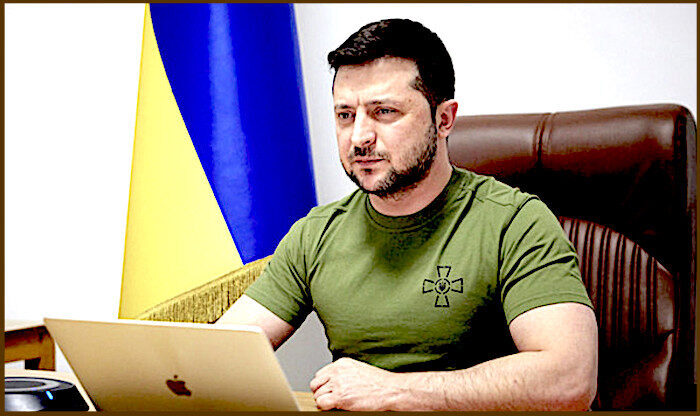
© Getty Images/Future Publishing/ContributorA large number of Americans would be OK with Zelensky and Ukraine losing
Speaking to Polish journalists amid the ongoing Russian offensive in Ukraine, Zelensky said that guarantors would need to make decisions within hours rather than days or weeks, as any delay in providing emergency military assistance would cost lives. The Ukrainian leader described this relationship between casualties and delays by saying "hours equals people."
He explained that Ukraine now knows "what works on a battlefield and what doesn't," what should be done in various situations and what exactly is needed. Therefore, he explained, speedy decision making by Ukraine's guarantors would be a key factor.
"The ability to save a number of people depends on other numbers - terms, weapons ... I do not want to be very pragmatic .. But to tell you the truth: in terms of blood and casualties, hours mean people, so I believe that our security guarantees should be based on the formula 'people equals hours,'" Zelensky, who has previously blamed Kiev's Western partners for being slow in providing help, told the reporters.
Comment: That's only true if by 'people' Zelensky means the neo-Nazi troops. Otherwise, civilians continue to be evacuated through Russian maintained humanitarian corridors and Russia has intentionally sought to minimize civilian causalities - risking the lives of its own troops in the process. However, Zelensky and his handlers know that this kind of sloganistic appeal to emotion marketing pitch will achieve the desired aims of selling the lies to an incredibly misinformed public.
Zelensky explained that he is not insisting on NATO-style provisions.The president underlined that nobody knows how NATO would act if one of its members is attacked, as such a situation has never arisen and "God forbid that it arises."
Comment: Russia is going out of its way to avoid such an occurrence, despite NATO being directly party to the war. It's notable that Zelensky mentions it - however disingenuously - because NATO countries have become even more involved in the proxy-war, and Putin recently commented that Russia will be forced to respond in the event of any grievous actions on behalf of its members.
"So I'm not comparing. But I know for sure that we need security guarantees, and I know for sure what we need. We want to ask what we need, not what NATO can provide," he said.
Comment: Security guarantees were in the Minsk agreement that Ukraine flouted for nearly a decade, there's no reason to believe that giving them now would make any difference. Commentators have noted that these attempts at diplomacy by Ukraine are likely intended to buy time, because it has as good as lost the battle.
He explained that a security union he'd offered to create in March has a working title U-24 (Union-24) because it suggests that "the decision is made on the first day, not the second, not the third, but the first." The guarantors should not "decide for ten days, send for four weeks, analyze for another eight weeks," as speed is a key factor for saving lives, Zelensky stressed.
Comment: Despite the US and Ukraine doing exactly that to Russia when it put forward its final peace proposal.
He added that an agreement on security guarantees should make absolutely clear to a potential aggressor which measures would be taken in response to particular threats or actions.
On March 29, during the last in-person meeting between the Ukrainian and Russian negotiators in Istanbul, Kiev proposed penning an international agreement on security guarantees for Ukraine. These guarantees are named by the Ukrainians as a condition to agree to the neutral status that Russia insists on.
Earlier this month the president suggested that a peace agreement with Russia might consist of two separate documents that would cover the two key issues - security guarantees for Kiev and its future relations with Moscow. He explained that a document covering security guarantees could be signed by those countries "who are ready for these security guarantees," while another document could cover future relations between Ukraine and Russia. Zelensky also revealed that the UK, US, Italy and Turkey have showed their readiness to provide security guarantees for Ukraine, but there has been no final answer from any of them.
As for now, the talks between Russia and Ukraine have stalled. Russian Foreign Minister Sergey Lavrov recently accused London and Washington of telling Kiev to backtrack on previously-reached agreements with Russia. Ukraine's new proposal, according to Lavrov, fails to mention that the security guarantees Kiev wants to obtain do not cover Crimea.
Comment: An honest mistake, no doubt...
Russia sent its troops to Ukraine in late February, following Kiev's failure to implement the terms of the Minsk agreements, first signed in 2014, and Moscow's eventual recognition of the Donbass republics of Donetsk and Lugansk. The German- and French-brokered Minsk Protocol was designed to give the breakaway regions special status within the Ukrainian state.
The Kremlin has since demanded that Ukraine officially declare itself a neutral country that will never join NATO. Kiev insists the Russian offensive was completely unprovoked and has denied claims it was planning to retake the two republics by force.
France promises more weapons for Ukraine Macron says he hopes for a negotiated solution to the conflict
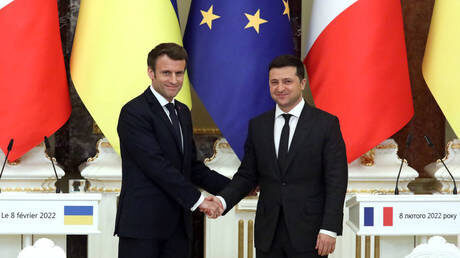
© Getty Images / Future Publishing / ContributorPresident of Ukraine Volodymyr Zelenskyy (R) and French President Emmanuel Macron in Kiev, February 8, 2022
During a phone conversation on Saturday, less than a week after Macron's reelection, Zelensky thanked the French leader for providing Ukraine with "major" military equipment which "contributed to the Ukrainian resistance," the Elysee Palace said in a statement.
Macron "indicated that this support will continue to be strengthened, as will the humanitarian assistance provided by France." The presidential office noted that France has already provided Ukraine with "more than 615 tons of equipment including medical equipment, generators for hospitals, food, household goods and emergency vehicles."
Comment: Macron was recently reelected and so he's feels at liberty to drop the diplomatic mask.
Zelensky recently said that Ukraine's partners have finally begun to provide Kiev with some of the heavy weapons which it had requested. This was after France and Canada announced their plans to send long-range artillery systems for the first time.
Russia, meanwhile, has warned the West against "pumping" Ukraine with weapons, saying it would only lead to a prolongation of the conflict. Moscow has made it clear that it would consider any foreign weapons on the Ukrainian territory as a legitimate target.
Macron also promised Zelensky that a team of French experts would continue collecting evidence related to crimes allegedly committed "within the framework of the Russian aggression."
Since the launch of Russia's military assault, Moscow and Kiev accused each other of committing war crimes.
During the phone call, which lasted approximately an hour, the French leader "reaffirmed his desire to work actively during his second term to restore the sovereignty and territorial integrity of Ukraine" in close coordination with European allies.
Macron also reiterated his "deep concern" over "Russian bombardments of Ukrainian cities" and "the unbearable situation in Mariupol" despite "repeated calls to the Russian president to respect international humanitarian law."
Moscow denies that it has ever targeted civilians in Ukraine and claims that Azovstal steel plant remains the last stronghold under Ukrainian control in Mariupol, with the fighters of the notorious neo-Nazi Azov regiment and other units holed up there.
The French President expressed his hope for progress in the negotiations between Russia and Ukraine, saying the talks could bring "a lasting solution to the conflict and a return to security on the European continent."
Comment: Whilst he sends tons of weaponry to Ukraine?
Currently the peace negotiations appear to have stalled, with Russian Foreign Minister Sergey Lavrov accusing the West of making Kiev to backtrack on previously agreed terms with Moscow.
Macron has been one of very few Western leaders who, since the launch of Russia's military operation in Ukraine, has continued direct dialogue with the President Vladimir Putin. At the same time he has insisted on stepping up sanctions against Moscow, including tougher restrictions on Russian energy.
Comment: Macron had an election to think about, and he's always been extremely duplicitous - particularly with regards to Russia - despite this Russia keeps the diplomatic doors open.




He wants to be in total control and have everyone responding to his demands.