

© Nicolas Tucat/AFP via Getty ImagesLe Pen makes the race uncomfortably close for Macron ahead of the first round of voting
And yet it's not. The leader of the far-right National Rally party is making the race uncomfortably close for the liberal president ahead of a first round of voting on Sunday.
Comment: If you can stomach the propaganda, watch Politco's breakdown of the election below:
Indeed, the French president has been battling to defend his own track record on Russia. On Wednesday, Macron responded forcefully to criticism made by Polish Prime Minister Mateusz Morawiecki that he was talking to Putin, and therefore "negotiating with criminals."
"Those words are both unfounded and scandalous, but they don't surprise me," Macron said on French TV channel TF1. "They are interfering in the presidential campaign. The Polish prime minister belongs to a far-right party and he supports Marine Le Pen."
Morawiecki was referring to Macron's regular calls with Putin as part of an ongoing, albeit unsuccessful, diplomatic effort to halt the war. On Wednesday, Macron again defended his decision to keep the line to Moscow open, and tried to redirect criticism toward Le Pen.
"I totally, totally stand by my choice of speaking to Russia, to avoid war ... And I have never been an accomplice [of Putin], unlike others," he said, hinting heavily at Le Pen's past cozy relations with Moscow.
Comment: Childish tit-for-tat.
Likewise during a visit to Brittany on Tuesday, Macron tried to shine the spotlight on his rival's past relations with Russia, telling reporters that he's not the one who has been "complacent" toward Putin nor "was funded by Russia.
Water off a duck's back
Le Pen and Russia go back some way. Her National Rally party is still paying off a €9 million loan from a Russian bank in 2014 and has often sided with Moscow - whether on the annexation of Crimea or the fate of Russian opposition leader Alexei Navalny. Last month, Le Pen's campaign team reportedly had to bin over a million campaign leaflets because they featured a picture of her shaking hands with Putin in 2017.
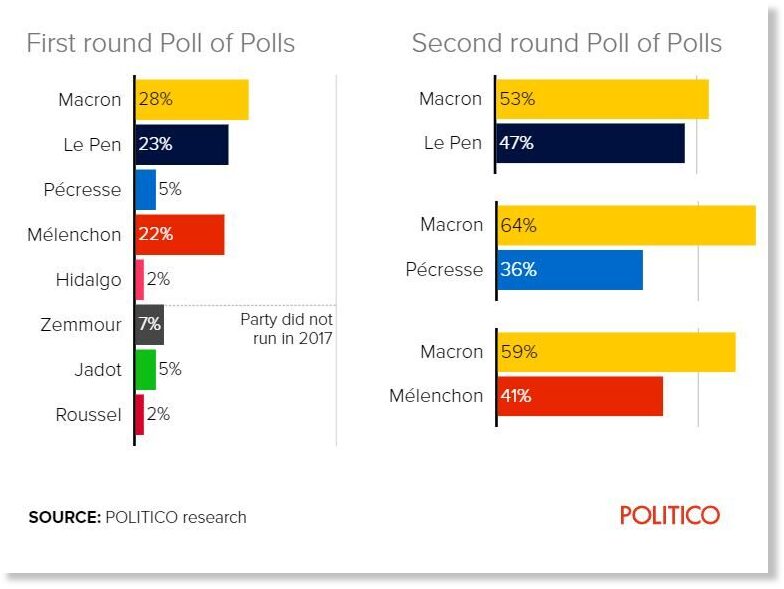
And yet these have not overly troubled Le Pen's presidential bid and she has stubbornly risen in the polls since the Russian invasion of Ukraine. According to POLITICO's Poll of Polls, Le Pen is set to win 22 percent of the vote in the first round, having narrowed the gap with front-runner Macron on 27 percent. Crucially, polling for the expected April 24 runoff vote shows Le Pen significantly reducing the gap with the incumbent.
This is partly to do with Le Pen's deft approach to the war in Ukraine. The far-right leader U-turned swiftly on Putin at the start of the war, admitting on television that the conflict had "changed her opinion" of the Russian president, and she has since consistently condemned the invasion.
At times, she has even sought to outdo Macron in her response to the crisis, calling on Wednesday for the Russian ambassador to be expelled, when France decided to kick out several dozen Russian diplomats over reports of atrocities against civilians in the Ukrainian city of Bucha.
Her far-right rival Eric Zemmour has also taken much of the flak amid tighter media scrutiny. Also an admirer of Putin, Zemmour stumbled in the early days of the war, calling for Ukrainian refugees to be welcomed in Poland rather than France.
MACRON RUNNING FOR SECOND TERM
In April 2022, French voters will decide the next president of the Republic. If no candidate wins an outright majority in the first round of the presidential election on April 10, a run-off will be held on April 24.Here's the latest amalgamation of all French presidential election polls.
© Politico
Comment: That's interesting, a recent poll showed a number of French actually agreed with Moscow's actions:
The argument that the persecution of Russian-speaking Ukrainians by their government had validated Moscow's military action was accepted by 28% of people and rejected by 31%. The statement that discrimination has been ongoing for years in some parts of the country was backed by 23%, with 32% rejecting it.
Russia's claim that its national security had to be protected by all means due to NATO's drive to integrate Ukraine was deemed true by 22% of respondents, while 42% thought it false.
Instead, Le Pen has kept her campaign focus on the rising cost of living for ordinary French, pushed higher by inflation and the impact of sanctions against Russia on the European economy. The theme has come to dominate the public debate in the run-up to the election.
On Tuesday, Le Pen sought to project herself as the protector of French families against EU sanctions on Russia.
"The solution of cutting gas and petrol imports [from Russia], that will be a tragedy for French families," she told French radio RTL. "I'm sorry to tell you, my priority is to defend the purchasing power of French families," she said.
Macron instead has appeared to be playing catch-up in the campaign, arguing that his economic measures protect French purchasing power too, and battling revelations that his government spent millions of euros on costly consulting firm fees. His government is also actively promoting more energy sanctions on Russia.
If, as the polls indicate, Macron and Le Pen face off in the second round, Le Pen may then have to convince voters beyond her political base that her Russian connections are no impediment to running France.
Macron, so far, has held off from naming Le Pen directly in terms of her Russia ties. In the second round, the gloves are more likely to come off.




By leaking some unpleasant information about Mariupol ...