

© Marian Kushnir/RadioSvoboda.Org (RFE/RL)Border guards patrol at a fortified post west of Blahovishchenka, a remote Ukrainian village surrounded on three sides by Russia.
Russia is the country that surrounds her village on three sides and forbids the locals to swim in the Povna River that marks the border, like she used to do in the summer as a child. It also bars them from fishing in the eddies -- and now forces farmers to drive twice the usual distance to sell their winter wheat, barley, or feed crops.
War doesn't top the list of her worries, though.
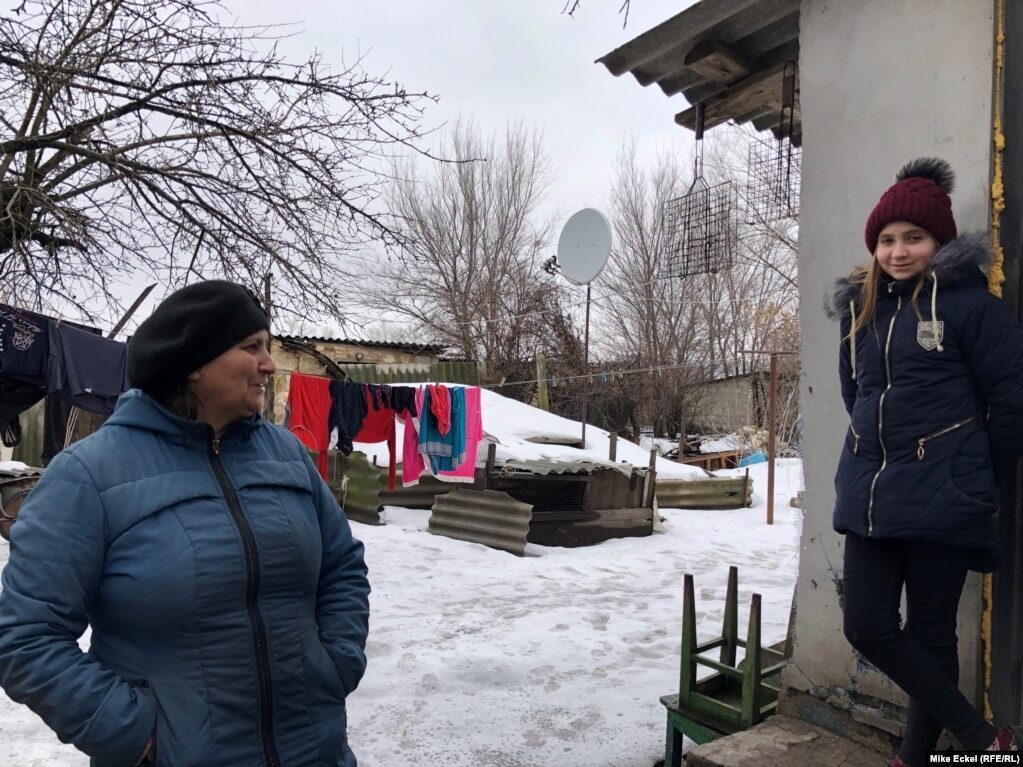
© Mike Eckel / RFE/RLSvitlana Sukharevska and her 12-year-old daughter Arina stand in their backyard. The border with Russia is just 100 meters away.
"It's the damn school bus. It keeps breaking down," she says. "We're supposed to make our kids walk, what, 10 kilometers to school? In the cold? There are wolves, foxes."The Ukrainian capital is a distant notion for the 100 or so villagers who remain in what's left of Blahovishchenka, a nub of a settlement that sticks into the neighboring Russian province of Rostov like a bent thumb. Here, Russian TV broadcasts are the norm; signals for Ukrainian channels are too weak. Until recently, Internet service came from across the border, too.
But a new Russian invasion is also a distant notion. True, the border is a constant reminder of a foreign country out the back door. The main road out of town runs past barbed wire, soil raked for detecting footprints, warning signs, an anti-tank trench, and one fortified border guard post.
The Remote Ukrainian Village Surrounded By Russia
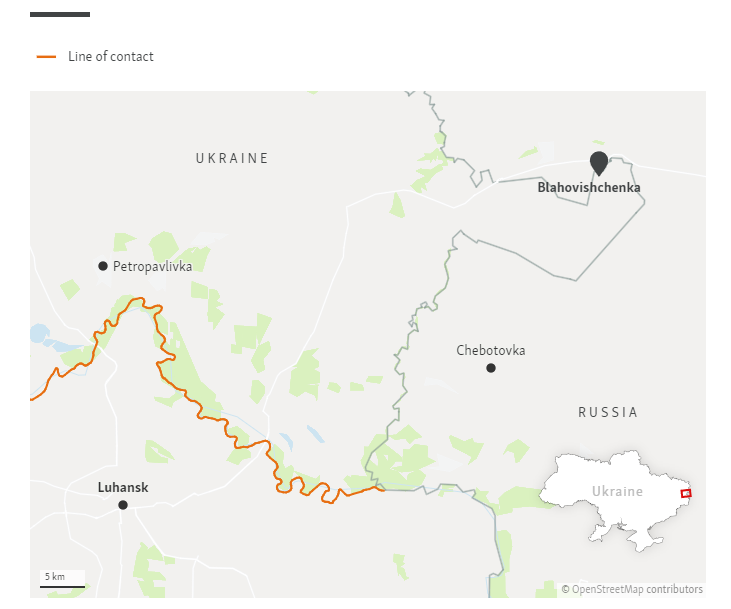
© RFE/RL, February 2022The current crisis between Russia and Ukraine is forcing farmers from Blahovishchenka to drive twice the usual distance to sell their winter wheat, barley, or feed crops.
Blahovishchenka is in Ukraine's Luhansk region, which was ripped apart following the outbreak of war in 2014. Ukrainian government forces now face off against Russia-backed separatists along the "line of contact" that zigzags through the province and the neighboring Donetsk region.
But from Blahovishchenka, the closest staging ground for any new Russian invasion force is about a four-hour drive almost due south, and aside from the rare echoes of gunshots, there's no reason that villagers expect to see tanks rolling through the town or through fallow fields.
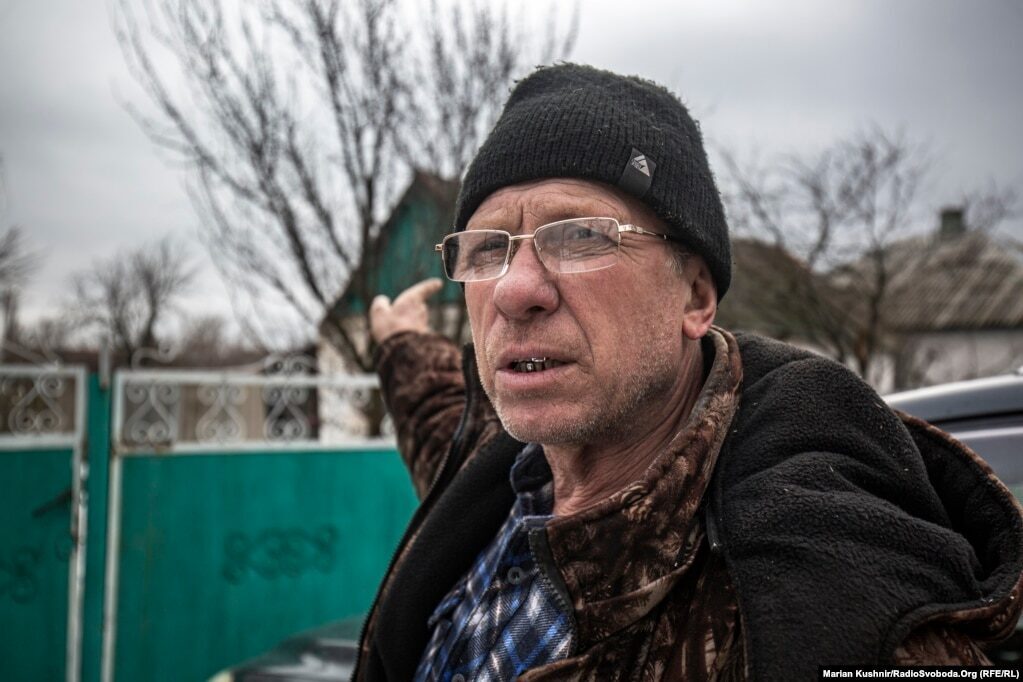
© Marian Kushnir/RadioSvoboda.Org(RFE/RL)Oleksandr Kopov, 60, was born and raised in Blahovishchenka. He says he's not worried about war: "If [the Russians] were hiding something, we’d see it. You can’t hide equipment from the villagers.”
"War? No one believes it here," said Oleksandr Kopov, 60, who was born here and was visiting his son-in-law and grandson, Sasha, who also wishes the school bus was working.Like Sukharevska, Serhiy Ivanovskiy, who lives six houses down the street, said he has more pressing concerns.
"Why don't I believe it? Well, in 2014, when this whole mess began, in Ukraine, the road was still open, the border was open, we went back and forth without checkpoints," he said.
"We had tanks here, National Guard everywhere, soldiers. Here at every field, there was heavy equipment," he said, referring to Ukrainian forces.
"Now we don't see anything. Nothing. Totally empty. If they were hiding something, we'd see it. You can't hide equipment from the villagers."
"No one needs us here. Тhey don't give a damn about us. Not in Kyiv, not in Russia," said Ivanovskiy, 43, who feeds and clothes five children -- the youngest is 3, the eldest 14 -- by growing and selling feed crops for livestock.He and other farmers here and in the next town down the road, Talove, used to be able to truck their sunflower seeds about a 45-minute drive east to the Russian town of Millerovo, to be pressed for cooking oil. Now, Ivanovskiy said, it's about a two-hour drive southwest to Luhansk, the regional capital.
"There's nothing to buy here," he said. "And there's nowhere to sell."
These days, the more problematic border is in that direction.
'I Want A Post Office'
For generations, as in many places along the two countries' 1,970-kilometer land border, the frontier was an imaginary thing for the residents of Blahovishchenka. People came and went. Farmers drove crops to market, produce to stores, back and forth. They swam in the creeks, hunted in the fields, fished in river eddies, and visited relatives and friends without giving the border any thought.
Even after Russia and Ukraine became independent nations in 1991, no one saw any reason why anything should change.
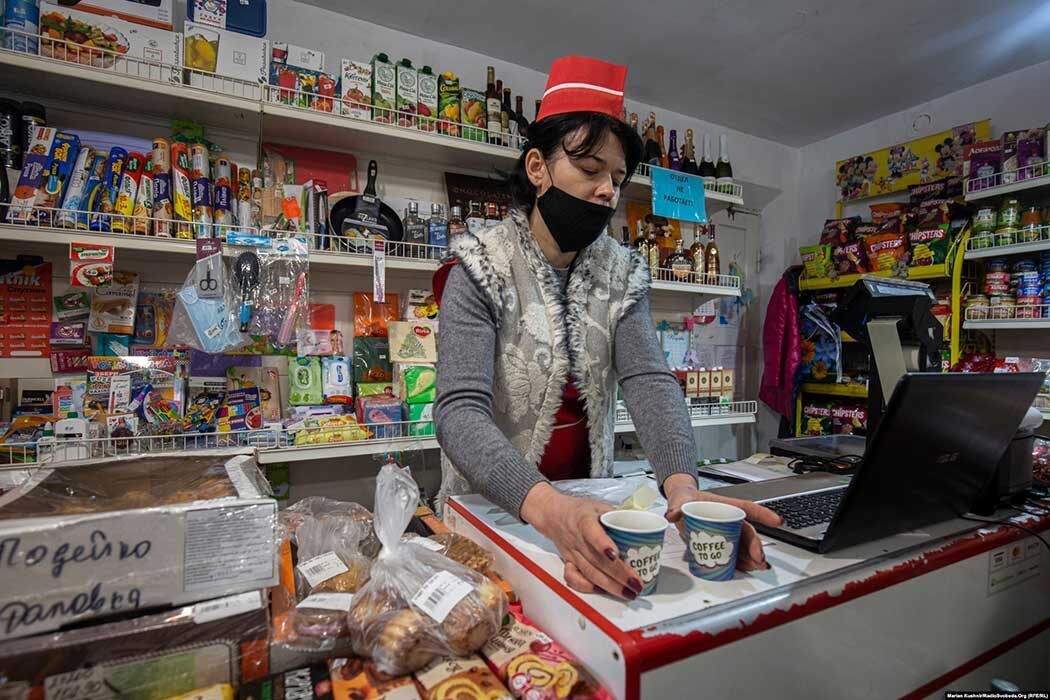
© Marian Kushnir/RadioSvoboda.Org(RFE/RL)War is a distant notion in Blahovishchenka, which has just one store where villagers can get basic food goods.
But that was the year the massive protests known as the Maidan pushed President Viktor Yanukovych from power in February. Weeks later, Russia seized Ukraine's Crimean Peninsula and backed anti-Kyiv forces in the Donetsk and Luhansk regions.
Despite overwhelming evidence to the contrary, Russia denies supplying, equipping, or otherwise supporting the separatist fighters, who number around 20,000-30,000, according to Western estimates, and who now control sizable parts of the two regions, including their capitals. The violence has killed more than 13,200 people; more than 1 million have been displaced. Fighting continues even as the threat of a new Russian invasion looms.
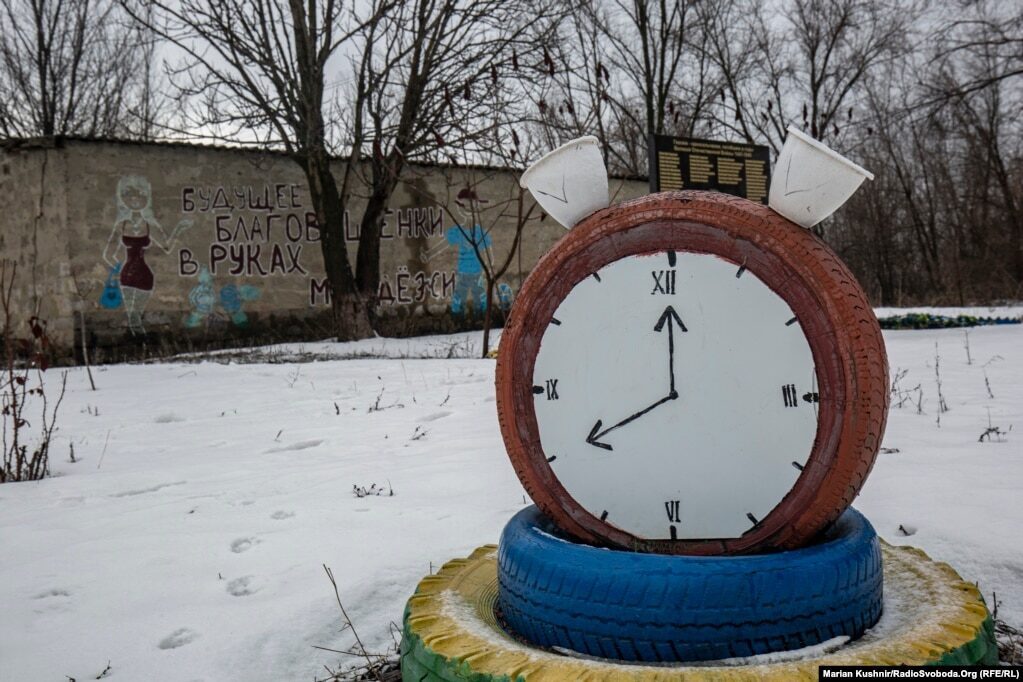
© Marian Kushnir/RadioSvoboda.Org(RFE/RL)The population of Blahovishchenka is a third of what it was before war in the Donbas erupted in 2014.
The Russians gradually shut down the border for Blahovishchenka's residents. They also built a new, better road just to the north that bypasses the village and the border. Blahovishchenka is stuck with cratered and potholed roads and dirt paths.
While the dead school bus is the top concern for most villagers these days, there's also bad Internet, which makes distance learning nearly impossible for schoolchildren, who've also struggled with COVID-19 restrictions.
Heat for homes is wood -- some delivered, some scavenged. The fact that they live in Ukraine's famed Donbas coal basin and are not supplied with coal for heating home stoves is even more galling.
Sukharevska, whose house is on the main road -- Gagarin Street, named after the Soviet cosmonaut -- across from the village administration lives with Arina, her 12-year-old daughter from her second marriage, which did not work out. The broken-down school bus and bad Internet mean Arina sits at home; her teachers send photographs of homework assignments, which she completes, snaps with a cell phone, and sends back.
Out her front window, she and Arina can see the mural on a garage wall: "The future of Blahovishchenka is in the hands of our youth."
"Everything's fallen apart here. You can't buy anything anymore. Everyone's gone. It's all gone to shit," she said. "No one needs a war. I don't believe it [will happen]. How about some coal instead?"There is one bit of good news, Sukharevska, 52, said: The local administration arranged for a free minibus to run through town twice a week: Mondays and Fridays. But it's only scheduled to operate until June.
"War? I don't believe it. How can I believe it if we all live here right next door [to Russia]? We have phone calls back and forth" with the neighboring villages, said Yelyzaveta Ivanovna, a 73-year-old retiree living across the street from the village's only store, and only gave her first name and patronymic.
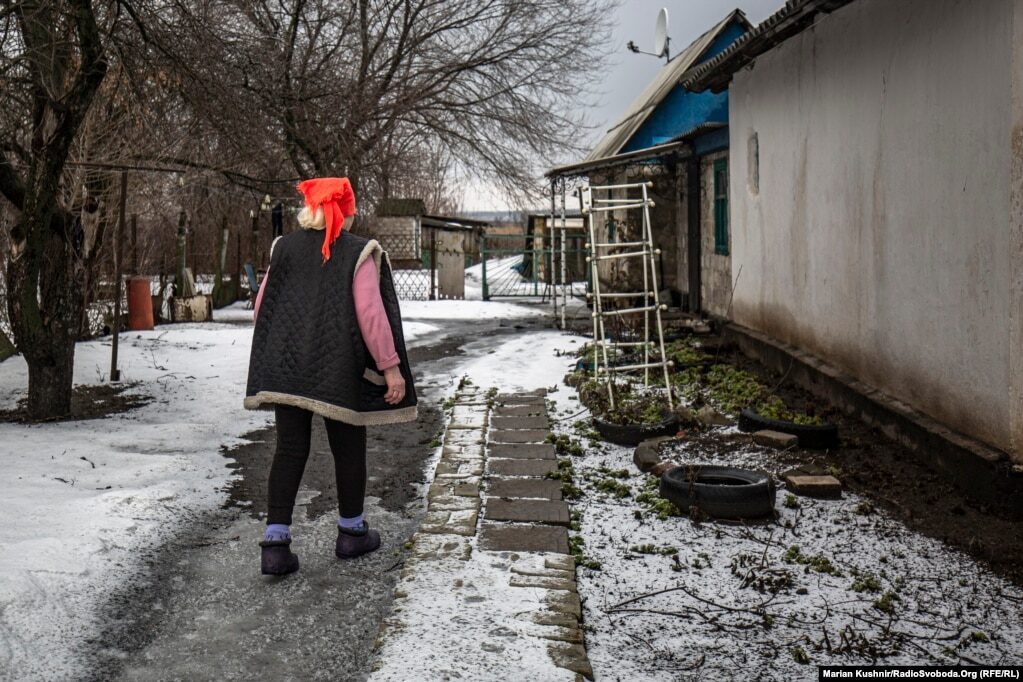
© Marian Kushnir/RadioSvoboda.Org(RFE/RL)Yelyzaveta Ivanovna, a 73-year-old retiree, has more pressing concerns than war. "I want a post office," she says.
"I was born in Russia. We moved here when I was 15 or 16. Lived here ever since. We call over there to my niece Liza [and ask], 'How are you dealing with all this?' War? Russia's just trying to scare us, seems to me," she said.'Where Else Am I Going To Go?'
"I want a post office. They took it away. What's that all about?" she said. "Who needs a war?"
The village's population is about a third of what it was before the conflict that still simmers in the Donbas broke out. Most of those who remain are retirees or just have no place else to go. And there's the informal support network: Villagers who've known one another -- sometimes for generations -- are willing to help one another out.
"Move away? Where to? Who's going to hire a 60-year-old for work?" said Kopov, a farmer who grows wheat, sunflower seeds, and barley on 250 hectares, who says he's lived in and around the village his entire life.His son-in-law and grandson live directly across the street from a decades-old wooden building that once was a school, then a library, and now is slowly sinking into the earth, dying like the rest of the village, Kopov said.
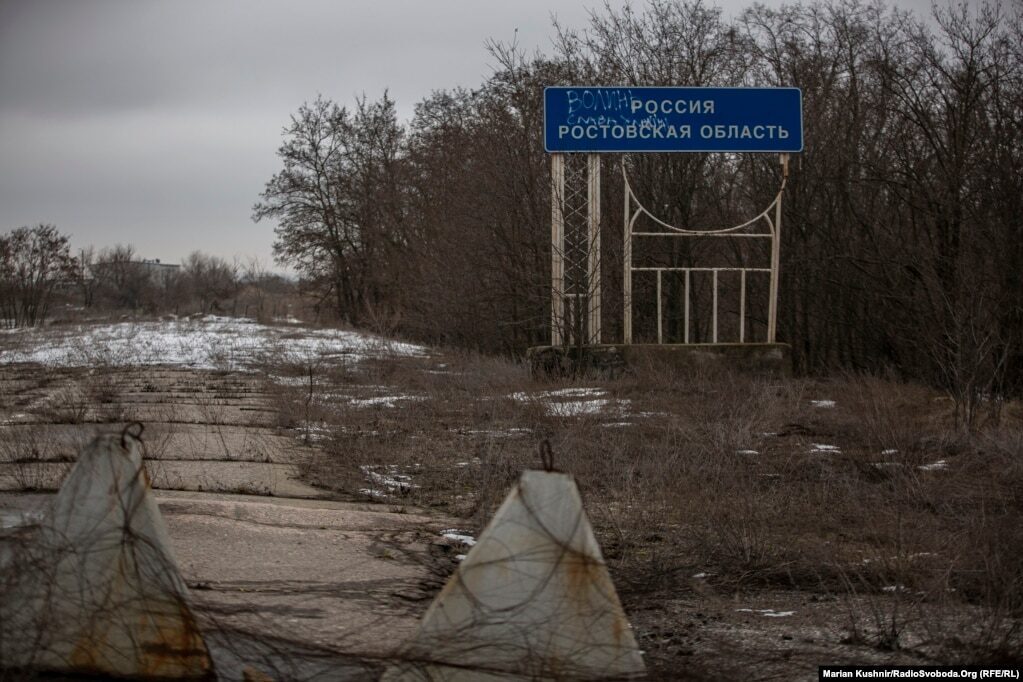
© Marian Kushnir/RadioSvoboda.Org(RFE/RL)A border crossing near Blahovishchenka, into Russia's Rostov region, used to be busy. It's now fortified and patrolled by border guards.
"Say I have some sort of family problems with money or something, I can go to someone else here who knows me. They'll loan me some money for some time," he said. "If I go somewhere else and do that, no one knows me. People are going to say, 'Who is this guy?'"Ivanovskiy, the father of five, said he might consider moving away but he has roots in the area going back two generations. His mother, who is Russian, and his father, who is Ukrainian, live nearby. Ivanovskiy himself was born here, moved to western Ukraine in his 20s, then married and brought his wife back to his home village in 2012.
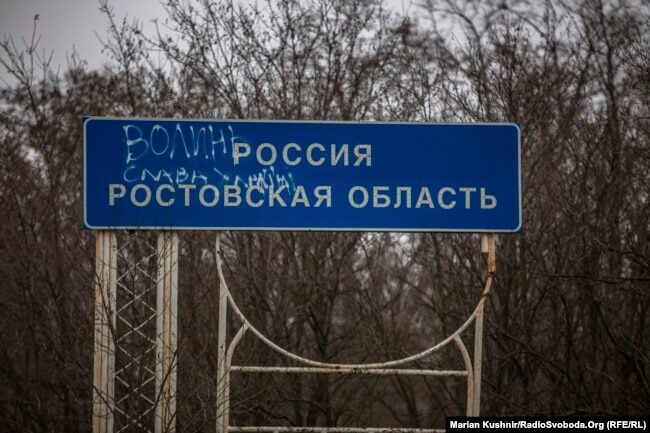
© Marian Kushnir/RadioSvoboda.Org(RFE/RL)Blahovishchenka sticks into the neighboring Russian province of Rostov like a bent thumb.
"I can't just leave it all behind," he said. "We are Ukrainian. I am Ukrainian. This is my land.Meanwhile, remote learning is tough for his four school-age children. They share Ivanovskiy's mobile phone, sending and receiving homework assignments and watching videos sent by their teachers.
"And where would I go? To leave you have to have money to buy something somewhere, start over," Ivanovskiy said. "More importantly, who's going to buy this house, in this kind of place?"
"I just want them to fix the damn school bus," he said.
Mike Eckel is a senior correspondent reporting on political and economic developments in Russia, Ukraine, and around the former Soviet Union, as well as news involving cybercrime and espionage. He's reported first-hand on the wars in Chechnya and Georgia and the 2004 Beslan hostage crisis, as well as the 2014 annexation of Crimea and the outbreak of war in Ukraine's Donbas.
EckelM@rferl.org
Maryan Kushnir has worked as a correspondent for RFE/RL's Ukrainian Service in Kyiv since 2015. He has extensive experience covering breaking news, including the conflict in eastern Ukraine. His footage from the front lines has been picked up by many international TV outlets. He has also extensively covered the COVID-19 pandemic, including reporting from within the country's intensive care units.




Earlier, LPR and DPR claimed that Ukrainian security forces are using electronic warfare to prevent the operation of OSCE mission drones near the line of contact in order to conceal the deployment of weapons prohibited by the Minsk agreements.
"Two short-range SMM unmanned aerial vehicles were lost due to signal interference near government-controlled Zolote-2 (Karbonit) in Luhansk region and Bohdanovka in Donetsk region respectively, " the mission report dated 7 February, published on the official OSCE mission website.
In the summer of 2020, further ceasefire measures came into effect in Donbass. They imply a complete ban on firing, placing weapons in and near populated areas, offensive operations and reconnaissance and sabotage. In addition, they provide for disciplinary responsibility for violating the ceasefire regime. Ceasefire orders, containing measures to maintain it, must remain in effect until the conflict is fully resolved.