
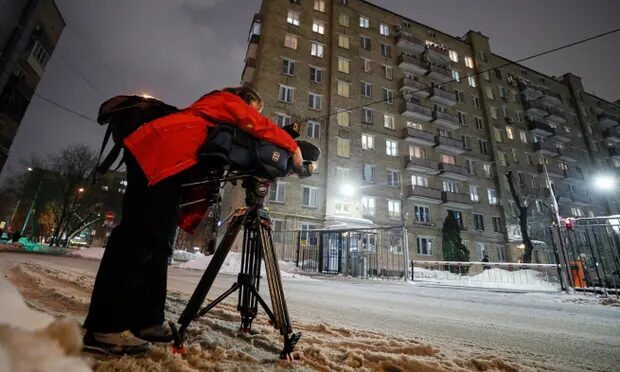
© Yuri Kochetkov/EPAAndrew Roth Moscow correspondentA cameraman outside a building housing an office of Deutsche Welle in Moscow.
The foreign ministry said the press credentials of DW's correspondents would be revoked, its bureau in Russia closed, and its German-language broadcasts would be banned from Russian satellite television in the near future. It said this was the first stage of its "retaliatory measures".
The move marks an escalation in Russia's media war with the west, in which there have already been expulsions of a BBC journalist and a Dutch reporter in the last year.
Comment: "Russia's media war with the West"; The Guardian's newspeak is almost insufferable these days, because it's pretty clear from their own reporting that this was a retaliatory measure.
It comes during a period of heightened geopolitical tensions as western governments have accused Russia of preparing to launch an attack on Ukraine and threatened crippling sanctions.
Comment: Not quite, the US has backtracked on its months-long, baseless, claims of an 'imminent invasion', and even EU politicians have spoken out against additional sanctions because they would significantly harm the European economy as much as, if not more than, Russia's; that's why they've delayed enacting them.
On Wednesday German authorities banned broadcasts by RT DE, the broadcaster's German-language channel, saying its Serbian licence was invalid in Germany. A Kremlin spokesperson called the decision political and said it was "nothing but an attack on freedom of expression".
Comment: It's blatantly obvious that this is political, as well as outright censorship. This has also been happening in parallel with Germany's block on Nord Stream II, and, as a consequence, Europe is suffering an energy crisis.
Russia has said it will retaliate against journalists when foreign governments target RT, a state-funded news agency that western governments have accused of spreading propaganda.
Comment: The BBC is funded by the state and has been outed on numerous occasions as a little more propaganda peddler. There's even reason to believe that The Guardian, a recipient of the government's 'coronavirus messaging' payments, has also been reduced to a government operation.
Ultimately, the foreign ministry went beyond a tit-for-tat decision to ban DW's broadcasts, in effect blocking the broadcaster's ability to report on the ground in Russia. RT DE journalists were not stripped of their accreditation as part of the German government decision.
The Russian foreign ministry also said it would initiate a procedure to recognise Deutsche Welle as a "foreign agent" in Russia and it would draft a list of German state and public figures who were "involved in restricting the broadcasting of RT DE and otherwise putting pressure on a Russian media operator". They would be banned from entering Russia, the ministry said.
DW's director general, Peter Limbourg, said in a broadcast interview that Moscow's retaliation exceeded his expectations. "We had been expecting some measures by the Russian side, but I think this is a total overreaction from the Russian government," he said, adding that it was "another sign that the Russian government is not interested in press freedom and freedom of opinion".
He said: "Even if we have to leave the country, we will intensify our reporting on the country. We will not just ignore what is happening in Russia, we will report. And we will do more and more."
RT's head, Margarita Simonyan, hailed the decision and suggested that further retaliation could lead to all German media being expelled.
RT DE had already been under considerable pressure. YouTube removed the channel from its site last year. On Wednesday the Russian foreign ministry said it would retaliate against "internet intermediaries" that had blocked the channel, in an apparent warning to YouTube.
RT has been required to register as a foreign agent in the US and has faced heightened scrutiny from Ofcom in the UK. The regulator has fined RT for breaching impartiality rules in its coverage of Syria and the Salisbury poisoning.



Right did Russia.
Planet Earth has broken the balls of all these CENSORS ... The time has come for everyone to realize it