

© GoogleMapsThe notorious, massive Qalandiya checkpoint lies in the center area surrounded by three roundabouts. Qalandiya is the scene of relentless ethnic control, murders by the IDF, violently suppressed protests, and a major cause of the impossibility of normal civilian life and movement. On GoogleMaps, the checkpoint does not exist.
What Orwell could not have foreseen was a world in which Big Brother did not need to destroy evidence, a world in which evidence did not exist in physical form and could be changed at will without a trace. All "copies" of a virtual newspaper would instantly update to every new "truth". Thought-criminals might, of course, have saved a copy of the previous virtual file, or even a screen-grab, but all these were nothing but numbers on media. What proof of whose sets of digits were the true ones, when there is no physical, forensic trail? True, false, faked, real, new, old, past, present, cause, effect, and even time-stamps and digital signatures, are ultimately nothing more than sets of ones and zeros with no distinction, because - to rewrite another Orwell novel - all numbers are created equal, none more equal than others. Whoever controls the virtual printing press that creates and rewrites reality as needed, wears the Wagnerian ring of the Nibelung - is granted the power to rule the world.
Welcome to the present. Welcome, for example, to Google Maps.
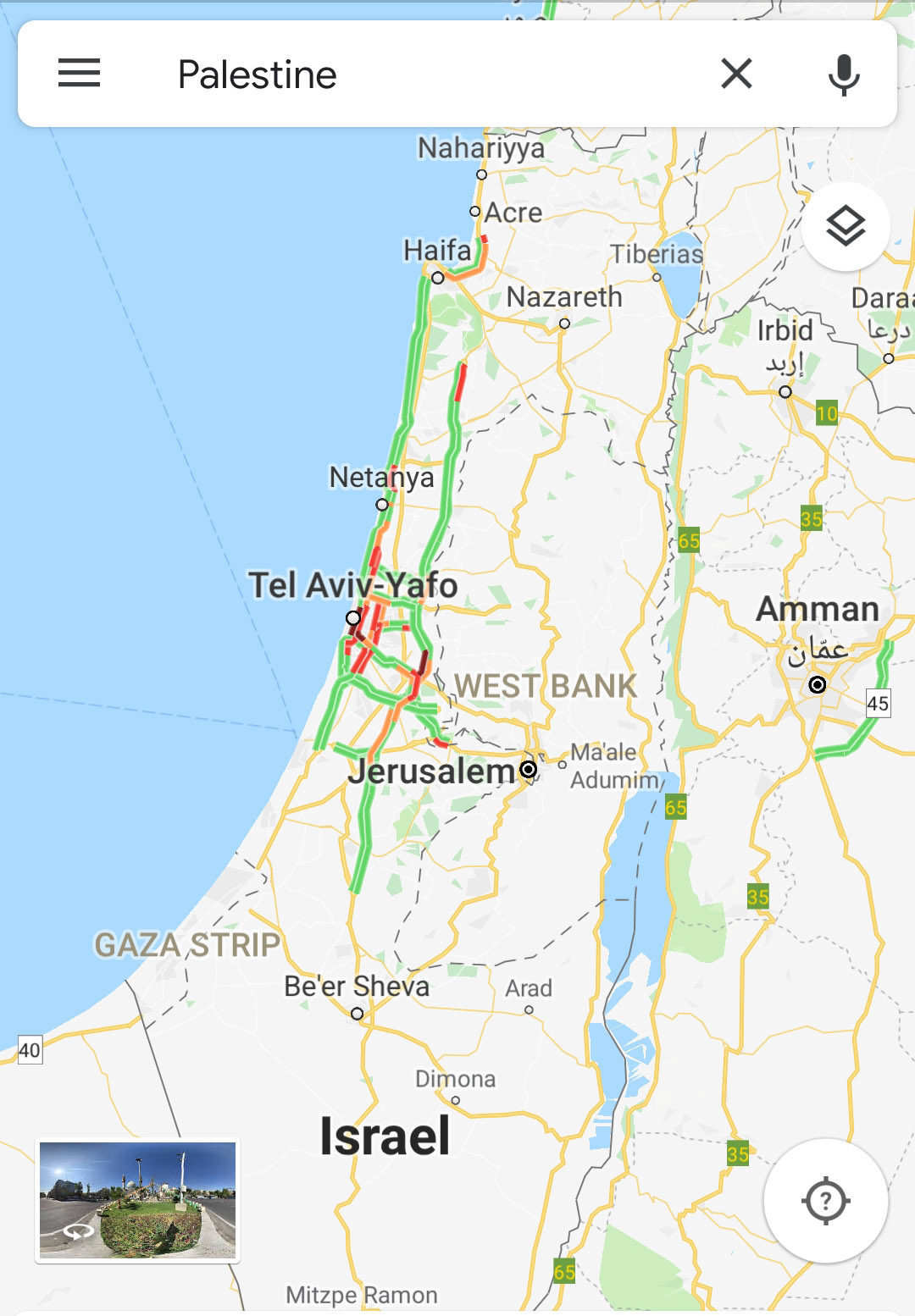
© GoogleMapsA search for “Palestine” on Google Maps brings up the region with only Israel as a country name. In this general view, the only place that appears within the West Bank or Gaza is the Israeli settlement of Ma’ale Adumim.
Google's attempt to de-exist Palestine has been well-reported*, along with its "explanation" that no country by that name exists. But even that vacuous excuse fails to address its refusal to chart access to any place in Palestine except illegal settlements - that is, its blocking cartographic information from Palestinians as a tool of ethnic control.
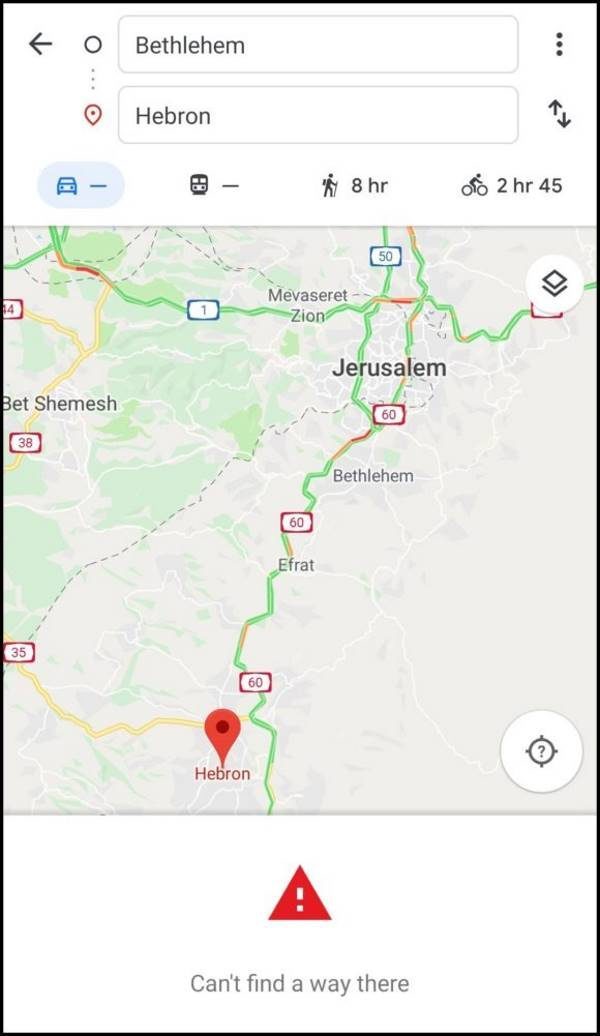
Google Maps has turned Palestinian towns and cities into ghosts. They appear (unlike the term Palestine, Google cannot pretend they don't exist), yet according to the technology Goliath they do not exist as places one can actually get to. They float in a different dimension. If you want to go between West Bank towns, even major cities such as Jericho, Bethlehem, or Hebron, Google will reply Sorry, we could not calculate driving directions from...
But if West Bank settlers want to visit other West Bank settlements, Google is at their service.
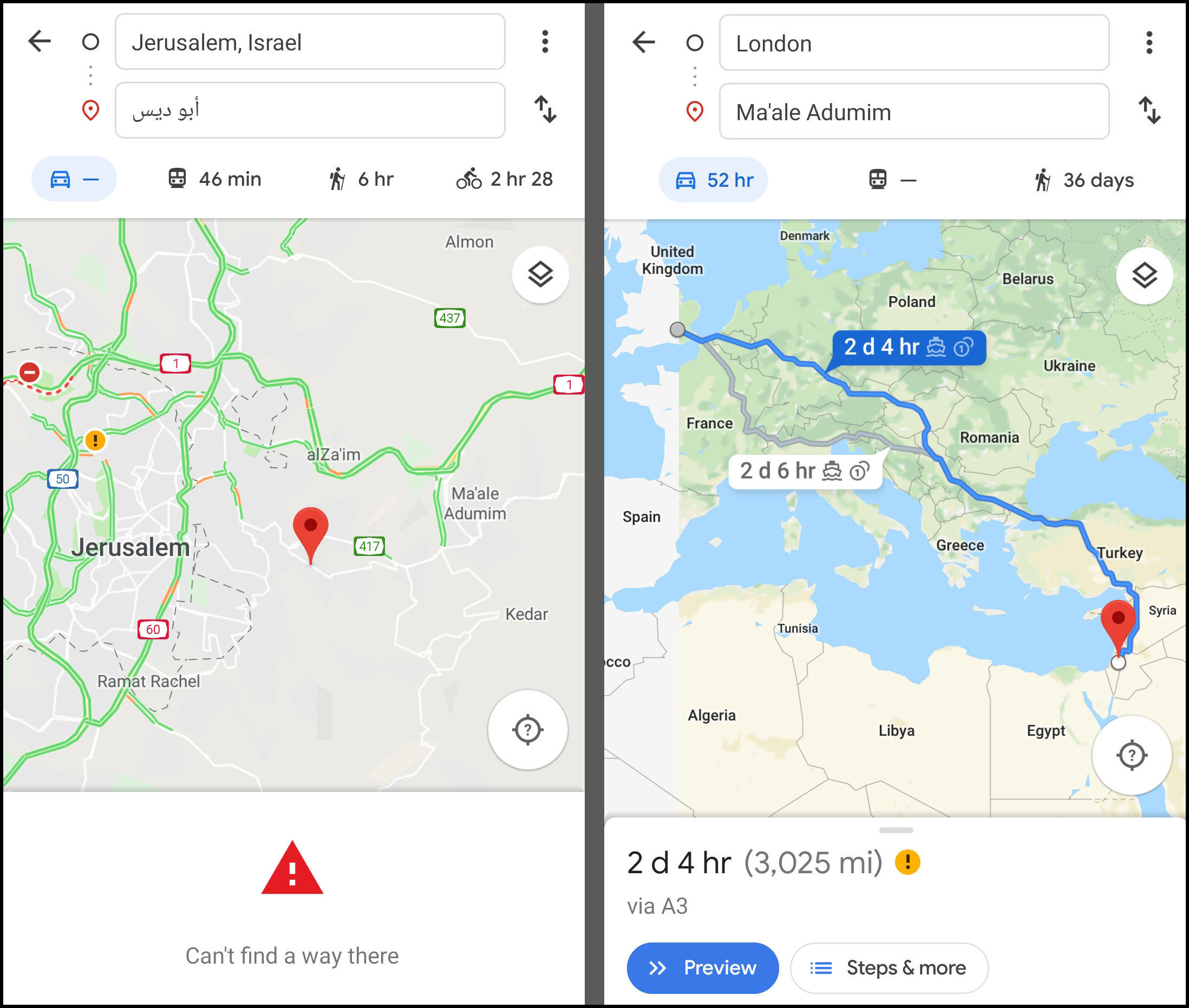
© GoogleMapsDespite Israel’s diversionary flaunting of Abu Dis as a proposed capital of a future Palestinian state, Google can’t figure out how to get there from neighboring Jerusalem (left). But if you want to go to the Israeli settlement of Ma’ale Adumim nearby Abu Dis, the fog suddenly clears. Even if you’re starting off from London, the only question is whether you want the northern route or the southern route (right).
Bethlehem and Hebron are an easy half-hour drive apart, assuming no interference from the IDF on behalf of the several Israeli settlements dotting the way. Google, however, is stymied.
© GoogleMaps
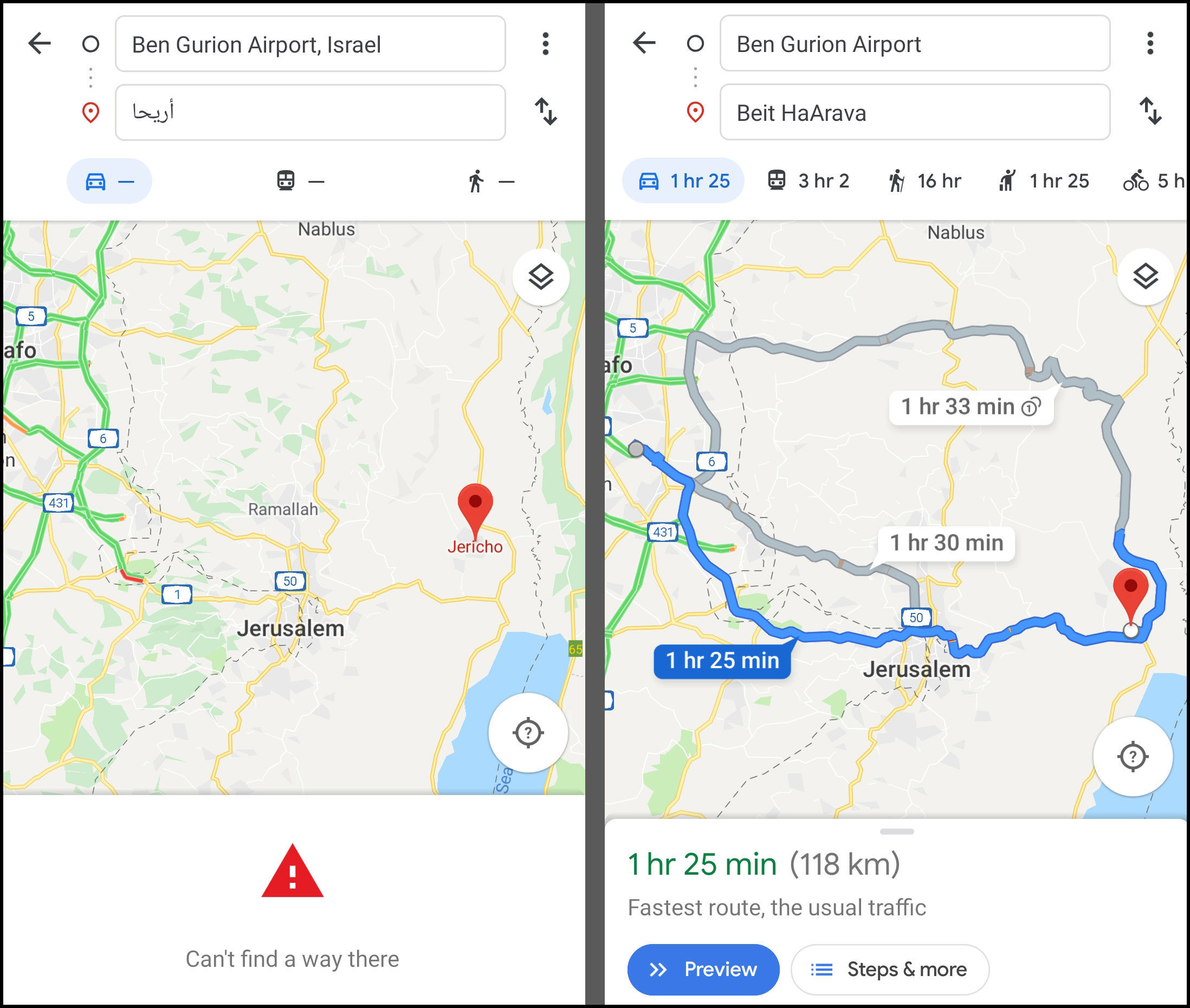
© GoogleMapsGoogle "can't find a way" to Jericho, an iconic city in human civilization (left). Nonetheless, it instantly finds three routes to the nearby Israeli settlement of Beit HaArava (right)
Israel used its friends in the US government to attempt to control another aspect of the mapping of Palestine-Israel: satellite detail. In 1997, a year before Google was founded, Senators Jon Kyl and Jeff Bingaman successfully authored an Amendment to the Military Defense National Defense Authorization Act that restricted the detail of publicly available satellite views of the land under Israeli control.[1] But this Act can only control US companies, and its effectiveness waned as cartographers not bound by US law offered satellite images in greater detail.
Printed maps must still be destroyed the old way. When HarperCollins produced a (printed) book for the Middle East market with a map which did not label Israel, the uproar was palpable; the publisher was accused of antisemitism and of wishing to "wipe Israel off the map", understanding the phrase's connotation far beyond the cartographic. The books were pulped.[2]
But onscreen maps do not need to be pulped, and even the same map is not static. Information and nomenclature may appear or disappear on some pecking order as the view is zoomed in or out. When the word "Israel" did not appear on an onscreen Air France flight map, the Jerusalem Post headline similarly read "Air France wipes Israel off of the map...literally".[3] Although Air France's routes includes Tel Aviv, it was accused of engaging in BDS. The airline apologized and fixed the issue, explaining (plausibly) that the omission had been the result of "map scale and display problem". Some Middle Eastern airlines' maps continue to omit Israel, whether as a political statement or prioritizing onscreen space if the airline does not fly to Israel.[4]
Although Google has positioned itself as most people's default cartographer, there are alternatives. Here is how other major mapping services fare at writing, from a London IP address, a cleared cache, and Firefox. All these label Israel with or without searching for it, whereas none of these indicate "Palestine" or "Palestinian Territories" without entering it as a search term, and only one - MapQuest - indicates Palestine even when it is entered as a search term.
- Google Maps: Palestine comes up on a search? No. Labels Palestine? No. Directions to Palestinian locales? No.
- MapQuest: Palestine comes up on a search? Yes. Labels Palestine? Yes, as "State of Palestine"(!). Directions to Palestinian locales? Yes, many, if not comprehensive.
- Bing: Palestine comes up on a search? No. Labels Palestine? No. Directions to Palestinian locales? Yes.
- Rand McNally: Palestine comes up on a search? No. Labels Palestine? No. Directions to Palestinian locales? No.
- Waze (Israeli-developed, now owned by Google): Palestine comes up on a search? No. Labels Palestine? No. Directions to Palestinian locales? Extremely limited.
- HereWeGo: Palestine comes up on a search? No. Labels Palestine? No. Directions to Palestinian locales? Limited.
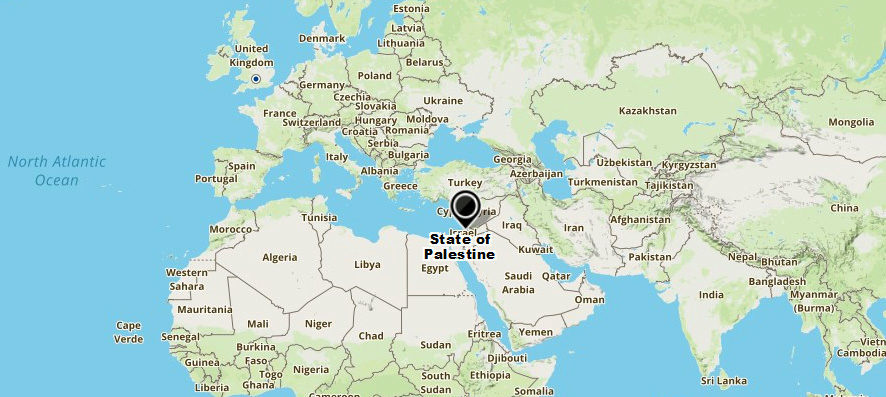
© MapQuestOf the major online map services tested, only MapQuest recognized "Palestine" - indeed as a state (above screen-grab is unedited). Yet Israel still wins the cartographic wars on MapQuest: If one simply goes to the region "neutrally", without search terms, only Israel is labelled.
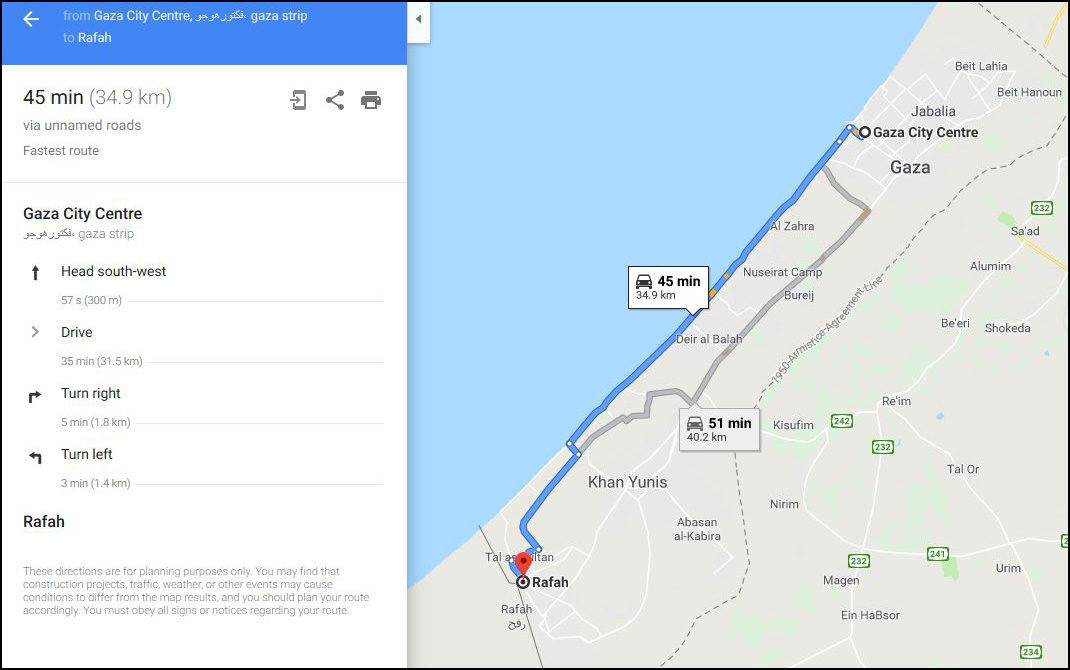
© GoogleMapsSince Gaza is under Israeli siege rather than active Israeli colonization, Google directions works within the strip.
Maps are by definition charged creatures - there is no such thing as a "neutral" map. All maps reflect the collective cultural, historical, scientific, thematic, and aesthetic biases of their makers. There are however maps whose intent is to present their subjects "fairly" within the world in which they exist and the purpose they were created to serve. Google Map's treatment of Palestine is, rather, cartographic thuggery, the use of its dominant platform as a weapon for Israeli aggression, subjugation, and ethnic cleansing.
* I highly recommend downloading the excellent PDF report by the Arab Center for Social Media Advancement, Mapping Segregation - Google Maps and the Human Rights of Palestinians (September, 2018), which systematically address issues not covered in this article, such as "unrecognized" villages, checkpoints, and apartheid roadReferences:
- Kyl-Bingaman Amendment, Public Law 104-201, Section 1064, Military Defense National Defense Authorization Act for 1997.
- Middle East atlas omitting Israel to be pulped following widespread anger (The Guardian, January 5, 2015)
- Air France wipes Israel off of the map...literally (The Jerusalem Post, August 3, 2015)
- Why THIS country does NOT appear on airline route maps (The Express, March 9, 2017)
- Map map on the wall, who's most existing of them all? (Tom Suarez, April 30, 2017)
- Google blames bug for removing 'West Bank' and 'Gaza' from Israel/Palestine map (Wilson Dizard, August 10, 2016)
- Google and the eternal, undivided capital of the Jewish people (Tom Suarez, January 10, 2013)
- Mondo Exclusive: Google map of Israeli settlements from leaked database (Adam Horowitz, February 3, 2009)
- Google Maps' Endangering Palestinian Human Rights
- Why Does Google Maps Not Recognize Palestine or its Roads?
- Lost in Occupation: How Google Maps is erasing Palestine
Tom Suárez' writing on map history has figured into today's map wars: his 1999 book Early Mapping of Southeast Asia (Charles E. Tuttle) was among the evidence (Annex 528) used by Philippine negotiators in their successful UN suit against China's attempt to claimed sovereignty over the Paracel and Spratly islands. Tom Suarez is the author, most recently, of State of Terror, how terrorism created modern Israel.


well?