
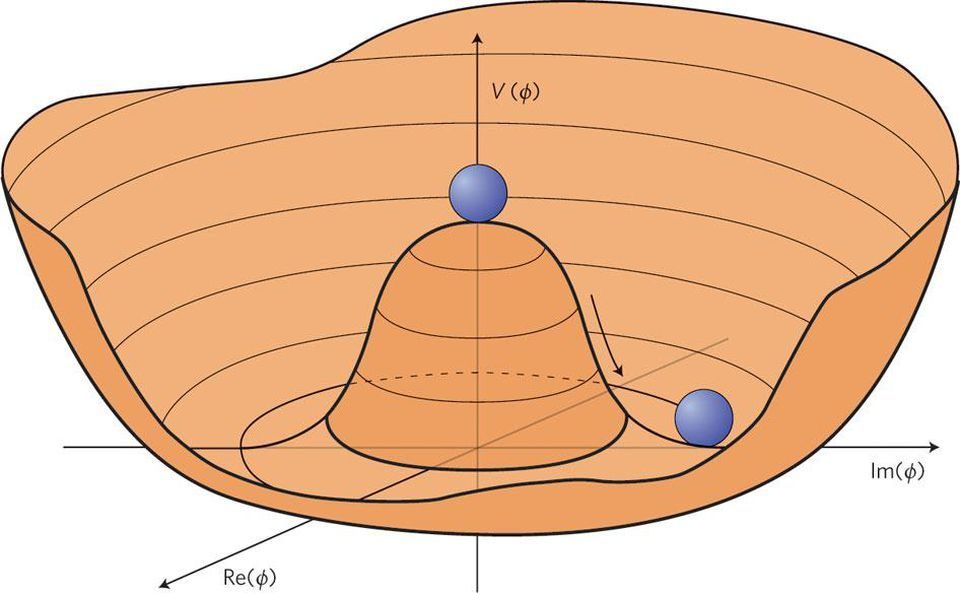
© LUIS ÁLVAREZ-GAUMÉ & JOHN ELLIS, NATURE PHYSICS 7, 2–3 (2011)When we see something like a ball balanced precariously atop a hill, this appears to be what we call a finely-tuned state, or a state of unstable equilibrium. A much more stable position is for the ball to be down somewhere at the bottom of the valley. Whenever we encounter a finely-tuned physical situation, there are good reasons to seek a physically-motivated explanation for it.
Comment: Note the last sentence in the caption above. What are the 'good' reasons? And there possibly good reasons for seeking a non-physically-motivated explanation, too?
When you approach the world scientifically, you seek to gain knowledge about how it works by asking it questions about itself. You observe its behavior; you perform experiments on it; you measure specific quantities that you're interested in. If you ask the right questions in the right ways, you can begin to gain information about what physical phenomena govern the behavior that was revealed in each and every one of your investigations.
Most of the time, your results will teach you something specific about the Universe. But every once in a while, you'll find something that seems too good to be true. You'll measure something that will confuse you in one of two ways: either two things that appear unrelated are perfectly (or almost perfectly) identical, or two things that appear related are extraordinarily different. This is known as fine-tuning, and it really is a problem in physics.
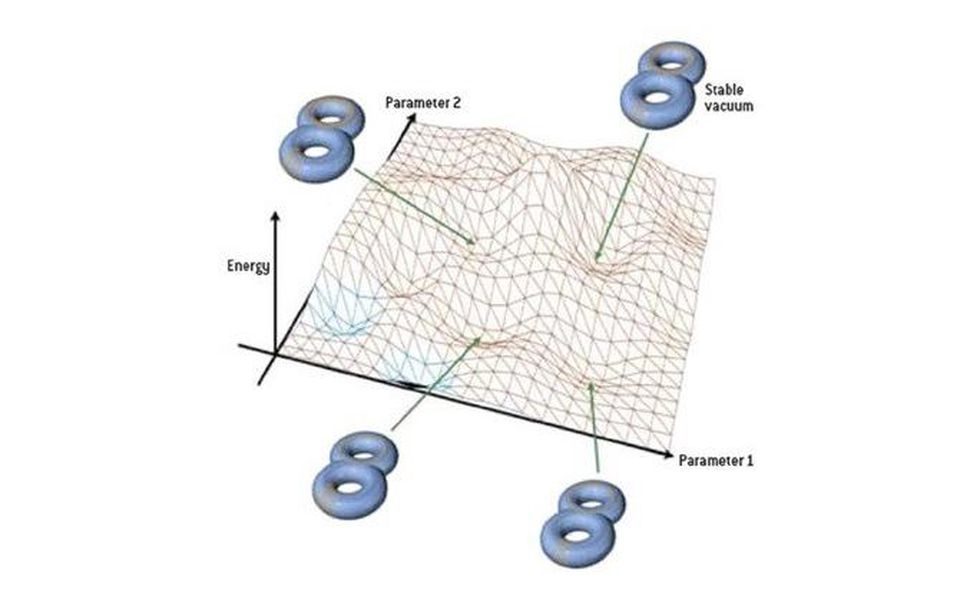
© UNIVERSITY OF CAMBRIDGEThe string landscape might be a fascinating idea that's full of theoretical potential, but it cannot explain why the value of such a finely-tuned parameter like the cosmological constant (or the value of dark energy) has the value that it does. Still, understanding why this value takes on the particular one it does is a fine-tuning question that most scientists assume has a physically-motivated answer.
Comment: Again note the last sentence. Most scientists "assume". Is their assumption justified?
You don't even need to look at physics to understand why this would be the case. Imagine, instead, you were looking at the net worths of some of the richest people in the world, as based on the Forbes Billionaires list. If you were to pick two of them at random, what would you expect to find? Sure, you'd expect that each one would be worth at least one billion dollars, but you'd also expect there would be a large difference between these two values.
If the first billionaire is worth an amount A, and the second is worth an amount B, then the difference between them is C, where A - B = C. Without any further knowledge, you should be able to assume something about C: it shouldn't be much smaller than either A or B. In other words, if A and B are both in the billions of dollars, then it's likely that C will be in (or close to) a value of billions as well.
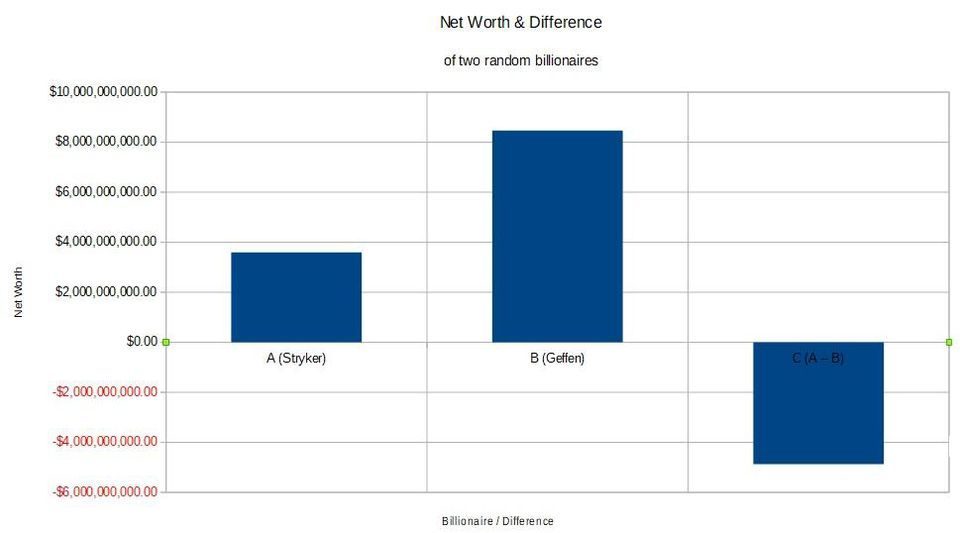
© E. SIEGEL / DATA FROM FORBESWhen you have two large numbers, in general, and take their difference, the difference will be of the same order of magnitude as the original numbers in question.
But it won't always be. For example, most of the over 2,200 billionaires in the world are worth less than $2 billion, and there are hundreds worth between $1 billion and $1.2 billion. If you happened to pick two of them at random, it wouldn't surprise you terribly if the difference in their net worth was only a few tens of millions of dollars.

© ASTRID STAWIARZ/GETTY IMAGESEntrepreneurs Tyler Winklevoss and Cameron Winklevoss discuss bitcoin with Maria Bartiromo at FOX Studios on December 11, 2017. The first 'bitcoin billionaires' in the world, their net worths are practically identical, but there's an underlying reason behind why.
After all, you don't know which billionaires were on your list. Would you be shocked to learn the Winklevoss twins - Cameron and Tyler, the first Bitcoin billionaires - had identical net worths? Or that the Collison brothers, Patrick and John (co-founders of Stripe), had net worths that differed by only a few hundred dollars?
No, it wouldn't be particularly surprising. In general if A is large and B is large, then A - B will also be large, unless there's some reason for A and B to be very close together. The distribution of billionaires isn't completely random, as there might be underlying reasons for two seemingly unrelated values to actually be related. (In the case of the net worths of the Winklevosses or the Collisons, there's literally a blood relationship!)
Comment: And it's not just a blood relationship; it's the fact that they coordinated their decision-making and actions. That is, they made purposeful choices together.
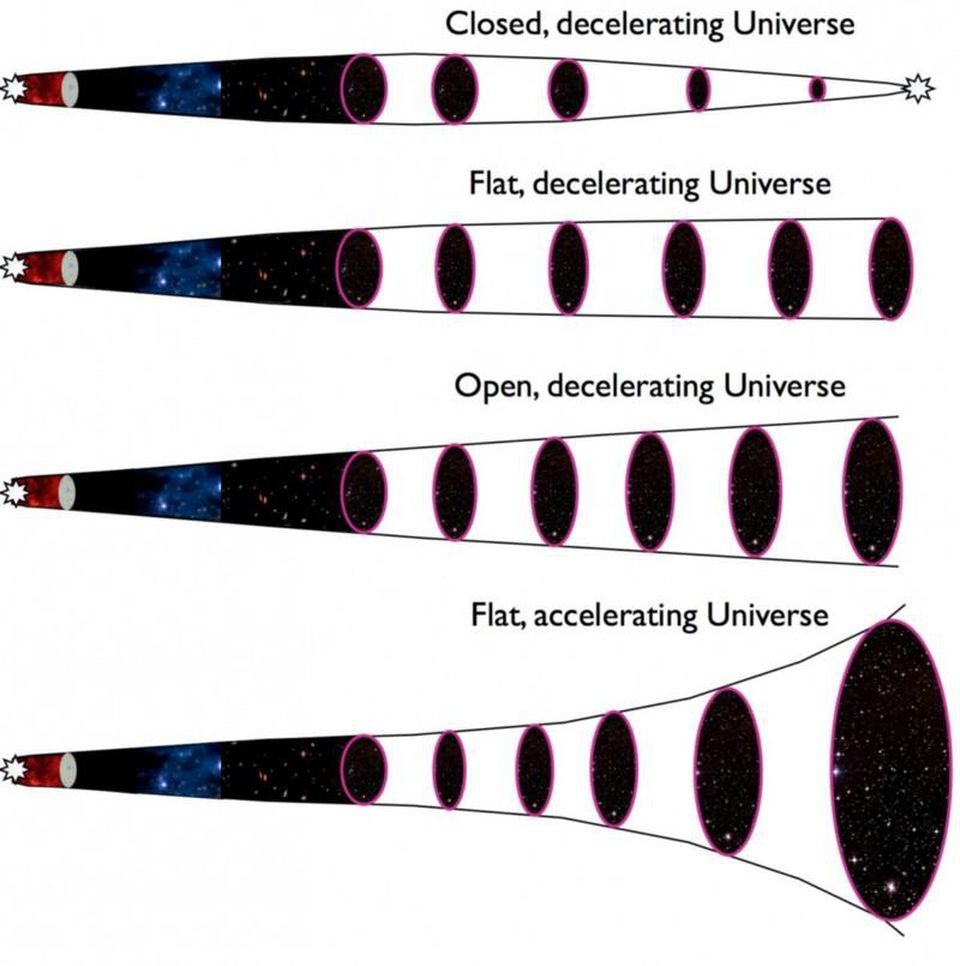
© E. SIEGEL / BEYOND THE GALAXYThe expected fates of the Universe (top three illustrations) all correspond to a Universe where the matter and energy combined fight against the initial expansion rate. In our observed Universe, a cosmic acceleration is caused by some type of dark energy, which is hitherto unexplained. All of these Universes are governed by the Friedmann equations, which relate the expansion of the Universe to the various types of matter and energy present within it. There's an apparent fine-tuning issue here, but there may be an underlying physical cause.
The expanding Universe is basically a race between these two competing forces:
- the initial expansion rate, which works to drive everything apart,
- and the gravitation of all the different forms of energy present, which works to pull everything back together,
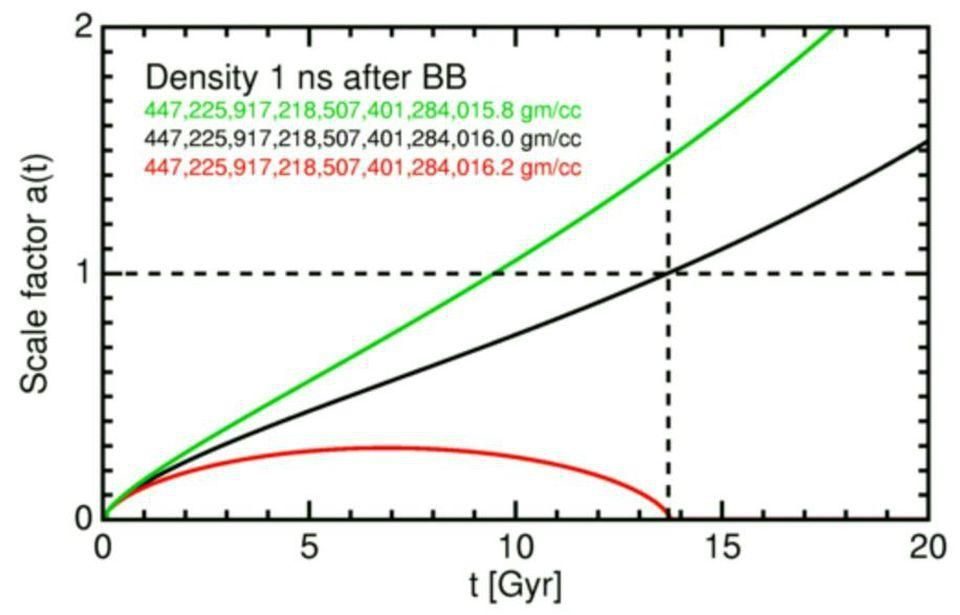
© NED WRIGHT'S COSMOLOGY TUTORIALIf the Universe had just a slightly higher density (red), it would have recollapsed already; if it had just a slightly lower density, it would have expanded much faster and become much larger.
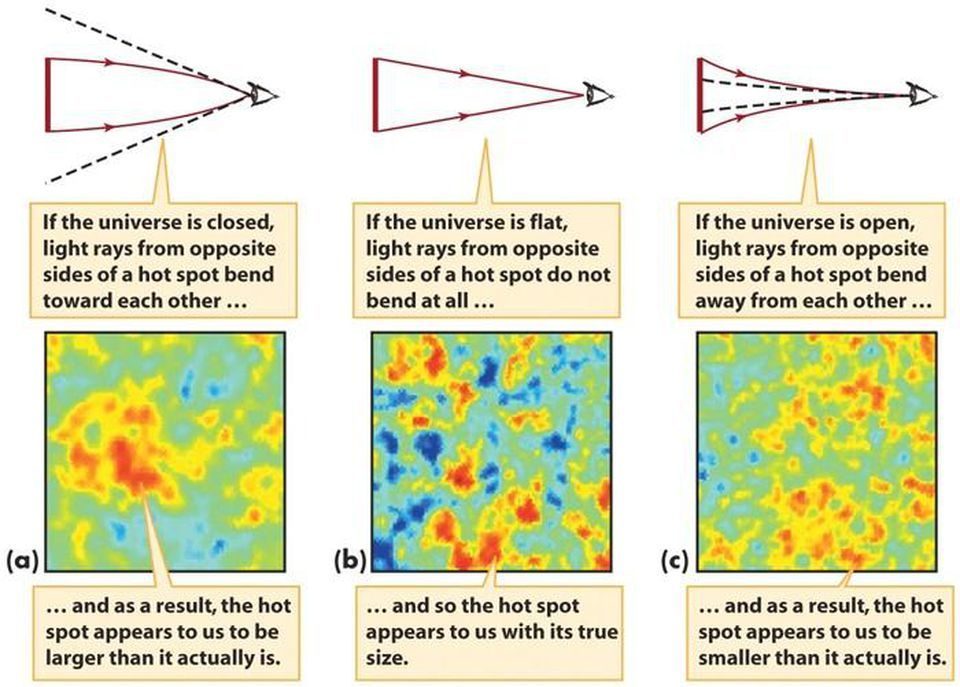
© SMOOT GROUP AT LAWRENCE BERKELEY LABSThe appearance of fluctuations with different angular sizes in the CMB results in different spatial curvature scenarios. Presently, the Universe appears to be flat, but we have only measured down to about the 0.4% level. At a more precise level, we may discover some level of intrinsic curvature, after all.
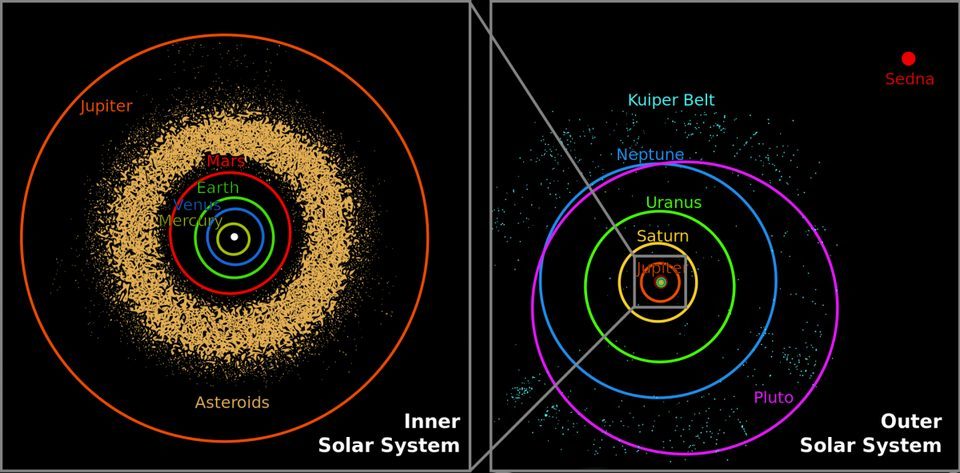
© NASA / JPL-CALTECH / R. HURTThe orbits of the eight major planets vary in eccentricity and the difference between perihelion (closest approach) and aphelion (farthest distance) with respect to the Sun. There is no fundamental reason why some planetary orbits are more or less eccentric than one another; it's simply a result of the initial conditions from which the Solar System formed.
Venus, for example, orbits the Sun in an elliptical shape, similar to how all the planets orbit. But Venus has the smallest percent difference between its closest approach to the Sun (perihelion) and when it reaches its farthest distance from the sun (aphelion) of any of the planets.
Why is Venus more circular, and less elliptical, than any of the other planets? It's simply due to the initial conditions of the material that gave rise to the Solar System. Neptune is the second most circular, followed by Earth. The least circular planet? Mercury, followed by Mars and then Saturn. There wasn't a mechanism that caused these eccentricities; it had the outcome we observe today because of the (seemingly random) initial conditions our Solar System was born with.

© GETTYThis rock formation, known as Balanced Rock in Arches National Park, appears to be in unstable equilibrium, as though someone stacked it there and balanced it perfectly, long ago. However, it isn't merely a coincidence, but rather a consequence of the underlying geology and erosion processes that gave rise to the structure we see today.
Comment: So the two options are accident and mechanism. But what if the universe is neither? What if it is teleological, as philosopher Thomas Nagel and others have proposed? That's the only answer that actually makes any sense.
For example, if you take a look at an enormous rock balanced precariously on a perch, you would assume that something caused it to be that way. It could be because someone carefully placed and balanced it there, or it could be because erosion and weathering happened in such a way that this structure evolved naturally. Fine-tuning doesn't need to imply a fine-tuner, but rather that there was a physical mechanism underlying why something appears finely-tuned today. The effect may look like an unlikely coincidence, but this may not be the case if there's a cause responsible for the effect we see.
Comment: So Siegel will admit that purposefulness is a possible explanation. Then why not present it is a real option, rather than simply saying it doesn't "need" a fine-tuner? Sure, it doesn't "need" one. But that is not to say there is not one. A balanced rock may have been caused by erosion, or it may have been placed there, as at Stonehenge. Which is more likely requires more analysis than simply writing off one of the options from the start.
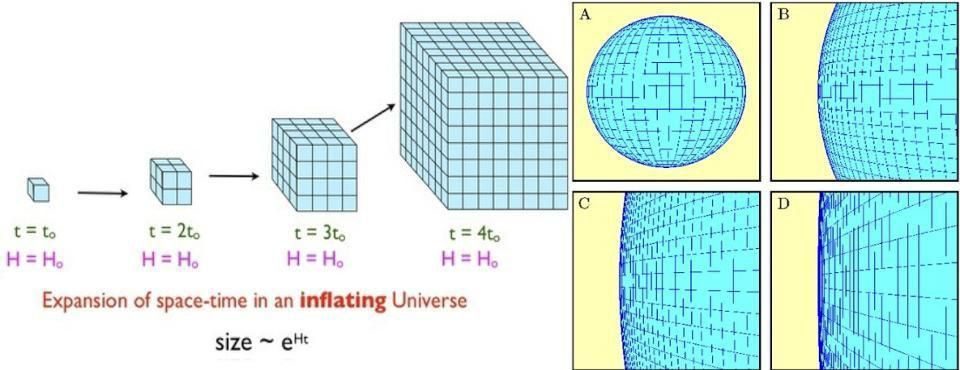
© E. SIEGEL (L); NED WRIGHT'S COSMOLOGY TUTORIAL (R)Inflation causes space to expand exponentially, which can very quickly result in any pre-existing curved or non-smooth space appearing flat. If the Universe is curved, it has a radius of curvature that is at minimum hundreds of times larger than what we can observe.
It's also possible that a phase of the Universe existed before the Big Bang, expanding rapidly and stretching the Universe so that it's indistinguishable from perfectly flat. It's possible that the Universe really is curved, but that it's curved on a much larger scale than our observable Universe permits us to access, in the same way that you couldn't measure the curvature of Earth solely by examining your own backyard.
The whole point of a fine-tuning argument isn't to declare that we have a weird coincidence, and therefore anything that explains this coincidence is likely to be right. Rather, it points us to the various ways we might think about an otherwise unexplained puzzle, to try and provide a physical explanation for a phenomenon that has no obvious cause.
Comment: Again, that's all fine and good. But why limit the type of explanation sought after? If you only look for physical explanations, all you'll find are physical explanations, even if they are incomplete or happen to be wrong.
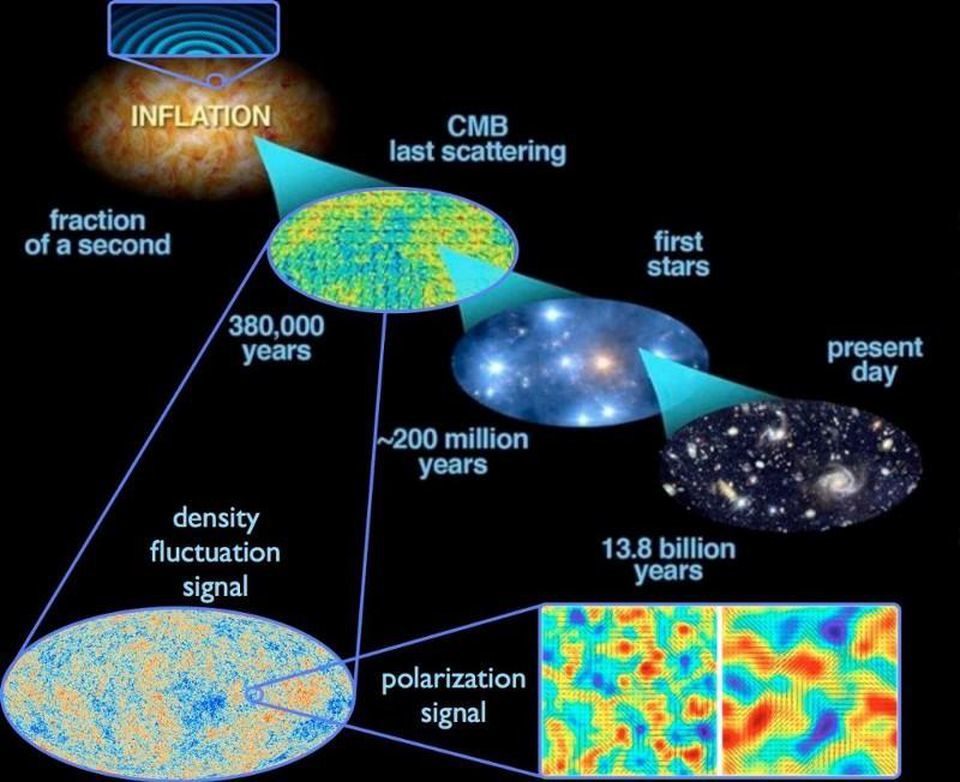
© E. SIEGEL, WITH IMAGES DERIVED FROM ESA/PLANCK AND THE DOE/NASA/ NSF INTERAGENCY TASK FORCE ON CMB RESEARCHThe quantum fluctuations that occur during inflation get stretched across the Universe, and when inflation ends, they become density fluctuations. This leads, over time, to the large-scale structure in the Universe today, as well as the fluctuations in temperature observed in the CMB. New predictions like these are essential for demonstrating the validity of a proposed fine-tuning mechanism.
Comment: No, that is not the goal of science. It is the goal of materialists. Scientists recognize teleology when they see it. And if they're unsure, they at least recognize purpose as a possibility, as when they try to determine if a rock fragment was formed by natural processes, or human hands.
When we see what appears to be a cosmic coincidence, we owe it to ourselves to examine every possible physical cause of that coincidence, as one of them might lead to the next great breakthrough.
Comment: Absolutely. But we also owe it to ourselves to be open to additional, non-physical causes.
That doesn't mean you should credit (or blame) a particular theory or idea without further evidence, but the possible solutions we can theorize do tell us where it might be smart to look.
As always, we have strict requirements for any such theory to be accepted, which includes reproducing all the successes of the previous leading theory, explaining these new puzzles, and also making new predictions about observable, measurable quantities that we can test. Until a new idea succeeds on all three fronts, it's only speculation. But that speculation is still incredibly valuable. If we don't engage in it, we've already given up on discovering new fundamental truths about our reality.
Astrophysicist and author Ethan Siegel is the founder and primary writer of Starts With A Bang! His books, Treknology and Beyond The Galaxy, are available wherever books are sold.




Is it on going?