
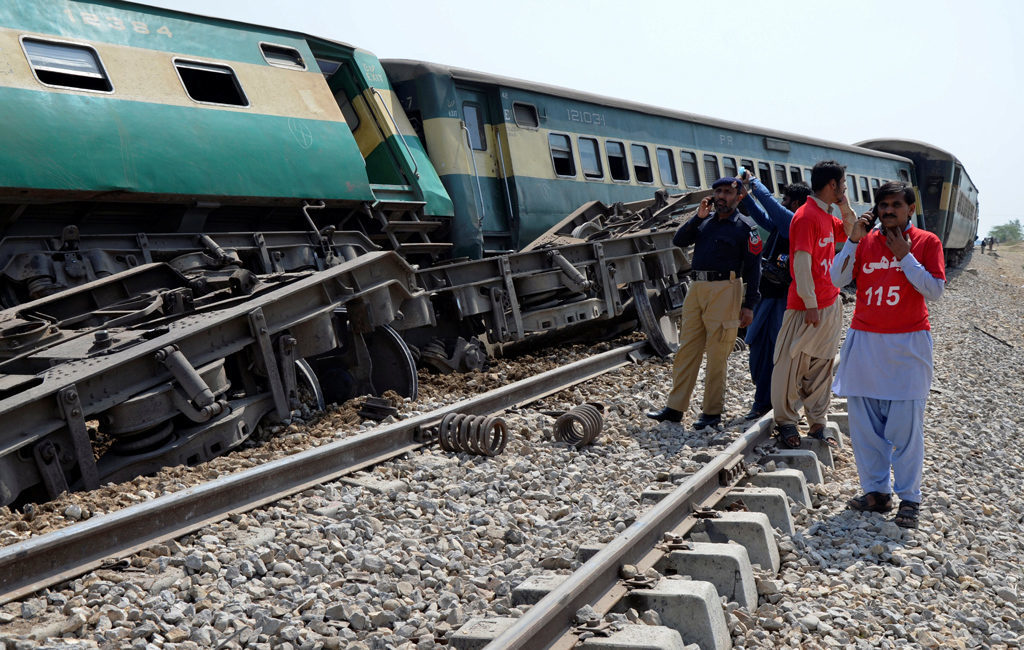
© ReutersA police officer and rescue workers stand near to a derailed passenger train, after a bomb went off on track in Naseerabad, Pakistan March 17, 2019
There was no immediate claim of responsibility, but ethnic Baluch separatists, fighting what they call the unfair exploitation of their province's gas and other resources, have attacked trains in the past.
"Four people - a teenage girl her mother and two others were killed in the blast," Irfan Bashir, police chief of Naseerabad district where the blast occurred, told Reuters.
The blast derailed six carriages of the Jaffar Express train, which was travelling from the northwestern city of Peshawar to the Baluchistan provincial capital of Quetta.
It was second train attack in two weeks in the area. No casualties were reported in the earlier blast, said another police officer.
Previously in 2016, a similar attack on the same train also killed four people.
Baluchistan is an important part of transport and energy projects that form part of China's Belt and Road initiative, which has brought $57 billion of investment to Pakistan.
Violence in the province, which borders Afghanistan and Iran, has fuelled concern about security for the investment, in particular an energy link planned to run from western China to Pakistan's southern port of Gwadar.
Earlier in January, four Pakistani paramilitary soldiers were killed in action against local militants. Barely a week later, a suicide bomber managed to kill seven people in an attack on a police truck.



Comment: Pakistan is under the spotlight for its use of terrorist groups in recent decades.
But as you see here, it's more complicated than just Pakistan using these groups for political reasons.
Two powerful incentives others have for maintaining terror networks in south Asia are:
1.) Ringing Iran with troublespots, thus 'containing' it.
2.) More broadly, keeping the region 'infertile' for Chinese-led infrastructure projects.