

The speed of response was much faster than Wiltshire Police and Crime Commissioner Angus Macpherson has given reason for at the time; in the eleven months of his tweeting after the incident; or under direct questioning over several days of last week.
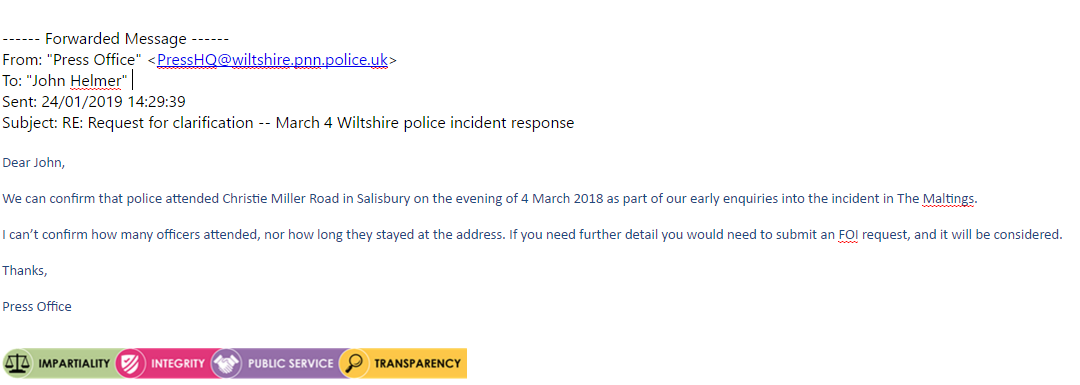
"We can confirm that police attended Christie Miller Road in Salisbury on the evening of 4 March 2018", Macpherson said through a spokesman, "as part of our early enquiries into the incident." That was not an answer to the question Macpherson was asked.
The new police evidence - an excerpt from the Wiltshire police incident response log and Macpherson's cover-up of the particulars - contradicts the allegations the British government and police in London have made that the outside door-handle of the Skripal house had been sprayed by Russian assassins with a "military grade nerve agent" named by the British authorities as Novichok.
An unpublished Wiltshire police report indicates the likelihood that British secret service surveillance of the Skripals was under way on March 4, during their movements around Salisbury on March 4, before their collapse, and led to an anonymous call to the emergency services. That call was the first to report the incident to the police. Secret service agents then appear to have been at the Skripal house, with a police guard, several hours before local detectives conducted a search of the interior, telling the BBC later that the house "looked normal. There was nothing untoward."
"The incident was reported at 16:16 hours on the 4 March 2018," according to the Wiltshire police report, "by way of what we term a silent 999, i.e. with nothing said to the operator. A further call was then received stating that there was a male and female on a bench 'passed out' this was deemed to be a medical incident and an ambulance was tasked as well as police unit".
For an explanation of what British police mean by a "silent 999", read this.
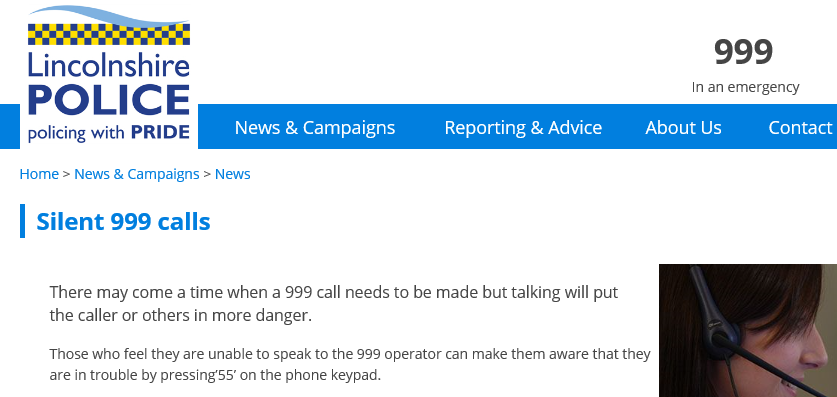
The Wiltshire police log excerpt does not say whether the extra 55 code was received. The police have not reported that Sergei or Yulia Skripal used their telephones to make the first 999 call.
Subsequent Salisbury media reporting has identified the second of the callers on the police log. "Abigail McCourt has spoken about the Salisbury Novichok incident for the very first time", SpireFM reported on January 21. "The 16 year old, from Larkhill [10 miles north of Salisbury], was the first to spot two people collapsed on a bench in the Maltings on March 4th and didn't hesitate to help. Abigail believed Sergei Skripal was having a heart attack."
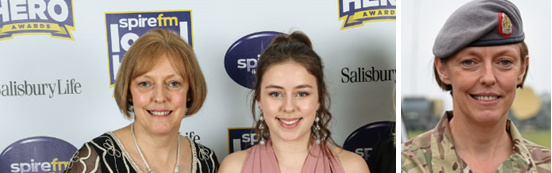
Left image: Alison McCourt and daughter Abigail at the “Local Hero” awards ceremony in Salisbury this month; right image, Alison McCourt in Army uniform.
McCourt says she did not call the police immediately. Several minutes elapsed because she telephoned her mother first "because I thought he was having a heart attack and so we went over and obviously it developed from there." Abigail says she then discovered that Yulia Skripal was not breathing and moved her into the "recovery position". Abigail's mother, Alison McCourt, was reported in the local press as a "nurse". Colonel McCourt is head of nursing for the British Army and Senior Health Advisor.
Days earlier, on February 20, the annual Army chemical warfare exercise TOXIC DAGGER concluded three weeks of troop training with the Defence Science and Technology Laboratory at Porton Down, near Salisbury. "Casualty treatment was a key part of the Salisbury Plain exercise," according to a Royal Marines release.
Colonel McCourt has told the press she was nearby in the city centre with her husband, when telephoned by her daughter. She said she and her husband joined her daughter and son at the scene of the Skripals' collapse. Col. McCourt was treating them when the police and ambulance paramedics first arrived.
The Wiltshire police control room log's next entry reads: "The police unit arrived first at 16:24 hours and an off-duty medical person at the scene stated to the officers that she believed the male and female (later identified as the Skripal's) had taken something. Further units were tasked at 16:27 to keep back onlookers." Col. McCourt was the "off-duty medical person"; it was her diagnosis the police logged in.
A police interview, reported in December, gave a slightly different account, but confirmed the timing of the first emergency call. Examination of personal belongings, including Sergei Skripal's wallet with his driver's licence and home address, did not occur until after the 16:27 cordon had been set up around the Skripals. At that point, the police at the scene say they "called CID [Criminal Investigation Division] and a duty inspector...CID officers attended. 'They were like: 'That's fine, everything's OK', and off they went again,' said Holloway."
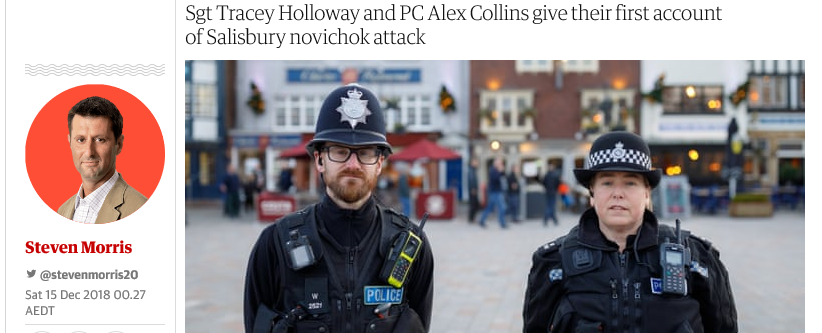
© Guardian
This is not what the evidence at the Skripal house on Christie Miller reveals. Neighbours on the road reported to a local newspaper that evening that a police van had arrived at the house at 5 pm. The timing is significant. This was just 12 minutes after the 16:48 police log report; the despatch and arrival of the van have been omitted from the police report.
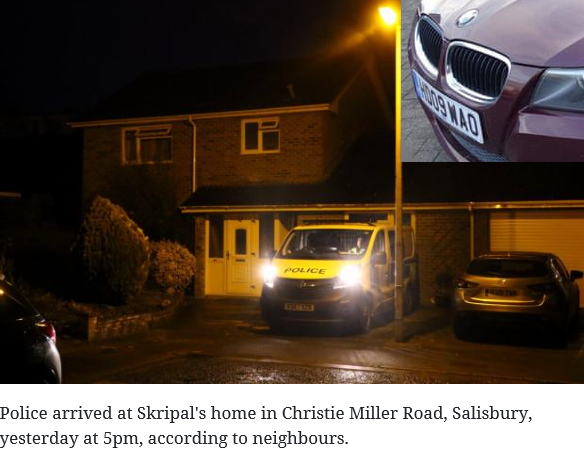
© salisburyjournal.co.ukThe newspaper photograph with caption, published on the morning of March 5, shows a police van, headlights illuminated, at the entrance to the Skripal house on the evening before, March 4. The driver-side seat of the vehicle appears to be empty; the front passenger seat occupied by an officer. Next to the van is an unmarked official car, parked in front of the Skripal garage. It is not the Skripal-owned BMW, plate number HD09WAO (insert upper right) documented in press photographs; that vehicle was left by Skripal at a carpark in the city centre before he and his daughter spent three hours walking, eating, and drinking ahead of their collapse. The newspaper reported that the police van arrived the house at 5 pm. In another newspaper account, a neighbour in the street said: “Police have been here since Sunday afternoon”.
Wiltshire Council was asked what time the street lights were turned on that evening; the Council's press office promised to reply. It hasn't done so.
A BBC reporter, Mark Urban, reported in a book published in October that "people at MI5 and MI6 jointly responsible for the team looking after Sergei [Skripal] had known [of the city centre incident] since the police phone call of the previous evening." The police record shows the first police call to the secret services was made as soon as Skripal's name was checked on the police computer; that was in the afternoon, before 5 pm.
Urban, who received secret service sponsorship to interview Skripal months before the March 4 incident, also reported in his book that when Skripal's name was entered into the national police computer, the Wiltshire police discovered a Don't Stop notice. "On screen", according to Urban, "there is a note beside his [Skripal's] listing and a number to ring." Urban confirmed the secret services were alerted from the Wiltshire police control room, and that the telephones of "seven or eight officers" on duty at the police station "were buzzing".
Angus Macpherson, a chartered accountant by profession, has worked in the Wiltshire police since 2005. In 2012 he was first elected as the Conservative Party candidate for police commissioner; he was re-elected in 2016.
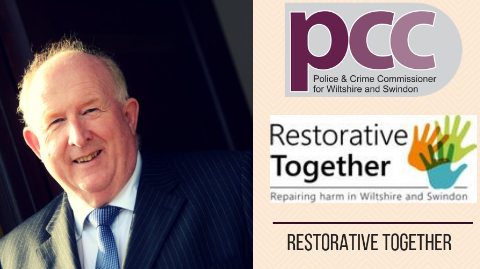
Macpherson (above) operates a Twitter account in which he has regularly issued details of his personal involvement in the police operations which followed the Skripal incident on March 4. Macpherson’s tweets – as yet unredacted – also claim personal credit for successfully negotiating an agreement with the Home Office and other central government agencies in London to pay £10 million in costs for the local police work on the Skripal case and its alleged sequel, the case of Dawn Sturgess and Charles Rowley.
Macpherson is emphatic the Wiltshire police report to him. "I am the person accountable to the people when it comes to crime and anti-social behaviour. I hold the Chief Constable [of Wiltshire, Kier Pritchard] and the force to account for how they are doing the job; and the voters in turn hold me to account."
Macpherson was asked to clarify the time the police van arrived at the Skripal house, how many officers were in the van, and how long they stayed. Through a spokesman, Macpherson replied with this email:
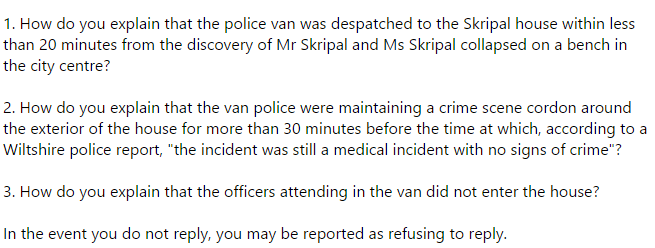
Chief Constable (CC) Kier Pritchard told the Salisbury Journal last June that officers had been sent to the Skripal house "looking for information to establish a timeline of events and explain why the Skripals had fallen 'gravely ill', as well as making sure there was nobody else affected. 'That [information] could be a suicide note, it could be evidence of drugs, it could be evidence of some form of substance, CC Pritchard added."
Pritchard also told the newspaper: "officers at the scene underwent a 'decontamination process" at Salisbury District Hospital overnight on Sunday [March 4] and into Monday morning [March 5], after details of the attack became clearer."
Pritchard did not distinguish between the police at the scene of the Skripals' collapse in the city centre and the police despatched to the Skripal house. Nor did he mean Detective Sergeant (DS) Nick Bailey; Bailey was not one of the "officers at the scene" to whom the Chief Constable was referring. The later testimony of Bailey suggests that he and one (possibly two) other police officers did not arrive at the Skripal house until late on Sunday evening, and that when they did, they came in a police car. Bailey reported to the BBC that he did not go to Salisbury District Hospital until twenty-fours after he had returned from the Skripal house to the police station, and then to his home. "By Tuesday [March 6] he was so unwell, he was rushed to hospital," the BBC reported.
One London newspaper has reported that "DS Bailey went to A&E [Accident & Emergency] and was initially discharged - but returned when his condition worsened."
Subsequent local media reports indicate that Bailey's police car, the evidence room and two individual lockers at Bailey's station Bourne Hill, were subsequently investigated by chemical warfare specialists; they have not reported finding Novichok traces. "After extensive testing and cleaning by specialist teams Defra [Department for Environment, Food and Rural Affairs] have handed Bourne Hill back to the Salisbury recovery group stressing it is 'safe to return to public use.' The deep clean focused on two areas of the building, the evidence store used by Wiltshire Police and two lockers. All other areas of the building were decontaminated as a precautionary measure."
Macpherson's refusal now to clarify discrepancies between the evidence given by the police to the press and the police incident response log contrasts with the commissioner's loquaciousness on Twitter and in the Salisbury media. After being criticized by Wiltshire critics for "draining vital police resources" on his own job and salary (£85,000), Macpherson has been tweeting to emphasize his value to the security of Wiltshire voters. On March 7, at his first press conference after the Skripal incident, Macpherson said it "appears to have happened on a quiet Sunday afternoon in our cathedral city. In the past couple of days I've been briefed regularly by the chief constable and can say with confidence that the matter has received the full support of both the police and our partner agencies in a coordinated major response. Measures necessary to ensure the safety of the public in and around the scene have also been taken."
On March 8, Macpherson tweeted: "I am pleased to hear from the Chief Constable that [Detective Sergeant Bailey] was sitting up and talking today." His record of Bailey's two-day recovery from an allegedly lethal nerve agent raised a question not intended by the commissioner at the time, intent as he was to show he was in charge. The question, not asked since, was what evidence is there that Bailey had been exposed to Novichok since the Salisbury Hospital had missed it when he first presented himself (if the report of his first decontamination and discharge was true); and since he recovered his faculties much faster than the other alleged victims?
In his tweeting over the weeks to follow, Macpherson repeated announcements on the Skripal case from the Metropolitan Police in London and the statements of Prime Minister Theresa May in parliament. For the backfile reports of those stages in the case, click to read.
Repeating what he was told as often as he did to convince Wiltshire voters that he was in command has produced a record of how the local and national authorities changed their narrative. Examined now in retrospect, Macpherson's reports of the investigation of the hospitalization of Dawn Sturgess and Charles Rowley on June 30, Sturgess's death on July 8, and the allegations from London that they were exposed to the same Novichok as had caused the collapse of the Skripals on March 4, are contradicted by what Macpherson shows he was doing himself.
For details of the Sturgess-Rowley case and the coroner's court inquest, read this.
On July 4 the BBC version of what had happened to Sturgess and Rowley reported the "man and woman are in a critical condition after being exposed to an unknown substance, which counter terrorism officers are investigating. The pair, believed to be Charlie Rowley, 45, and Dawn Sturgess, 44, were found unconscious at a house in Amesbury, Wiltshire, on Saturday. It is understood tests are being carried out on the substance at a government chemical weapons laboratory."
The BBC also reported Macpherson as denying there was any connexion to the Skripal case. "Wiltshire's Police and Crime Commissioner Angus Macpherson said the police had worked hard at 'containing any risk that might be there.' 'There's no reason to think it's connected with matters of last month,' he said. 'I haven't seen anything in this incident yet that I would consider to be an overreaction in terms of previous incidents, it all seems fairly textbook.'"
Late in the same day, the Metropolitan Police in London announced "test results from Porton Down [government chemical weapons laboratory] which show that the two people have been exposed to the nerve agent Novichok," Neil Basu, Britain's most senior counter-terrorism officer, told reporters." He added the tests confirmed the Novichok "was the same nerve agent that contaminated both Yulia and Sergei Skripal."
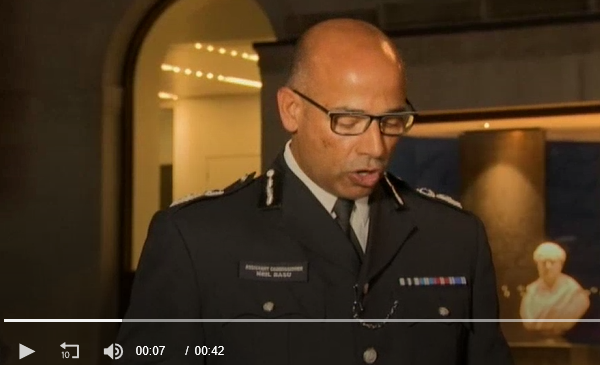
Scotland Yard’s chief of anti-terrorism operations, Assistant Commissioner Neil Basu, making his Novichok announcement on the evening of July 4. Basu also claimed: “We are not in a position to say whether the nerve agent was from the same batch that the Skripals were exposed to. The possibility that these two investigations might be linked is clearly a line of enquiry for us.”
On July 7 Macpherson tweeted that a local police officer involved in the Sturgess-Rowley incident "is seeking medical advice at Salisbury District Hospital in connection with the ongoing incident in Amesbury. This is a precautionary measure." The time of Macpherson's tweet was 1:49 in the afternoon. One hour later at 2:47, Macpherson tweeted "assessed & given the all clear." Macpherson was confirming the police officer had not been contaminated by Novichok - where and how the policeman might have been exposed the commissioner did not disclose.
Just how confident Macpherson was that there was no risk of Novichok exposure at the home where Sturgess and Rowley had fallen ill was revealed in his tweets on July 8, four days after the couple had been publicly identified by Scotland Yard as having been exposed to the same lethal nerve agent as had felled the Skripals. Macpherson tweeted that at the site of Rowley's home on Muggleton Road, Amesbury, he welcomed Home Secretary Sajid Javid, together with Chief Constable Pritchard.
This was three days before the Novichok bottle was purportedly found by the police in Rowley's kitchen.
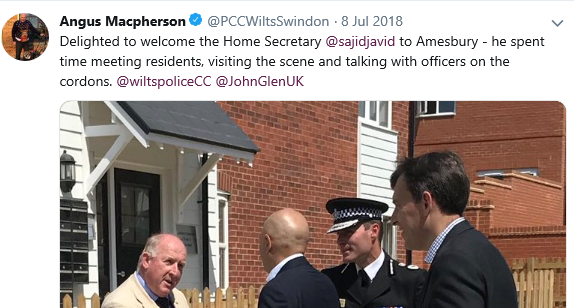
© TwitterLeft to right: Wiltshire Police Commissioner Angus Macpherson; Home Secretary Sajid Javid, and Wiltshire Chief Constable Kier Pritchard outside Rowley’s home on July 8.
On July 10, Macpherson tweeted an announcement from the chief constable: "As confirmed by the Counter Terrorism Policing Network, we now know Dawn's death is being treated as murder."
Macpherson added his statement at the same time: "I am horrified and appalled that an illegal and lethal nerve agent has been used on the streets of our county. And while the city of Salisbury has bounced back so resiliently, it saddens me greatly that Ms Sturgess, and now her family, are bearing the devastating impact of this incident. AC Neil Basu announced today that they are unable to say at this moment that the nerve agent found in this incident is linked to the attack on Yulia and Sergei Skripal. However this remains their main line of enquiry."
Three days later, on July 13, Macpherson tweeted the police announcement: "On Wednesday, 11 July, a small bottle was recovered during searches of Charlie Rowley's house in Amesbury. It was taken to the Defence, Science and Technology Laboratory (DSTL) at Porton Down, Wiltshire, for tests. Following those tests, scientists have now confirmed to us that the substance contained within the bottle is Novichok. Further scientific tests will be carried out to try and establish whether it is from the same batch that contaminated Sergei and Yulia Skripal in March - this remains a main line of enquiry for police. Inquiries are under way to establish where the bottle came from and how it came to be in Charlie's house."
Much later, on September 5, Scotland Yard's Basu announced that on July 10 police searching Rowley's kitchen garbage container had found a perfume box. The next day, July 11, according to Basu, the police had found a perfume bottle on the kitchen table. The bottle, Basu said, contained the Novichok to which Sturgess had been fatally exposed. For details of Basu's disclosure, read this.
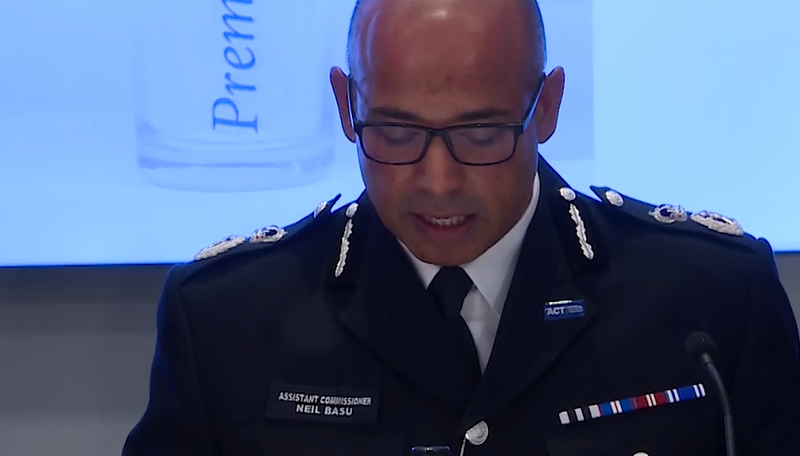
September 5, 2018: Assistant Commissioner Basu announces the police discoveries in Rowley’s kitchen of box (July 10) and bottle (July 11).
Did the evidence of the box and bottle appear after the narrative of the government in London had changed?
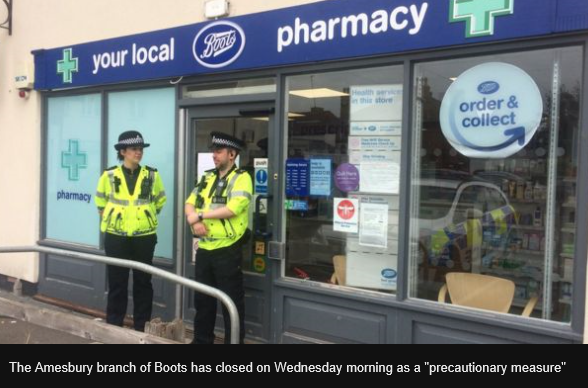
Local media reports and Macpherson's tweets indicate that on July 4, and then again on July 25 the police cordoned off a Boots pharmacy on Stonehenge Walk in Amesbury; the store is almost two kilometres from Rowley's home. A friend of Rowley's, Sam Hobson, told the police and press he had taken Rowley to the store on June 30 in order to collect a prescription for methadone, which Rowley was taking for treatment of heroin addiction. That was after Sturgess had been hospitalized in the morning, but before Rowley took ill and went to hospital in the afternoon.
© BBC
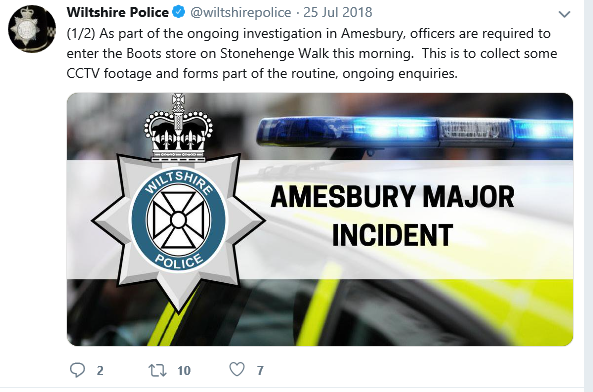
On July 25 - that is, two weeks after the box and bottle were reportedly found in Rowley's kitchen, three weeks after the police had been to the Boots store the first time - Macpherson re-tweeted a Wiltshire police announcement that they were investigating CCTV footage at Boots.
© Twitter
Local media reported on October 12 that the Boots store had been closed for four months by the police after the July 4 operation. Quoting from announcements by Boots management and the Wiltshire county council, SpireFM reported "the Stonehenge Walk store has been closed since June following the nerve agent incident. Defra [Department for Environment, Food and Rural Affairs] has announced this morning (Friday October 12th) that the clean-up process at the pharmacy has now been completed. We're told 'extensive testing' has been carried out on site to make sure the building's clean, and it's now been handed back to Boots...The store will remain closed for the time being while some maintenance work is done on site though." Boots issued a public announcement that it had re-opened on October 29.
The manager of the Boots store on Stonehenge Walk is Vincenzo Vecchio. Last week he was asked if the store stocks and sells brands of perfume. He refused to say. He was also asked what period of time was covered by the CCTV records taken by the police from the store on July 25, and whether the records have been returned. He refused again to answer, saying the press office at Boots headquarters in Nottingham would respond.
Emma Bull, a press spokesman for Boots, refused to answer the same questions.
The searches of Boots on July 4 and July 25 were for evidence that Rowley or Sturgess had been in the store and obtained products, possibly perfume there. Commissioner Macpherson and Assistant Commissioner Basu have acknowledged that they lack evidence of where the box and bottle were between March 4 and June 27; they have appealed publicly for witnesses to come forward.
Boots has come forward, but not publicly. The police have not reported what the Boots tapes show, or fail to show. If the evidence recovered on July 25 revealed the box and bottle of perfume reportedly found in Rowley's kitchen a fortnight earlier, then there would be no link between the Sturgess-Rowley case and the Skripal case.
The Novichok narrative connecting the two would be nuts.





Comment: More of Helmer's coverage of the Skripal saga: