
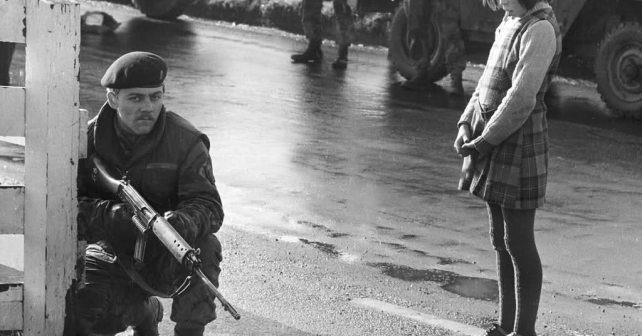
Incredibly, just as with the use of torture by the United States in its so-called War on Terror, all these actions were given official legal sanction by both the British government and judiciary. What other nation in the western democratic world would permit the legalised torture of people it claimed were its citizens? What other nation would permit the creation of torture centres for the incarceration and "processing" of people it claimed were its citizens? Well, up to the 2000s and the aftermath of 9-11.
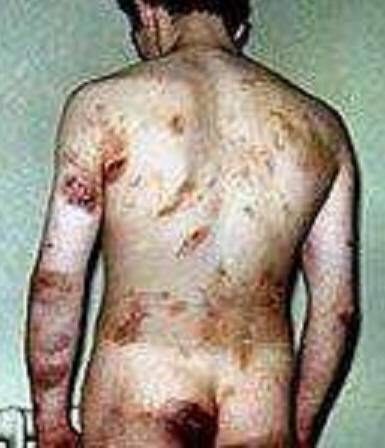
Photo taken by civil rights activists of an Irish civilian tortured by the British military interrogators in the Occupied North of Ireland, 1970s
The latest titbit is a tiny, if informative, admission from Harry Ferguson, a former agent with the British Intelligence Service or SIS (colloquially known as MI6) now turned writer and historian. Here he is in the Huffington Post UK discussing the use of torture by the United States and its proxies, when out slips this admission:
"As to the morality, British reasoning is simple: we don't use torture because it doesn't work. Like the CIA we had to learn the hard way. In Northern Ireland, IRA terrorist suspects were waterboarded in the 1970s. Even using such techniques, it took time to overcome the subject's resistance and by then the intelligence gained was virtually worthless. Intelligence is nothing if it is not timely.
Instead modern spies are taught that interrogation is a game of time - and it is something that those IRA suspects who were water boarded understood just as well. From the moment an agent is picked up and his loss is reported, the service is working to establish who and what might be compromised. Other agents will be moved, codes will be changed and, if necessary, entire operations will be closed down. You are not trying to hold out forever. You are holding out for as long as you can. You know that every minute before you break can be counted as another life saved."
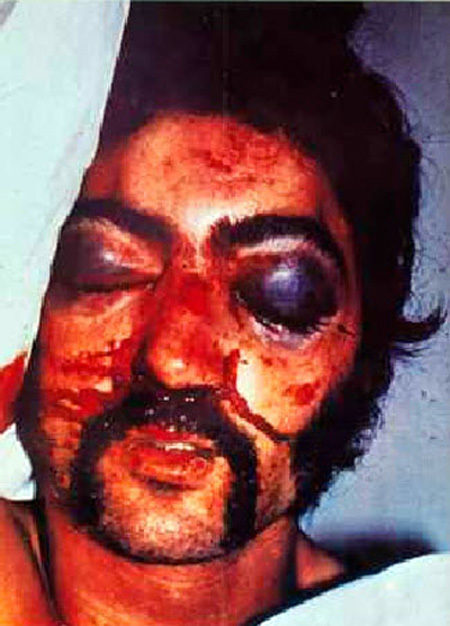
Eddie Carmichael, an Irish Republican prisoner beaten by British troops guarding the infamous Long Kesh concentration camp in October 1974
Finally, you may wonder why I use the words "formally abused" in the paragraph above? That is because the British Forces inflicted thousands of informal tortures throughout the British Occupied North of Ireland, and throughout the lifespan of the conflict. Take this recent account from the Irish singer and celebratory Brian Kennedy, describing his childhood in Belfast under the UK regime, and the casualness of abuse by Britain's troops - even against schoolchildren:
"Brian recalls how he himself felt the ire of British soldiers.He later forgave his abusers and moved on, finding indeed in Britain itself a career and liberation of sorts. Well away from the coal face of the Irish war zone, though.
'One asked me something and out of pure contrariness I started answering him in Irish. He put his gun right to my balls and he goes, 'Paddy, you better start speaking in English'.'
Did he have a hatred for the British back then?
'I hated how scary it was. They could stop you at any time and ask you were you were going, when you were coming back - and clearly I was going to school. They got into an awful habit of making you take your shoes off and socks off to search you in the freezing cold in the morning. Then they would say all these awful things about your mother, about your sister - and that was just so you could get beyond them to get to school.'"
So, that was then, and this is now. But what has changed? Have the British officially admitted the use of physical and psychological torture against thousands of Irish citizens who found themselves trapped under continued United Kingdom jurisdiction in the North of Ireland? Has the Irish government, their government, sought redress and compensation for their grievances? And what of the torturers? Not one British subject has served one day or even one minute in prison for the campaign of terror unleashed in the military and paramilitary installations in the north-east of this island nation. Indeed many have instead found themselves promoted or rewarded within the UK's Armed Forces, paramilitary police (the then RUC and its PSNI successor) and Intelligence community (MI5, MI6 and all the other acronyms).
And, to borrow a phrase from elsewhere, they haven't gone away you know.



Reader Comments
And to use torture against it's own citizens, after all, Northern Ireland..is part of the UK so we are lead to believe.
But because a country, a Nation divided, wanted to come together again as one, those that had the vision of a free Ireland, a Nation as one, were battered and tortured for those beliefs, that a Nation could be free and independent again, after what 500-400 years of occupation, a struggle since the English first set foot on Irish soil, and carved out the land, giving it to hangers of the British Court and clergy.
Are these images, a view of the past, the images, that in this day and age, shows the price for dissent comes with great suffering.
And what we call freedom is nothing more, an illusion, it is a compromise., if one does not want to end up with a face smashed to pulp, the warning signs of a totalitarian government.