
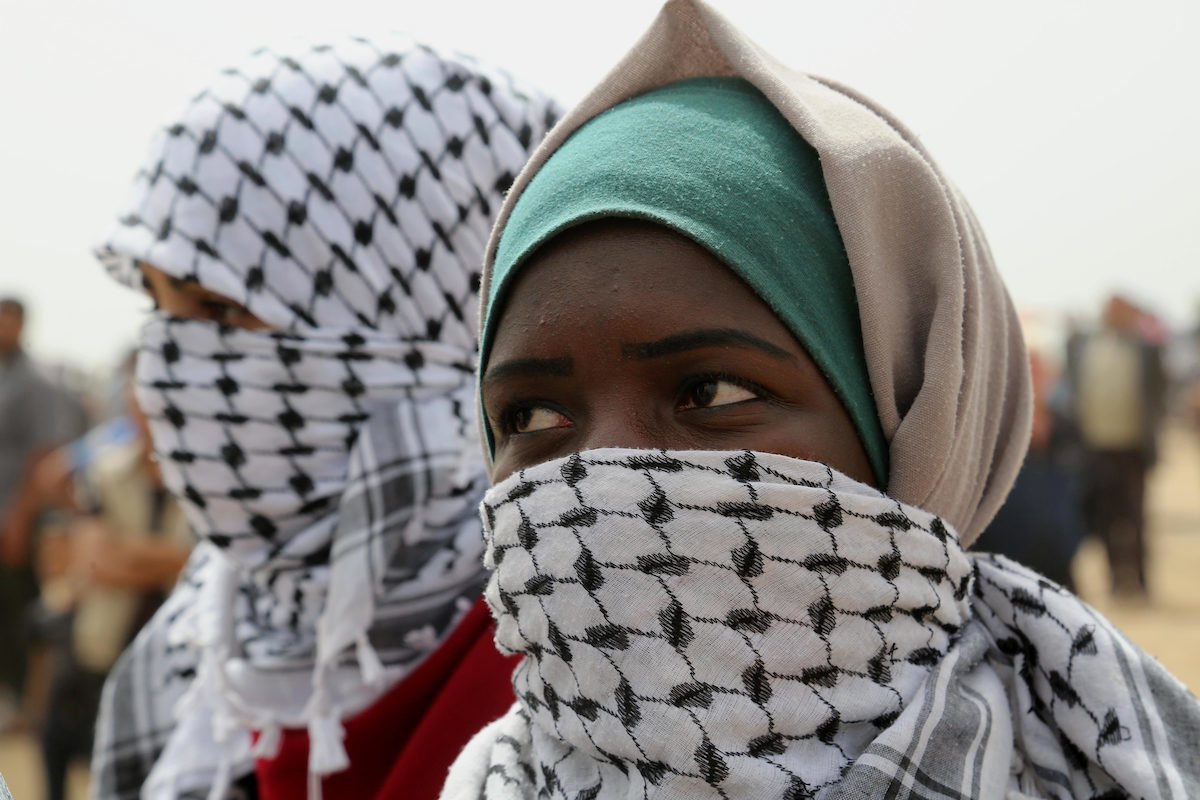
© Atia Darwish/APAA Palestinian girl during clashes with Israeli security forces at tents protest where Palestinians demand the right to return to their homeland, in east of Gaza City on April 20, 2018.
Mistakes have also been made in this effort, however, which have harmed this peaceful approach and even jeopardized its future.
The Great March of Return must go on. There is simply no alternative to peaceful popular resistance. But we also need to take a step back and think about how we can reduce its cost in lives and injuries to our people, so that we may be able to nurture and grow this new form of resistance.
Our struggle for freedom is long, and its victory will be the fruit of countless efforts and sacrifices. The occupation state has been revealed as the main perpetrator of murders and massacres, and its aim is clear: to raise the cost of the Great March of Return until we ourselves abandon this path.
Beyond this obvious interest of the occupier, however, we must also be able to engage in reflection and self-examination, to objectively assess our successes and failures to date and to narrow the space available to the occupation to attack and kill our people.
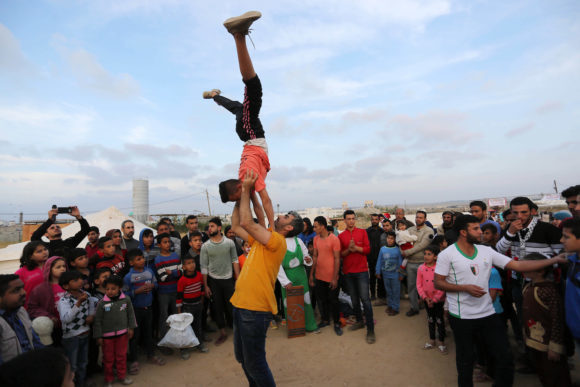
© Ashraf Amra/APAPalestinians show their skills near tents during the Great March of Return, at the Israel-Gaza border in the east of Gaza City on April 11, 2018.
Our struggle against the occupation is ultimately one of symbols and images; a battle to be waged in the global media and before the people of the world. It is this, more than any direct physical engagement with occupation forces, that can transform the broader conditions that allow the occupation to continue. And this can be done without spilling another drop of Palestinian blood.
The next phase of the Great March of Return must see an escalation in artistic, cultural and social actions. Instead of direct confrontation with occupation soldiers, the struggle should take the form of art exhibits, dance and theatre; children planting trees; university professors holding free classes in tents at the base camps; girls in our national dress; people painting, school and family trips; playgrounds and children's games; novelists and writers sharing our story with the world; musicians bringing our music to the world -all of this taking place in the return camps.
Hundreds of peaceful and creative actions can be imagined. But what will they achieve? They will show the world that we are people who love life, that we keep our national consciousness alive in our hearts, and that we are the victims of a racist occupation regime.
Let us not underestimate this goal. The occupation devotes tremendous energy to create the opposite image: that we are people who love death, who seek chaos, burning and vandalism. The occupation will continue as long as it can justify itself in the eyes of the world. That is why it cannot tolerate our peaceful march and that is why it has done everything in its power to make our march look violent. The occupier cannot simply kill us for no reason; he needs to be able to justify his killing to the world. Otherwise, he would not spend so much time and energy creating these images that explain to the world why he's killing us.
Peaceful resistance is a winning strategy because it destroys the propaganda foundation on which the occupation stands. It strengthens our moral legitimacy and our ability to develop a strong global advocacy for our just and human cause. It requires wise judgement and unwavering faith in its effectiveness. It demands continuous dedication to the work, to creativity and to minimizing harm to our people.
Now is the time to take a step back, to reflect and to plan for the future. Now is the time for the victory of peaceful Palestinian resistance.
Ahmed Abu Artema: Born in Rafah, Gaza Strip, in 1984, Ahmed Abu Artema is a Palestinian refugee. An independent Gaza-based writer and social-media activist, he has written the book "Organized Chaos" and numerous articles. He is one of the original founders and organizers of the Great Return March.



Comment: Perhaps a wise strategy, deprive the Israelis of justification for murdering or maiming protestors. However, devious and malevolent to the core, the Israelis can be expected to find (or create) reasons to continue the genocide.