
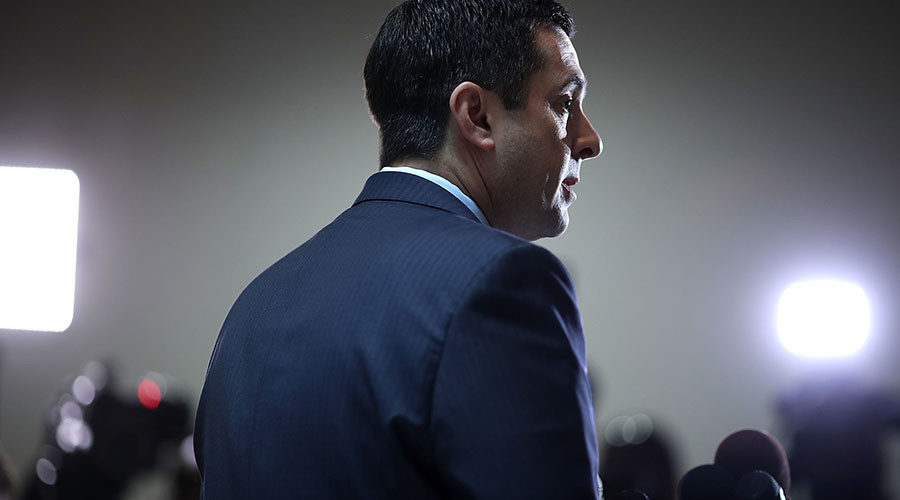
© Chip Somodevilla / AFPHouse Permanent Select Committee on Intelligence Chairman Devin Nunes
House Intelligence Chairman Devin Nunes (R) and ranking member Rep. Adam Schiff (D), both of California, agreed on the terms of the investigation, according to an announcement Wednesday evening.
The statement listed four queries:
- "What Russian cyber activity and other active measures were directed against the United States and its allies?"
- "Did the Russian active measures include links between Russia and individuals associated with political campaigns or any other U.S. Persons?"
- "What was the U.S. Government's response to these Russian active measures and what do we need to do to protect ourselves and our allies in the future?"
- "What possible leaks of classified information took place related to the Intelligence Community Assessment of these matters?"
Comment: 1) Everyone spies on everyone. Get over it. 2) U.S. persons and campaigns have "links" with most countries. Get over it. 3) Reasonable. 4) Russian leaks? Easy: none. Insider leaks? You betcha.
The committee's probe will consist of interviews, witness testimony, and a "review all reporting underlying the Intelligence Community Assessment (ICA) 'Russian Activities and Intentions in Recent US Elections,'" the announcement said.
Earlier Wednesday, the Associated Press reported that the Trump administration and staff had been instructed by White House attorneys to maintain records that could be relevant to such an investigation.
Comment: AP reports:
The instructions, which were sent to White House staff on Tuesday, come after Senate Democrats last week asked the White House and law enforcement agencies to keep all materials involving contacts that Trump's administration, campaign and transition team — or anyone acting on their behalf — have had with Russian government officials or their associates.
The Senate intelligence committee, which is investigating Russia's role in the 2016 election, has also asked more than a dozen organizations, agencies and individuals to preserve relevant records.
The three administration officials who confirmed that White House staffers were instructed to comply did so on the condition of anonymity because they were not authorized to publicly disclose the memo from White House counsel Don McGahn.
...
A Trump spokesman said the White House was "simply taking proactive steps" and called the accusations of nefarious ties between the president and Russia "false and politically motivated attacks."
Congressional staffers have said they are not aware of any evidence that materials related to Russia are not being preserved. But Senate Democratic leader Chuck Schumer of New York said last week: "There is real concern that some in the administration may try to cover up its ties to Russia by deleting emails, texts and other records that could shine a light on those connections. These records are likely to be the subject of executive branch as well as congressional investigations and must be preserved."
Trump has denied having any knowledge that aides were in touch with Russian intelligence agents during the election, as reported by The New York Times. The White House has launched an aggressive effort to discredit the report, including enlisting GOP chairmen of the congressional intelligence committees to push back against it.
The involvement of North Carolina Sen. Richard Burr and California Rep. Devin Nunes has sparked calls — mostly from Democrats — for a special prosecutor to investigate Russia's role in the election and possible ties to Trump.
The White House has acknowledged that Michael Flynn, Trump's former national security adviser, misled top officials about the nature of his contacts with Russia's ambassador to the U.S. Flynn initially told Vice President Mike Pence and other Trump advisers that he did not discuss sanctions with the envoy during the transition, though it was later revealed that he did.
The FBI interviewed Flynn about the contacts days after the inauguration. Trump fired Flynn after the discrepancies in his account were publicly revealed.
Late Wednesday evening, House Minority Leader Nancy Pelosi (D-California) released a statement calling on US Attorney General Jeff Sessions to resign over statements he made to the Senate during his confirmation process.
"Jeff Sessions lied under oath during his confirmation hearing before the Senate. Under penalty of perjury, he told the Senate Judiciary Committee, 'I have been called a surrogate at a time or two in that campaign and I did not have communications with the Russians.' We now know that statement is false," Pelosi wrote.
Unnamed Justice Department officials told the Washington Post on Wednesday that Sessions spoke to Russian Ambassador to the US Sergey Kislyak twice last year, which would contradict statements Sessions made as US senator during Senate hearings for his confirmation to the Attorney General post.
During his Senate judiciary committee hearing in January, Sessions told Senator Al Franken (D-Minnesota) that he "did not have communications with the Russians" after being asked what he would do if he found there had been conversations between individuals in the Russian government and the Trump campaign relevant to the election.
"I'm not aware of any of those activities," Sessions said.
Sessions responded, "No," when asked by Senator Patrick Leahy (D-Vermont) if he'd had contact with anyone connected with the Russian government "about the 2016 election, either before or after election day?"
"He was asked during the hearing about communications between Russia and the Trump campaign — not about meetings he took as a senator and a member of the Armed Services Committee," Sessions spokeswoman Sarah Isgur Flores told the Washington Post.
The US intelligence community has assessed that Russia conducted cyber operations to benefit Trump and hurt Hillary Clinton during the 2016 presidential campaign.
Russia has denied accusations of meddling in the 2016 US election, and the Trump administration and campaign has done the same against allegations it had ties to Russia.



Comment: The "leaks" keep on coming. FakeNews NYT is reporting: Yawn. As for Sessions' contacts: These people are paranoid.