
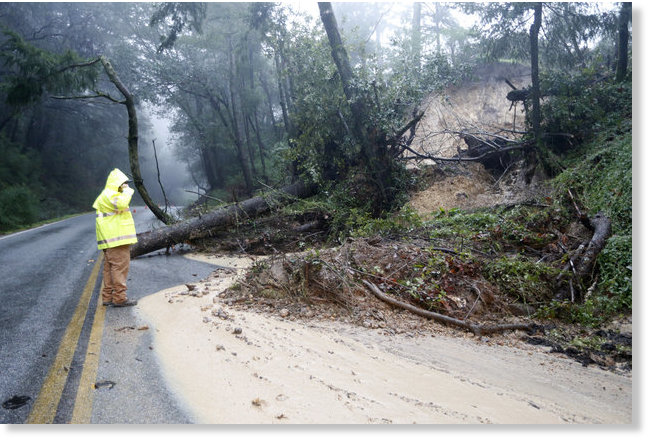
© Josie LepeA Santa Clara County Roads and Airport Department worker responds to the scene of downed tree and mudslide on Summit Road in the Santa Cruz Mountains, Calif., Sunday, Jan. 8, 2017.
Crews in California cleared trees and debris Sunday following mudslides caused by steady rain accompanying the system that could dump 15 inches in the foothills of the Sierra and heavy snow on the mountain tops before it's expected to move east early Monday. Forecasters warned a second storm is expected to hit the already drenched area Monday night.
In Nevada, emergency officials voluntarily evacuated a total of 400 homes affecting about 1,300 residents in a south Reno neighborhood Sunday afternoon as the Truckee River began to leave its banks and drainage ditches started to overflow south of U.S. Interstate 80.
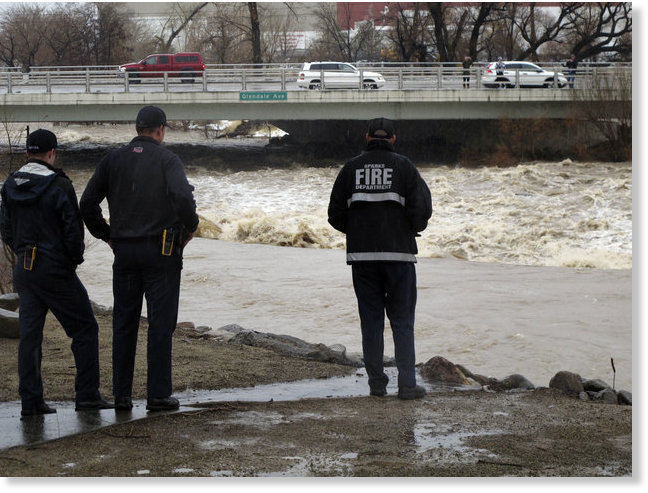
© Scott SonnerSparks firefighters monitor the rising Truckee River, Sunday, Jan. 8, 2017, where it runs near the Grand Sierra hotel-casino along a line that divides the cities of Reno and Sparks, Nev.
This is a serious flood situation," the National Weather Service said in a special flood statement late Sunday night. Flood warnings continue along much of the Sierra's eastern front and western Nevada into Tuesday
No injuries had been reported, but high waters forced the closure of numerous area roads, a series of bridges in downtown Reno and a pair of Interstate 80 off-ramps in neighboring Sparks, where the worst flooding is expected to send several feet of water early Monday into an industrial area where 25,000 people work.
Bob Elsen of Sparks said he saw plenty of wet weather in his former hometown of Bremerton, Washington, but he didn't expect it in Nevada's high desert where only 8 inches of precipitation falls annually on average.
"I don't think I've seen this much rain since I moved here six years ago," Elsen said as he watched the Truckee River's waters rise in Sparks. "It's why I moved out of Washington to get away from this stuff."
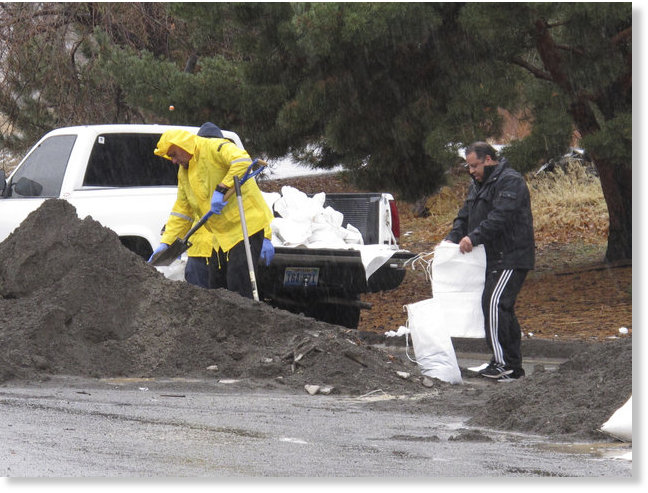
© Scott SonnerLocal residents braved the heavy rain to fill sandbags on Sunday, Jan. 8, 2017, near the Truckee River in Sparks, Nev.
Schools were ordered closed Monday throughout the Reno-Sparks area. Gov. Brian Sandoval — who declared a state of emergency on Saturday — told all non-essential state employees to stay home Monday.
"All first responders are all hands on deck," Washoe County Emergency Manager Aaron Kenneston told reporters at a briefing in Reno Sunday afternoon.
Bob Leighton, the Reno Fire Department's chief of emergency operations, called it "a very dynamic situation that's happening so fast it's hard to keep up with the road closures."
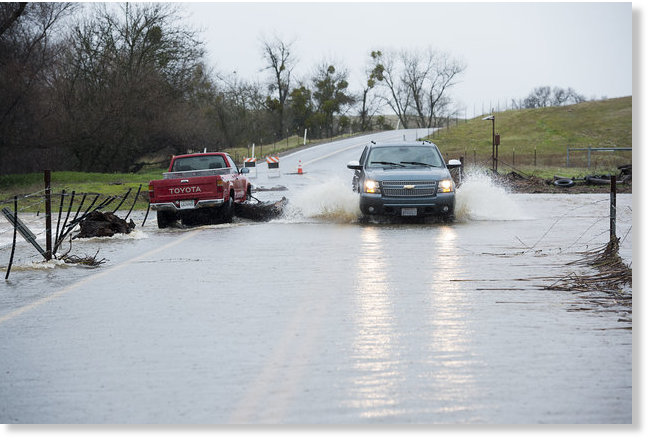
© Paul Kitagaki Jr.A vehicle drives past a truck struck on a log Sunday, Jan. 8, 2017, near Rancho Murieta, Calif.
In Northern California, toppled trees on Sunday crashed against cars and homes or blocked roads in the San Francisco Bay area, and officials rescued stranded motorists from cars stuck on flooded roads on Sunday. A giant tree fell across the southbound lanes of Interstate 230 in Hillsborough, injuring one driver who couldn't break in time and drove into the tree. A woman was killed Saturday by a falling tree while she took a walk on a San Francisco Bay Area golf course.
A well-known giant sequoia tree known for the huge tunnel carved through it that was once used by cars has toppled in Calaveras Big Trees State Park in Calaveras County. The San Francisco Chronicle reports the historic Pioneer Cabin tree came down during heavy rains on Sunday.
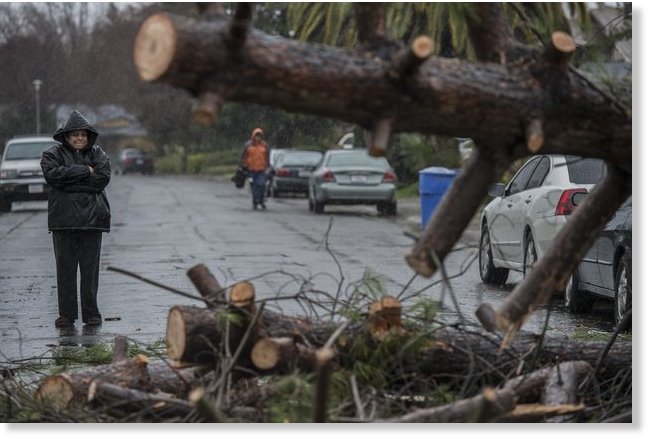
© Renee C. ByerRosie Salazar stands on Amapola Street after alerting neighbors that a tree had fallen and crushed two cars Sunday, Jan. 8, 2017, in Sacramento, Calif.
Farther north, the U.S. 395 highway was temporarily closed in both directions in Mono County because of flooding and two major highways across the Sierra Nevada were partially closed because of mudslides.
The California Highway Patrol's Truckee office said all westbound lanes of Interstate 80 near Donner Lake Road in Donner Lake were closed indefinitely because of a large mudslide Sunday evening. The westbound lanes of Highway 50 near Kyburz are also blocked by a mudslide.
Authorities were watching rising water levels of several rivers, including the Cosumnes, Truckee, Merced, American and Russian.
All roads leading to Yosemite National Park's valley floor remained closed amid fears that the Merced River could overflow its banks and cause major flooding.
"It's kind of surreal how empty the park is. There's nobody here," said Gary Kazanjian, a freelance photographer who spent the night in Yosemite and drove out Sunday as part of a caravan of stragglers.
At the Santa Cruz Diner in downtown Santa Cruz customers kept the crew relatively busy. Manager Garin Peck said the restaurant was quiet Saturday but Sunday was a typical day for the diner near the San Lorenzo River.
"A lot of people expected the storm to be a lot bigger and stayed home Saturday night" Peck said. "We were expecting a little more from the storm but so far there haven't been any major problems. I have seen a lot worse."
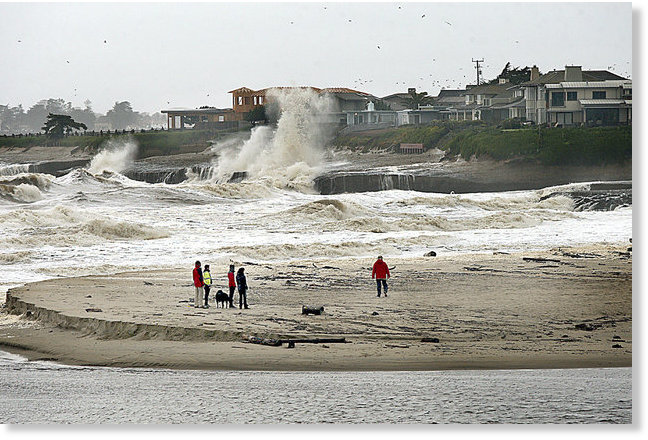
© Dan CoyroRoiling storm waves pound the rock ledge of Santa Maria Cliffs a few hours before high tide, Sunday, Jan. 8, 2017.
Relatively mild temperatures were driving up the snowline to above 9,000 feet throughout the Sierra Nevada, causing runoff in the lower elevations, where the ground is already saturated. Forecasters said Sunday it was tracking pretty much as they expected.
"For forecasters who've been here a decade or more, this is one of the most impressive atmospheric setups that we have seen in a long time for potential flooding in the region," said Chris Smallcomb, a National Weather Service meteorologist in Reno. "If you had to write a textbook on how to get a flood in the region, you would use a scenario just like this."
__
Rodriguez reported from San Francisco. Associated Press writer Christopher Weber in Los Angeles and Rebecca Boone in Boise, Idaho, contributed.
Source: Associated Press



Reader Comments
to our Newsletter