
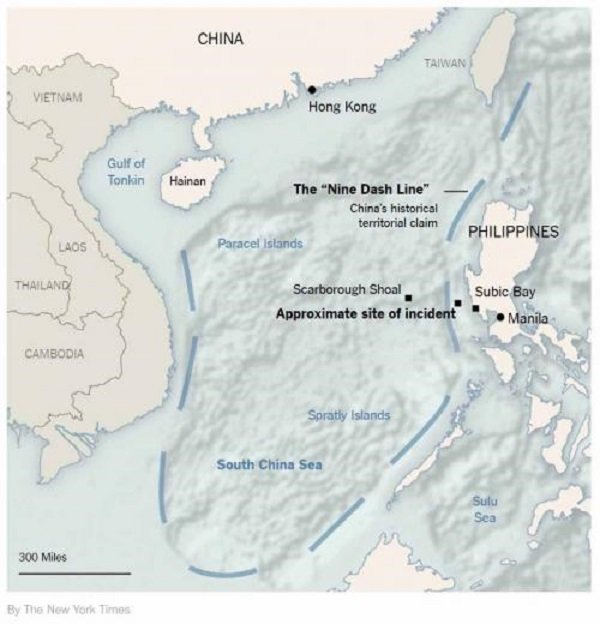
© New York Times
Quoted by Bloomberg, McCain, head of the Senate Armed Services Committee, told CNN's State of the Union that "The Chinese are able to do a thing called reverse-engineering, where they are able to - while they hold this drone, able to find out all of the technical information. And some of it is pretty valuable."
Comment: Like maybe finding out it was more than an "oceanographic" expedition.
McCain said China's seizure was "a gross violation of international law," echoing the prevailing U.S. response and Trump's initial blast via a tweet. The president-elect told his 17.5 million Twitter followers: "China steals United States Navy research drone in international waters - rips it out of water and takes it to China in unprecedented act."
His comments highlighted the U.S. political tensions touched off by China's decision to scoop up the submersible in international waters, which was not even located within the confines of the contested nine-dash line. Assurances from China that the vessel would be returned failed to quiet U.S. critics -- including Trump, who initially denounced the snatch-and-grab move and then reversed himself hours later. Trump said on Twitter late Saturday that "We should tell China that we don't want the drone they stole back - let them keep it!"
Asked about the tweet, Trump's communications director, Jason Miller, said on Fox News Channel that China was likely to return "a chunk of metal and maybe a bag of wires" after holding the drone for several days.
While the tensions unleashed by the episode underscored the delicate state of relations between the two countries, weeks before Trump's inauguration, they were merely the latest escalation in the growing conflict over whose geopolitical sphere of influence has legitimacy over the contest South China Sea zone, an area rich in resources and a critical nexus point for global naval commerce.
In the war of words that resulted following the capture of the drone, both sides laid out their cases clearly: "China is very sensitive about unmanned underwater vehicles because they can track our nuclear ballistic missile submarines fleet," said retired Major General Xu Guangyu, a senior researcher at Beijing-based research group the China Arms Control and Disarmament Association. "If one from the Bowditch can be detected and even snatched by a Chinese naval ship, it shows it's getting too close to the sensitive water areas." Meanwhile, in its statement Friday confirming reports that the drone had been captured, the Pentagon described it simply as "an unclassified 'ocean glider' system used around the world to gather military oceanographic data such as salinity, water temperature, and sound speed."
However, while the diplomatic spat between China and the US will likely not be resolved any time soon, and the seizure of the naval drone will simply add to the list of complaint vocalized by both sides, a more troubling diplomatic cascade may emerge if, as the NYT reports, US allies in China view Washington's response as "muted."
Only a day before a small Chinese boat sidled up to a United States Navy research vessel in waters off the Philippines and audaciously seized an underwater drone from American sailors, the commander of United States military operations in the region told an audience in Australia that America had a winning military formula. "Capability times resolve times signaling equals deterrence," Adm. Harry B. Harris Jr., told a blue chip crowd of diplomats and analysts at the prestigious Lowy Institute in Sydney, Australia, the leading city in America's closest ally in the region.In a repeat of the "Russian hacking" incident, which exposed a weak Obama administration unable to respond in any effective way to what it has dubbed a gross violation by the Kremlin, the NYT added that across Asia, diplomats and analysts said they were "perplexed at the inability of the Obama administration to devise a strong response to China's challenge. It did not even dispatch an American destroyer to the spot near Subic Bay, a former American Navy base that is still frequented by American ships."
In the eyes of America's friends in Asia, the brazen maneuver to launch an operation against an American Navy vessel in international waters in the South China Sea about 50 miles from the Philippines, another close American ally, has raised questions about one of the admiral's crucial words. It was also seen by some as a taunt to President-elect Donald J. Trump, who has challenged the "One China" policy on Taiwan and has vowed to deal forcefully with Beijing in trade and other issues.
"The weak link is the resolve, and the Chinese are testing that, as well as baiting Trump," said Euan Graham, director of international security at the Lowy Institute. "Capability, yes. Signaling, yes, with sending F-22 fighter jets to Australia. But the very muted response means the equation falls down on resolve."
The end result, analysts said, is that China would be emboldened by having carried out an act that amounted to hybrid warfare, falling just short of provoking conflict, and suffering few noticeable consequences.
"Allies and observers will find it hard not to conclude this represents another diminishment of American authority in the region," said Douglas H. Paal, vice president for studies at the Carnegie Endowment for International Peace.
It also means that the US is willing to acknowledge the decline of its regional influence even as China's grows by the day:
As China has built up its navy and its submarine fleet in the last decade, it has also emphasized what it calls its "inherent" right to dominate the regional seas, and to challenge the presence of the United States, its allies and partners in Asia.And while the outgoing Obama administration may simply not have any desire to get further involved in any escalating diplomatic entanglements with China (or Russia) over territorial disputes (or hack allegations), the same can hardly be said for the Trump administration. We, and the entire market, look forward with great interest to the president-elect's response following the next mini diplomatic spat to emerge between China and the US, which following the latest geopolitical staredown between China and the US, which saw the latter averting its gaze first, is guaranteed to follow in short notice.
The drone incident, which occurred Thursday, and was first broadcast by CNN despite efforts by the Obama administration to settle it quietly, was of a different nature and just as disquieting as past confrontations with China that involved bigger ships and more dangerous maneuvers, analysts said.
In 2001, soon after President George W. Bush came to office, an American spy aircraft, an EP-3, was forced to land on Hainan Island after colliding with a Chinese fighter jet. The Chinese stripped the plane of all its assets and returned it broken down to its parts and packed in boxes.
In 2009, two months after President Obama took office, Chinese vessels swarmed a United States Navy reconnaissance ship, the Impeccable, in what the Pentagon said were dangerous and unprofessional maneuvers.



LOL! I can imagine Jihadi John McCain having seizures over this incident, but that's his job and he does it well.
Given that China has had access to most American technology over the past twenty years, there is probably little in the way of proprietary technology on board that drone. As the SOTT comment suggested, the only thing China might find are tracking logs of their own subs and ships, which although is not unexpected, can certainly be used against the U.S. during bargaining.
For example; It's only been recently that the U.S. military has stopped using Chinese electronics in U.S. war machines and the Chinese fighter jets coming off the line look a lot like the U.S. F22 and F35 fighters.