
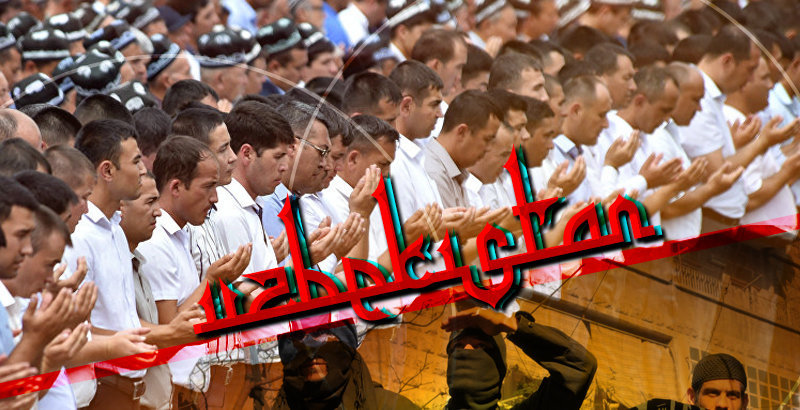
The history of Uzbekistan after the break-up of the former Soviet Union in the early 1990s is replete with ethnic division, civil strife and Islamic militancy. It is widely acknowledged that only the successful, yet often repressive leadership of one man, Islam Karimov, has been able to keep the nation together. Islam Karimov ruled the nation for over 26 years, and his death on September 2nd, 2016 now casts doubt on any potential successor's ability to keep the nation from fragmenting along ethnic, religious and geographic lines.
The Fergana Valley, a fertile valley that is also a major strategic gateway in Central Asia that straddles the old Silk Road, has been a hotbed of Islamic militancy and ethnic strife for generations. A number of Islamic terrorist organizations have found their genesis in this region since 1991, including the Islamic Movement of Uzbekistan (IMU). The IMU has been active in the neighboring countries of Pakistan, Afghanistan, Kirghizstan, and Tajikistan. The IMU has splintered into pro-ISIS and pro-Taliban factions over the past decade, and continues to pose a destabilizing force to the future of Uzbekistan and all of Central Asia.
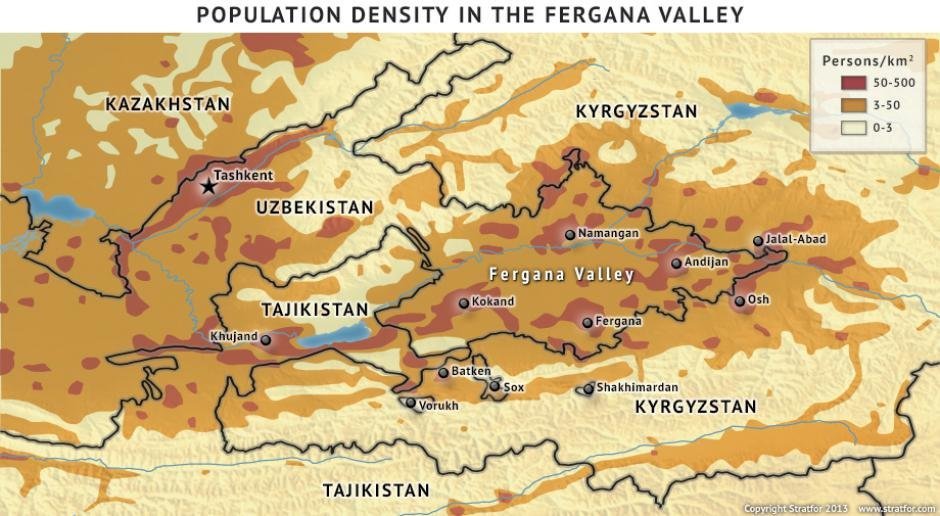
The Fergana valley is a hotbed of Islamic fundamentalist activity and a strategically important crossroads for all of Central Asia. This fertile valley is densely populated in comparison to the surrounding dry and arid Kyrgyzstan and Tajikistan that surround it, as well as the bottleneck of land that connects it to the rest of Uzbekistan to the West.
Brief History
The Republic of Uzbekistan became an independent nation in 1991. Islam Karimov had been the leader of the Uzbek Soviet Socialist Republic prior to the dissolving of the Soviet Union, assuming the post in 1989, and continued on as its president upon independence in 1991. Often criticized in the west as a post-Soviet dictator, Karimov actually had moved to improve relations with the U.S. and NATO following the events of September 11th, 2001. Karimov allowed NATO the use of the Karshi-Khanabad airbase to aid efforts in invading and occupying Afghanistan during Operation Enduring Freedom. The airbase would prove a key logistics asset in pursuit of U.S. efforts.
In his ongoing struggle to maintain the nation as an Islamic, yet secular state, Karimov found himself often at odds with a devout Islamic population, powerful tribal infighting, and the harmful, yet ever present influence of Islamic fundamentalism. These forces all coalesced, culminating in 2005 with a fateful tragedy in the city of Andijan. A general uprising in the city was crushed by the SBN and Army troops when they opened fire on allegedly unarmed protesters. Official reports state that 187 protesters were killed, but the actual number (according to some media reports) may have exceeded 1,000 dead. The United States responded to the incident with strong criticism in bilateral communications and through the United Nations. Karimov interpreted the U.S. actions as a stab in the back, and demanded that the U.S. led NATO forces vacate the Karshi-Khanabad airbase within 6 months. All NATO forces left the base by November, 2005.
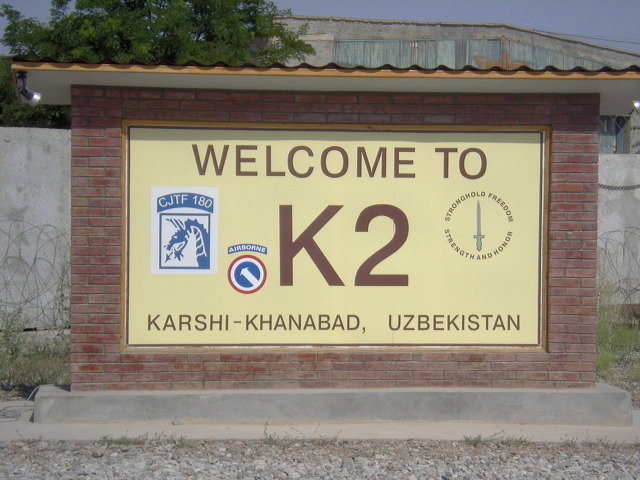
U.S. and NATO military assets were based at Karshi-Khanabad airbase (dubbed K2) for a period of approximately four years in support of NATO operations in Afghanistan. They departed the base in November of 2005.
Islamic Fundamentalism
Uzbekistan has been plagued by the specter of Islamic fundamentalism and terrorist organizations since its independence. Although Islamic fundamentalism existed prior to independence, it did not gain much traction until just before the fall of the USSR and the turbulent years that followed. In the turbulent 1990s, a number of notable Islamic groups that desired the overthrow of the secular state and the establishment of a greater "Turkestan" Islamic Caliphate in Central Asia were established. Most notable are the Islamic Movement of Uzbekistan (IMU) and the Islamic Jihad Union (IJU). Both groups have perpetrated attacks against the government of Uzbekistan and have found sanctuary in neighboring countries.
The Islamic Movement of Uzbekistan is an internationally recognized terrorist organization that has been in a state of flux since its inception. Plagued by infighting and fractious loyalties in recent years, it is still very much a threat in light of the power vacuum that may come in the wake of Islam Karimov's death. Karimov fought the IMU, and used it as an excuse to persecute anyone that threatened government control of religion, for the entire 27 years he was in power. The movement attempted to assassinate him in 1999, amongst a host of other terrorist bombings, including suicide bombings, over the past twenty seven years. Karimov's strong man rulership kept the lid on the radical Islamist bottle, and for most of his presidency, the IMU has been forced to find refuge in neighboring states, most notably Afghanistan and Pakistan, while launching attacks sporadically across the border.
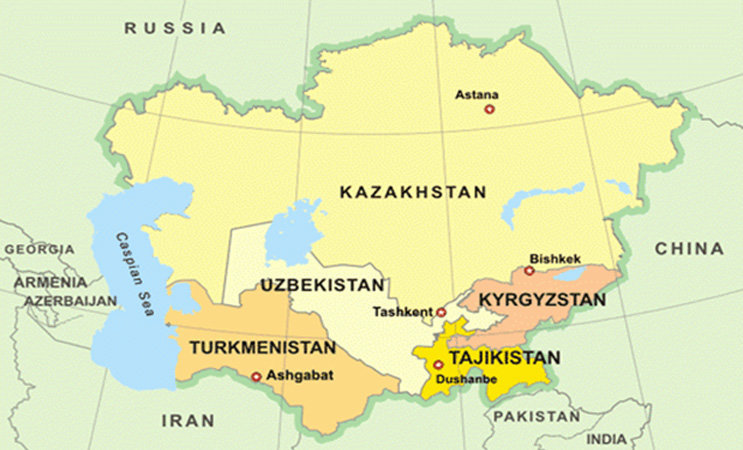
Uzbekistan lies in the center of Central Asia, and along the East-West transit corridor between China and Europe.
IMU leader Usmon Ghazi declaring allegiance to Islamic State in August, 2015. This fractured the IMU once again, and has led to much infighting and bloodshed between the Taliban, IMU and IS in Afghanistan
There is no doubt that Islamic fundamentalist groups such as the IMU and IJU will attempt to take advantage of any power vacuum or internal struggle created in the wake of President Karimov's death. Many members of these terrorist groups have been fighting in Afghanistan and Syria over the past decade and a half, and have been battle hardened and further pushed down the road of Islamic fundamentalism and zealotry. International intelligence services and independent analysts are all in agreement that the security services of Uzbekistan are going to be challenged by these groups, as well as a number of other possible indigenous and foreign based threats, in a challenge to the long standing political power structure and social cohesion of the state in the coming year.
The Armed Forces
Although larger and better equipped than most of its neighbors, the Armed Forces of the Republic of Uzbekistan are far from a modern, well-oiled military machine. Is the Uzbek military up to the task of providing for the security of the state against both internal and external threats? The answer is yes, and no. The Uzbek armed forces can defend the nation against any regional conventional force most likely to threaten the sovereignty of the state; however, the most likely threats to the state in the near future will not come from neighboring governments, and will be anything but conventional.
The Uzbek Armed Forces are primarily comprised of Soviet-patterned Motorized Rifle Brigades supported by independent Artillery Brigades, a number of airborne units, including one Air Assault/Airborne Brigade. These are supplemented by an unknown number of independent motorized units, Border Guard forces, as well as the three SBN controlled Spetsnaz battalions.
Tashkent Military District
Possibly one Artillery Brigade comprising of BM-21 Grad and BM-27 Uragan rocket artillery are assigned to the district. Tashkent is the capital of Uzbekistan, and the Tashkent HQ most likely relies more on Spetnaz and SBN forces for security and national defense concerns. Uzbekistan maintains a number of 2S7 Pion 203mm self-propelled guns and Tokcha ballistic missile launchers in its active TO&E, and these units are likely to fall under the command of Tashkent HQ.
Central Military District
One Motorized Rifle Brigade and one Artillery Brigade. As well as guarding the nation against any immediate incursion from the nations of Afghanistan, Turkmenistan and Tajikistan, the units of the Central Military District cover the confluence of national borders (most volatile of which is the border with Afghanistan) and serve as a strategic reserve to the Eastern Military District.
Eastern Military District
One Motorized Rifle Brigade, one Air Assault/Airborne Brigade and one Artillery Brigade. Without a doubt the most precarious region of the nation to defend and the most prone to internal strife and possible invasion, due to the strategic importance of the Fergana Valley. The military units responsible for defending the Eastern Military District are reinforced with a number of Border Guard units and SNB reinforcement.
Northwest Military District
One Motorized Rifle Brigade. Afforded the natural barrier of the Aral Sea and only one nation on its northwestern border, the Northwest Military District is the most secure.
Southwest Military District
One Motorized Rifle Brigade. Bordering Turkmenistan to the south, and supporting the Central Military District. It is important to note that this border is perhaps the most prone to illicit drug traffic originating in Afghanistan.
© U.S. Air Force Photo by Tech. Sgt. Scott T. SturkolUzbekistan Air Force maintenance personnel tow an Uzbekistan Air Force Su-24 Fencer fighter aircraft at Karshi-Khanabad Air Base, Uzbekistan, on Feb. 14, 2005, during Operation Enduring Freedom.
National Security Services
Though the Republic of Uzbekistan Armed Forces are perhaps one of the most capable in the region in real terms (total personnel, equipment, etc.), President Karimov directed far more funding, training and political focus toward the internal security apparatus of the state. Foremost among these assets is the National Security Service (NSS or SNB). Subordinated to the Interior Ministry since 2005, the SNB fills a similar function to the state as the CIA or the FSB. Much like the FSB, the SNB controls a number of Spetsnaz units, which it can utilize in a number of roles, including counter-insurgency, counter-terrorism, drug interdiction and a whole host of intelligence and paramilitary activities.
There are three Spetsnaz battalions under the jurisdiction of the SNB; Alfa, Bars and Scorpion. These units have been utilized by the SNB to interdict drug traffickers illegally entering Uzbekistan from neighboring countries, and more importantly, to raid and destroy Islamic militant strongholds and safe houses within the country and along the frontier. The Spetsnaz battalions are organized along Russian lines, their organization and equipment being quite similar. These units provide the SNB with a viable tool to strike at IMU and IJU militants before they are able to conduct terrorist operations.
© APUzbekistan National Security Service officers stand guard, as drugs are burnt behind them, at a plant on the outskirts of Tashkent, Uzbekistan’s capital, Thursday, June. 26, 2014.
Although the United States and other Western nations have chastised the often heavy-handed tactics of the SNB in its never ending struggle to insulate the state from Islamic militancy, both internally and externally, there is no doubt that these tactics have been successful over the past 27 years. President Islam Karimov relied on a close circle of trusted leaders, mostly from the "Tashkent Clan", and a strong SNB, to rule over the ethnically divided and religiously charged nation. Many analysts believe that the most likely successors to Islam Karimov are Prime Minister Shavkat Mirziyoyev, or the head of the SNB, Rustam Inoyatov. Always a power behind the scenes, and extremely secretive Rustam Inoyatov will most likely decide to remain out of the spotlight, letting someone else appear as the public head of state. He will continue to wield a great deal of power regardless.
Stability or Anarchy
The future of Uzbekistan, whether it holds the promise of continued stability or explodes into anarchy, largely depends upon the ability of the national leadership to maintain a strong sense of national identity among all Uzbeks, regardless of ethnicity, and to minimize the influence of Islamic militant groups within the country. The very fact that approximately 500 to 600 Uzbek militants are fighting with a number of groups in Syria, including with Islamic State and Imam Bukhari Jamaat, does not bode well for the long term stability of Uzbekistan. There is no getting around this problem, and it will have to be addressed in the near future. This is a shared reality for most Central Asian nations.
Syria has provided Islamic militants from Central Asia with a perfect training ground where they can gain combat experience, learn and perfect the manufacture and utilization of explosives, and to establish a more extensive international support network. In such a zealous environment, where Islamic radical groups from around the world are free to practice the most violent and corrupt version of Islam, these fighters will continue further along the road of radicalization. Regardless of the outcome in Syria, there is no doubt that the internal security forces and the military of Uzbekistan will have to contend with the return of a large number of increasingly radicalized terrorist cells. It is just a matter of when. If an injection of such radical forces coincides with a power vacuum arising from President Karimov's death, the SNB will be faced with a very dire scenario.
In the immediate future, Uzbekistan is likely to experience increased government repression and total intolerance for any form of civil protests. The SNB is already increasing its counter intelligence and anti-terrorism activities, and is undoubtedly increasing surveillance of Islamic fundamentalists and separatists of all stripes within the nation and abroad. Any bloody confrontation reminiscent of the Andijan Massacre will be seized upon by the IMU and like-minded groups to foment unrest in the general population, and will lead to a renewed call to jihad. After years of fierce fighting in Syria, Uzbekistan may seem a soft target to many such Islamic terrorist groups.
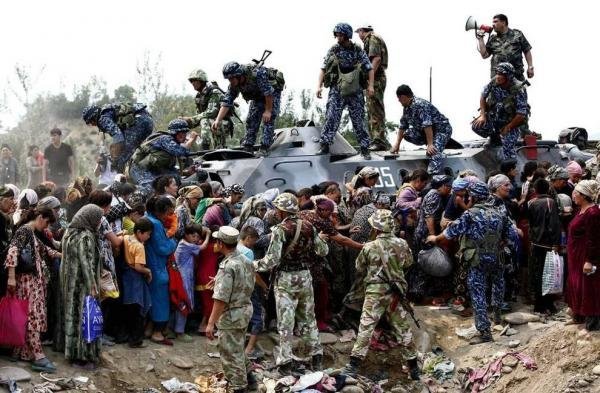
Kyrgyzstan security forces intervene to stop clashes between Kyrgyz and Uzbek groups in Osh, on the border between the two nations on the eastern edge of the Fergana valley. Ethnic conflict in the region is a constant threat to stability.
The Republic of Uzbekistan stands at a crossroad. Either the nation embraces the stability of a secular government, and subordinates ethnic differences and religious life from public governance, or the people of the nation embrace the fragmentation of the state along ethnic and theocratic divisions. Regardless, the full force of Inoyatov's SNB will be harnessed to insulate the state from the growing threat of Islamic fundamentalism. Ironically, Uzbekistan now stands threatened by the radical forces that it deposed and deported years ago. The IMU and its many factions and offshoots have only grown in number and capability in the intervening years. Now they are poised to return home, emboldened and empowered.
The fate of Uzbekistan may seem inconsequential to many. It is a poor country in the middle of Central Asia; however, in many ways it stands out as a singularly important domino, poised to be tipped over. The threat of Islamic Fundamentalism has been growing in Central Asia, held back by a multi-faceted defense strategy that utilizes many conventional and asymmetric components. The pivotal battle that is being waged in Syria will have a profound effect on the future of the entire region and the world. If the national leadership falters and the citizens of Uzbekistan fall to the destructive and murderous siren call of Islamic fundamentalism, all of Central Asia could descend into chaos.


Comment: See also: