
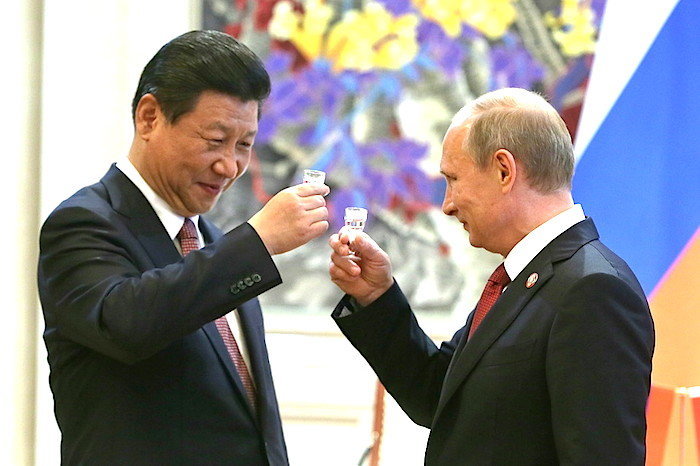
© ITAR-TASS/ZUMA PRESSPresident Xi Jinping and President Vladimir Putin: "Here's to the West."
According to the latest poll conducted by the independent research center Levada, about 40 percent of Russians are concerned about ongoing international isolation of their country. In early March 2014, soon after the international sanctions against Russia were introduced for the first time, this share was significantly larger at 56 percent. However, the decrease of concerned Russians could be explained by the fact that currently 43 percent of respondents think that sanctions have only had an insignificant negative effect on the Russian economy, while another 20 percent said there was no negative effect at all. Only 29 percent of those polled believe that Western sanctions had caused a significant problem for Russia's economy.
Some 77 percent of respondents told Levada researchers they had personally experienced the effects of the economic crisis, but 70 percent said that the government and other senior authorities should continue the chosen course regardless of external economic and political pressure. Only 21 percent said that they supported negotiations with the West and a search for a mutually-acceptable solution that would allow the sanctions against Russia to be lifted.
In the same poll, 58 percent of respondents said that they thought that reciprocal sanctions introduced by Russia were very effective because they afforded it more respect from foreign nations. Twenty-three percent said these restrictions were "senseless and absurd" and that they primarily hurt Russia's own population.
Levada head Lev Gudkov told Kommersant daily that the current outline in public opinion could be explained as the average citizen feeling that Russia is regaining its status as a great world power, and believing that international prestige is more important than the current economic situation.
The sanctions exchange started in mid-2014 as the US, EU and a number of their allies introduced sanctions against Russian companies and politicians over Russia's alleged role in the Ukrainian political crisis and the accession of the Crimean Republic into the Russian Federation.
In August 2014, the Russian government reciprocated with a ban on the import on meat, poultry, fish, cheese, milk, fruit and vegetables from the US, EU, Australia, Canada, Norway and other countries that had joined the initial Western sanctions.
The ban was initially to last for a year, but was later prolonged until August 2016, and more recently until December 31, 2017, due to the unwillingness of the West to lift restrictions on Russia.

Comment: Fists in air, Russians to West: "Sanction this!" Russia is a tough and resourceful country, not easily scared or swayed by Western reprimands and financial antics. In fact, the sanctions have energized Russian production, fostered new alliances, made it more secure and stronger, garnered the respect of its people and those around the world...a backfire on Western policy and punishment.