
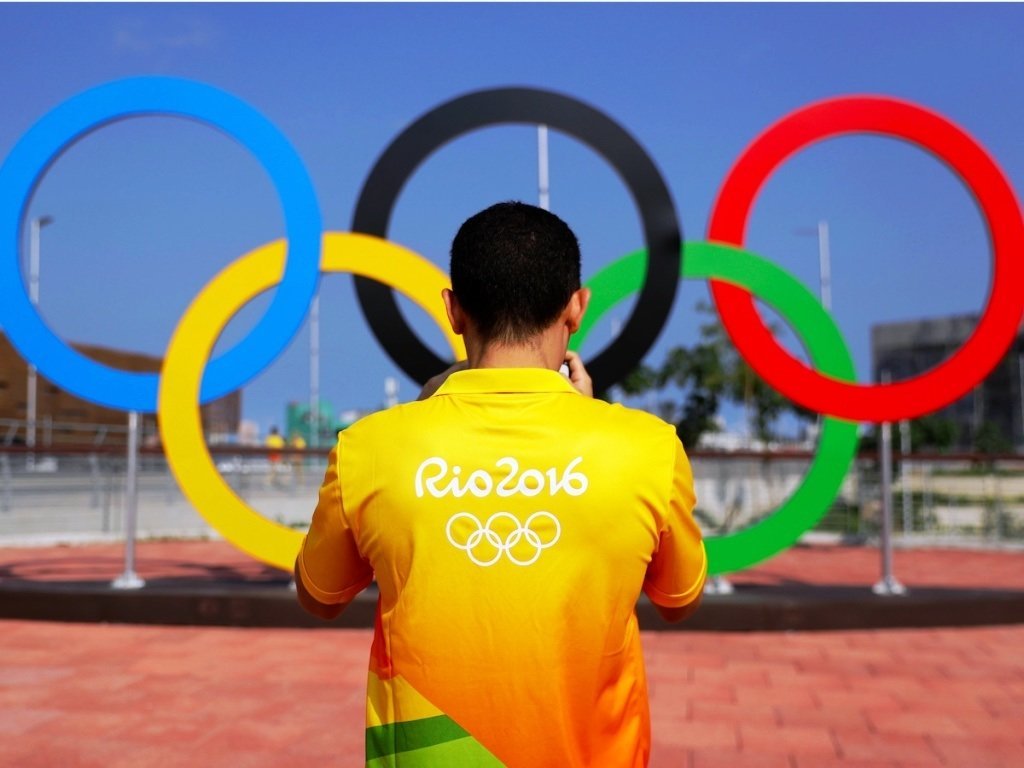
"Right is right, even if everyone is against it, and wrong is wrong, even if everyone is for it."I can't claim the social conscience of a Che Guevera, but it's absolutely true that I feel more motivated to write when I am furious about something, and few things so infuriate me like smug pig-ignorance. And no smug pig-ignorance is so infuriating as that displayed by one's own countrymen, as they happily allow themselves to be played like violins by an outside authority and exhibit their naked buttocks before the world. I really thought you were better than that, Canada.
- William Penn
"If you tremble with indignation at every injustice, then you are a comrade of mine."
- Ernesto Che Guevera
According to the CBC - the Canadian Broadcasting Corporation, a Crown corporation and the official voice of the nation - Russian athletes are "emerging as the villains of the Rio Olympics". And maybe it's just me, but the tone seems approving, self-righteous...judgy. As if the official mouthpiece of Canada is delighted to sign on to the Get Russia program offered by its southern neighbour and business partner to all its toadies and would-be chambermaids.
In a word, this is disappointing. I used that word because I didn't want to start swearing so early, although I'm sure we'll get to it.
Just so we're clear - whose interests does it serve for Canada to enthusiastically sign on to booing and hooting like howler monkeys whenever Russian athletes step up to compete, like we were English football hooligans? Canada's? How?
In fact, as everyone who is not thick as a BC pine knows, it serves Washington's interests, because the USA wants Russia isolated and alone and friendless because it is pissed off at it for other things, and the more disrespect and ignorance and rudeness it gets from the former politeness capital of the world, the better Uncle Sam likes it. WADA is going after every medal Russia ever won, and it is not even looking at anyone else. And that entire effort rests on the credibility of two people; one who was convicted of doping herself and barred from competition for two years for it, and her husband who knew and did nothing about it while he worked for the national anti-doping agency.
We'll get to that.
"It's something not usually heard at the Olympic Games. Booing. Loud, sustained booing. The rain of fury is directed at a common enemy: Russian athletes. The contingent, clouded and shrouded by drug scandal, has quickly emerged as the villains of these Rio 2016 Games. Like Cold War days of old, the Russians are once again the global bad guys.Disappointing. Disappointing to see how easy it is to get people who probably are reasonably nice under ordinary circumstances to get on board with the mob mentality, because it's kind of fun. Why is the western audience (because that's who it is, mostly - the North Americans, the Australians and the English) booing the Russians? Because the whole nation is implicated in a doping scandal.
After avoiding a full Olympic ban, some wondered how fans and fellow athletes would treat Russian athletes. That answer came quickly. At the opening ceremony, even athletes from pariah nations were given polite applause. But fans interrupted the global Kumbya moment to let the Russians know their presence wasn't welcome."
Is that all it takes to make otherwise-sensible people make one-syllable sounds of disapproval simultaneously, in a deliberately-insulting fashion? Good. Let's hear a long, sustained 'boooooo....." for the cheatingest nation on the planet - the United States of America.
Worldly-wise 19-year-old American 100-meter backstroke champion Lilly King unloaded on silver-medalist Russian Yulia Efimova, calling her a drug cheat and sounding off to reporters that the 'twice-banned' Russian athlete should not be allowed at the games; Efimova was booed by the crowd every time she appeared on the pool deck. World-class jackass Michael Phelps, American team leader, went further as he applauded King's rudeness; "It's kind of sad that today in sports in general, not just in swimming, there are people who are testing positive and are allowed back in the sport, and multiple times. I think it just breaks what sport is meant to be and that pisses me off."
That so, Michael? All about self-discipline, are you? Did you learn that in rehab? "I honestly didn't care about my training" leading up to the 2012 London Olympics; wasn't that you? Is that what sport is meant to be? Isn't this you, with a bong in your face? What's up with that, voice of clean sports?
While we're having this heart-to-heart, Michael, let me tell you what pisses me off. Hypocrisy.
Before the 2000 Olympic Games in Sydney even started, Dr. Wade Exum - former director of the US Olympic Committee's (USCOC) drug-testing program - announced that more than half of all US athletes caught doping prior to the Atlanta games (1996) suffered no penalty whatever and were permitted to compete at those games, where some of them won medals. At the time, ally Australia's opinion of America's drug-testing efforts was decidedly negative.
"We in Australia have been less than impressed with the efforts in America, and if you were to do a survey of the athletes, they'll tell you the country that's the major problem."And let me tell you this - that same country is still the major problem. It has hit upon the novel approach that rather than control the athletes and what they are taking, you control the testing process and develop performance enhancements which are ever harder to detect. Within months of Exum's joining USOC in 1991, the organization came to him with a proposal to trial a new injection 'just to see if it enhances performance'.
"They came to me and asked me to participate in a project in which they wanted to give athletes what they called ATP injections - that's aginicent triphosphate. That's the fuel that muscle cells actually operate on and I refused on the basis that i thought it was unethical to give people things in a non-medical fashion for non-treatment, but just to see if it would help performance. I also thought that even if that substance wasn't directly named or on the IOC list, that it was at least aimed in the direction of doping."Other Australians were less circumspect in their criticism. Sean Murphy, chair of the Australian Olympic Committee at the time, said, "They've got the facilities, they've got the research, they've got the motivation to be using drugs across the board in many different sports."
Read the rest of the article here.



But Guevara.