
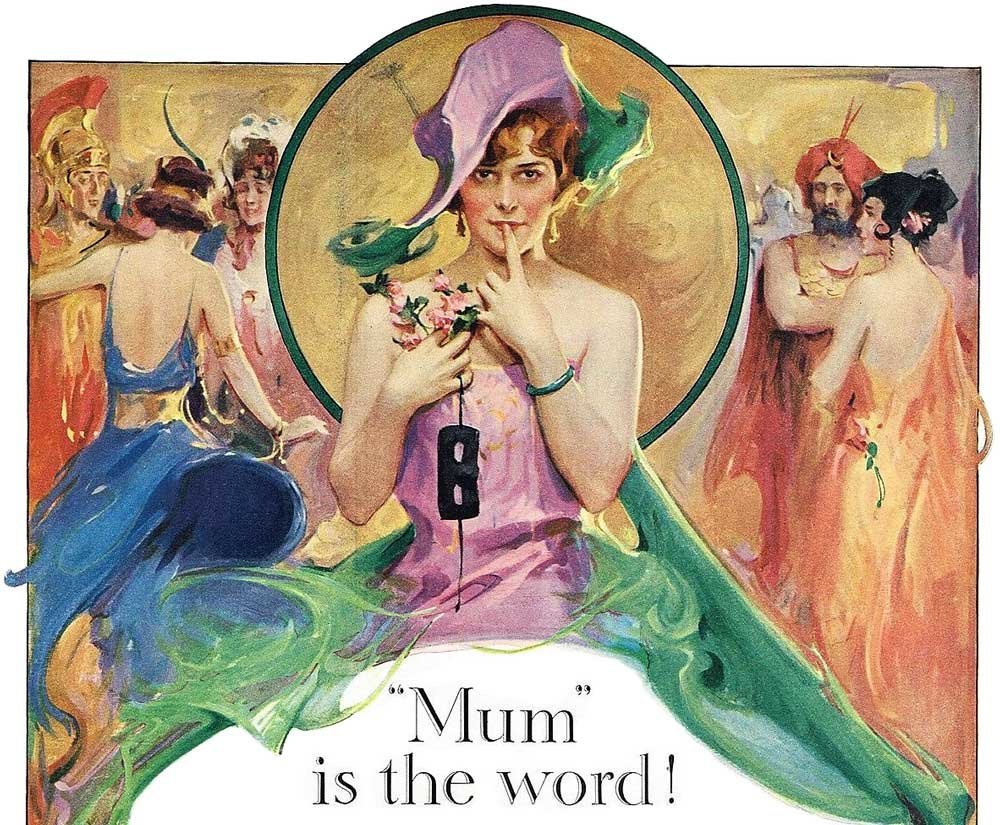
© WikimediaA Mum deodorant advertisement from the 1920s captures the beginning of the modern deodorized era.
Over the last few millennia, as scientific knowledge and social norms have fluctuated, what Westerners considered smelling "good" has changed drastically: In today's highly deodorized world, where the notion of "chemical sensitivity" justifies bans on fragrance and our tolerance of natural smells is ever diminishing, we assume that to be without smell is to be clean, wholesome, and pure. But throughout the long and pungent history of humanity, smelling healthy has been as delightful as it has disgusting.
The desire to surround ourselves with ambrosial fragrances can be directly traced to the unavoidably rank smell of unwashed humans, and to get to the root of body odor, you have to start with sweat. According to journalist Sarah Everts, who's conducted extensive research on the science of perspiration, human sweat by itself typically barely smells at all. "The problem is that bacteria living on our body like to eat some of the compounds that come out in our sweat," she says. Eccrine glands all over the body and apocrine glands found mostly in the armpit and genital areas secrete various compounds that are consumed by bacteria, which in turn release molecules with a smell we recognize as body odor. "In particular, it's one kind of bacteria called Corynebacterium, and they make a molecule which is really a top note of human body odor," Everts says. "It's called trans-3-methyl-2-hexenoic acid."
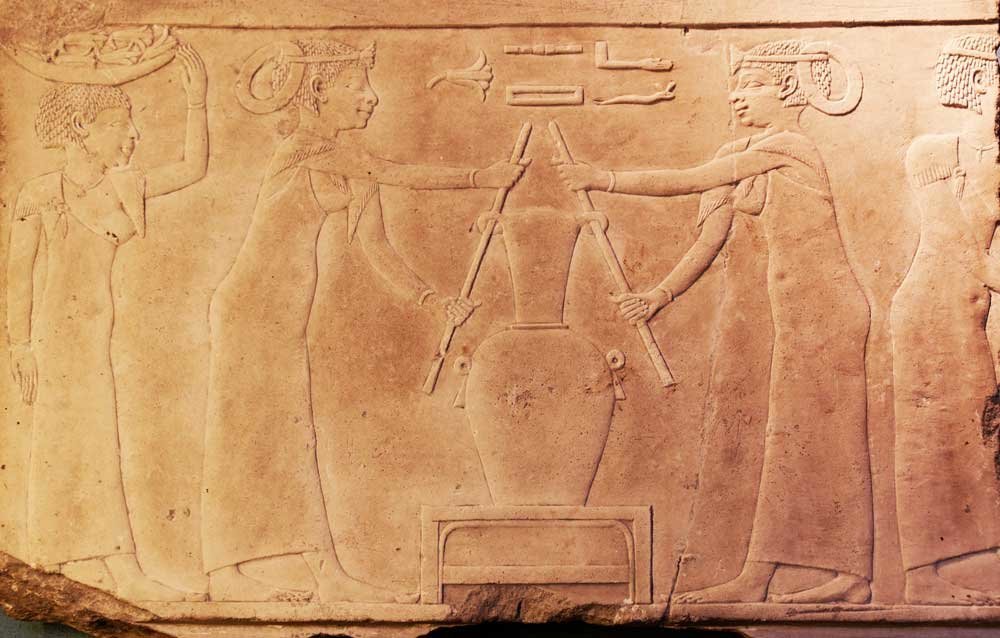
© WikimediaThis Egyptian relief carving illustrates the making of lily perfume, circa 2500 B.C.
Besides direct application on the skin, Egyptians burned fragrances as incense and developed jewelry that incorporated scented materials, a tradition still practiced by cultures throughout northern Africa. Hieroglyphics also depict men and women wearing small cones above their wigs, which are believed to have been made of perfumed wax and animal fats.
Today, we know that humans can smell essential oils in extremely miniscule amounts—early alchemists believed these concentrated extractions were a spiritual embodiment of nature, sort of like a plant's soul. For centuries, such botanical essences were distilled via two primary methods: "maceration," meaning plant material was pressed to remove oils and then ground into powders or pastes, or the more complicated method of "enfleurage," in which leaves or petals were placed in a thin layer of fat, which absorbed the plant's essential oils.
In ancient Greece and Rome, aromatic spices and perfumes gained traction as coveted luxury goods, spreading along trade routes between the Mediterranean and the Middle East. "From the moment people start to trade internationally, migrate, and cross borders, you encounter references to foreign scents," says Jonathan Reinarz, a professor of medical history who published a book called Past Scents: Historical Perspectives on Smell in 2014. "Travel literature is saturated with references to smell. You can imagine in every new market that people entered in Africa or Europe or Asia, they'd smell something they didn't recognize, but were nevertheless still quick to judge."
Though travelers often had instinctive negative reactions to such foreign smells, many exotic herbs were becoming desirable, stimulating a global scent market. The earliest known perfumeries date to the Roman Empire, a rare period when it was normal to bathe daily, both as a social custom and for religious purposes. Following a soak, the body was typically anointed with scented oils, and these salves were sometimes carried in small bottles tied around the wrist.
Early fragrance concoctions incorporated floral scents like jasmine, rose, iris, lavender, violet, or chamomile, as well as spicy smells from natural materials such as yellow amber, camphor, and cloves. Perfumes derived from animals included civet (from civet cats), musk (found in musk deer), or ambergris (a secretion of the sperm whale). As a bonus, these animal scents were also thought to be natural aphrodisiacs.
Before the ability to suspend natural essences in alcohol, aromatic oils were prone to go rancid if not protected from heat, so most products were designed for immediate use by local customers. However, complex scents weren't only intended for applying directly to the body: Scented powders made from talc were carried within fabric sachets, hardened pastes were made into beads and worn as jewelry, and garments were sewn from fabrics steeped in perfume.
By the 5th century A.D., scented oils and incense had become entwined with religious rituals across Europe, including those of Judaism and Christianity, even though such indulgences were previously shunned for their Pagan roots. In part, the mixing of various social classes at public worship spaces meant that everyone brought their own particular smells, and incense helped to mask the God-fearing funk. "In Katherine Ashenburg's book, The Dirt on Clean, she wrote that Catholic priests were so overwhelmed by the stench of their worshipers that they would avidly burn incense to counteract the worshipers' body odor," Everts says.
Even while the clergy were exalting religious incense, they sometimes derided perfume as a sinful, decadent indulgence. For several centuries, many Christians rejected bathing for its connection to the sin of pride or vanity, which explains, if only in part, why they were seen as dirty and malodorous by the rest of the developed world. "With the emergence of Christianity, the whole meaning of smell changes and the vocabulary expands," Reinarz says. "There were frequent references to the early saints with the devout often saying that, when these first martyrs died, their bodies had emitted fragrant scents. The problem, of course, is that when the scent industry started to develop, anybody could smell like a saint, so the religious language changed and instead of talking about the smell of a saint, people began to focus on detecting the false odors of sanctity—since even the harlot or prostitute could now buy perfume and wear these 'sacred' scents."
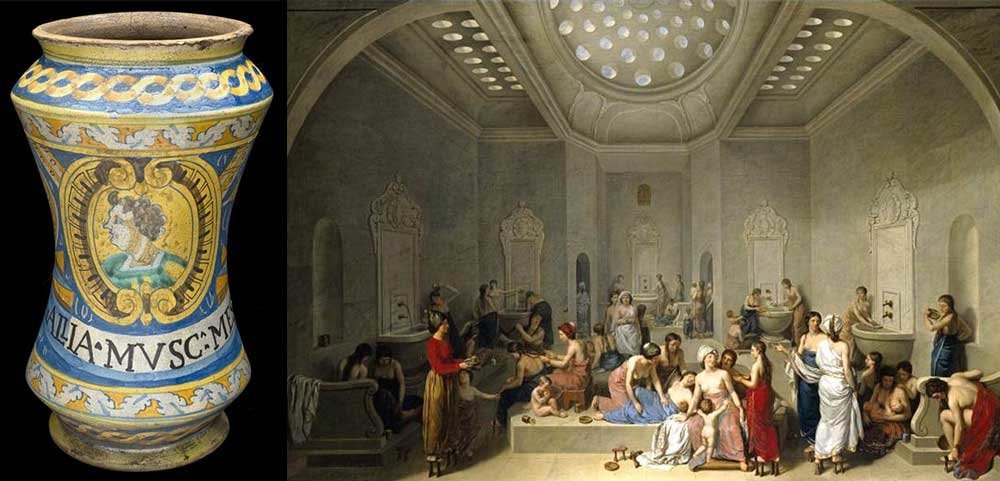
© Wellcome Library, LondonLeft, a 17th-century jar inscribed with “Mesue’s French Musked Lozenges of Aloes Wood” (in Latin) held lozenges made from aloe wood, ambergris, and musk to be taken for health purposes and to freshen the breath. Right, a 1785 painting of a Turkish bath by Jean-Jacques-François Le Barbier.
At the time, most household soaps were rough and smelled like the ash and animal fats they were made from, so were rarely used on the skin. But during the medieval period, Middle Eastern inventors developed better formulas incorporating vegetable oils that were more gentle on the body, and soap-making became the primary application for perfumes.
By the 13th century, chemists had mastered the art of distilling, whereby a natural specimen is boiled along with water and the evaporating substance—a combination of water and essential oils—is captured and separated during the cooling process. Inventors combined these essential oils with alcohol to create the stable, quick-drying perfume that we know today. The first major alcohol-based fragrance was a late 14th-century rosemary perfume known as Hungary Water, since it was designed for Queen Elizabeth of Hungary.
By this time, most of Europe's public bathhouses had been closed due to the bubonic plague, which killed more than a third of the population. Without a scientific understanding of germs, people believed that diseases like the plague were contagious through the air. "Before germ theory, there was the widely held belief in miasma or malaria," which Reinarz says described unhealthy or disease-causing odors. "Today, of course, we associate malaria with a specific disease, but if you take the literal Latin translation 'mal-aria,' it's bad air, which was thought to impact dramatically on people's health and even create epidemics."
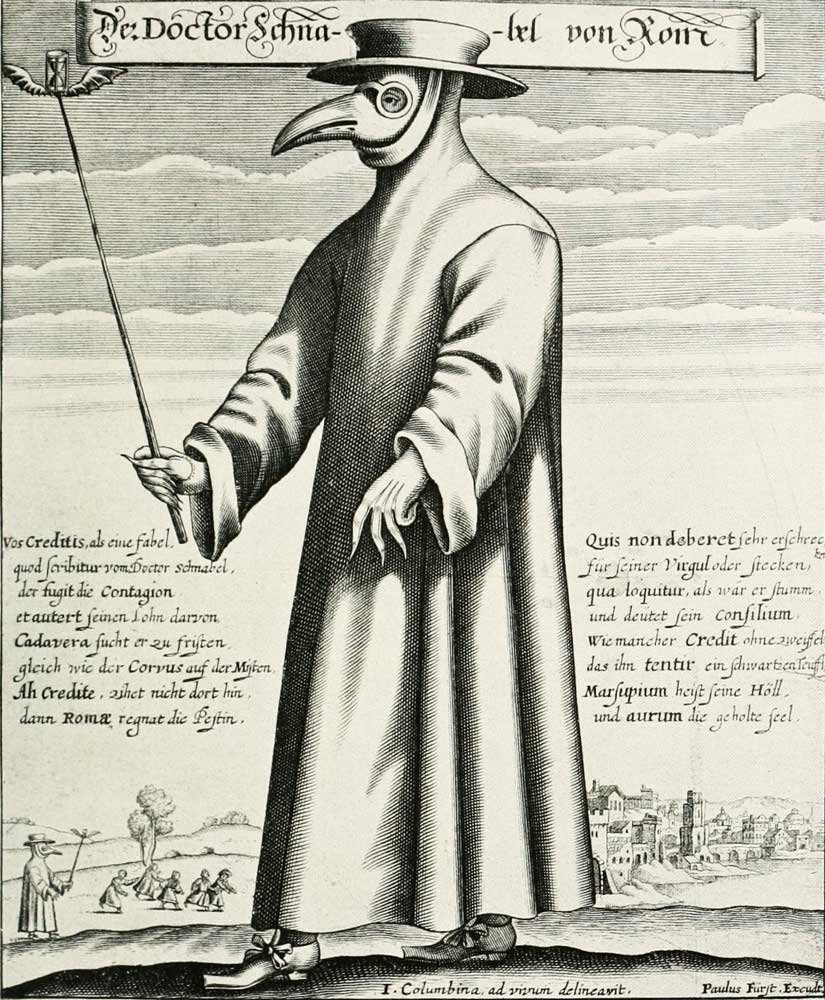
© WikimediaThe distinctive beaked mask worn by plague doctors was filled with aromatic substances supposed to prevent them from catching the illness, as seen in this illustration, circa 1656.
In their book, Aroma: The Cultural History of Smell, Constance Classen, David Howes, and Anthony Synnott detail other fragrant methods used to protect one's health: "Municipal authorities had bonfires of aromatic woods burnt in the streets to purify the atmosphere. Individuals fumigated their homes with, among other things, incense, juniper, laurel, rosemary, vinegar, and gunpowder. Even burning old shoes was thought to help, while, for added olfactory protection, some families kept a goat in the house."
Today, we know that some of the odors used to overpower this miasma of illness were unhealthy pollutants, like the coal smoke of 18th and 19th centuries. "Coal burning was seen as an antidote to all the bad smells that accumulated in urban centers," Reinarz says. "People at the time more likely thought, 'Thank goodness we live in a manufacturing city where all of these chimneys belching out smoke are disinfecting the air.'"
Meanwhile, the true antidote to major epidemics—better hygiene via bathing and handwashing—was unattainable as long as most Europeans believed that bathing was dangerous to one's health. In the 15th and 16th centuries, prominent scientists helped spread the falsehood that water's ability to soften skin and open pores actually weakened the flesh, making it more susceptible to the foul smells of sickness. With this in mind, the few who did bathe regularly often took special precautions, like anointing the body with oil and wrapping themselves in a scented cloth immediately afterward.
Instead, layers of linen clothing and undergarments were thought to cleanse the body by absorbing its oils and smells, and clothing was believed to be much safer to wash than the skin. Hair could be rubbed with aromatic powders and bad breath was improved by chewing pungent herbs.
With its growing wealth and powerful trading ties to the East, Venice led Europe in the adoption of perfumed goods, especially devices to be carried or worn on the body that would mask unseemly odors. One popular form was the pomander, a word that came from the French phrase "pomme d'ambre" or "apple of amber," referring to the ambergris often contained in the spherical pendants. While the original pomanders were simply fruits like oranges studded with cloves, the term eventually described a pendant made from precious metals with several small compartments for different fragrances.
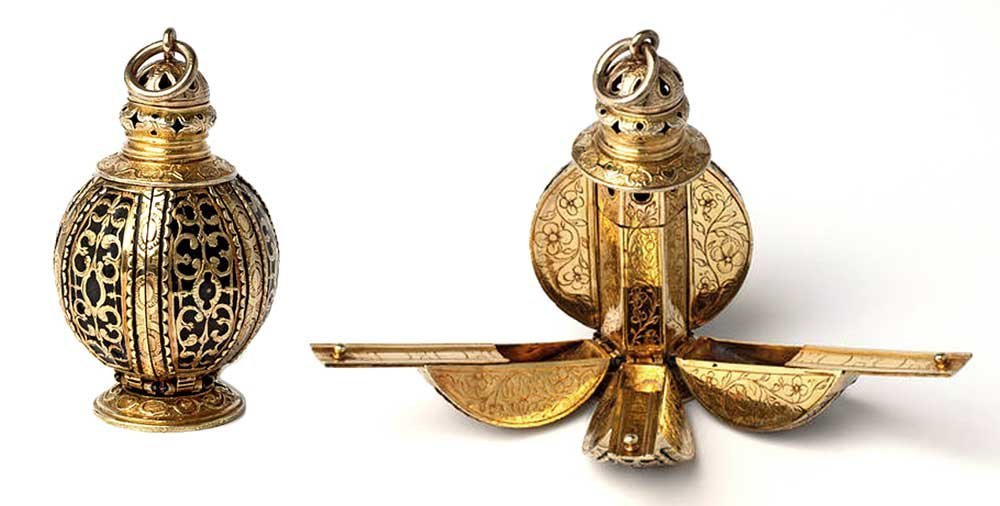
© Victoria & Albert MuseumThis spherical pomander opens into separate compartments for different scents, circa early 17th century.
In the 17th and 18th centuries, the French aristocracy took perfumery to a new level, installing scented fountains at their dinner parties and making their own custom essences, sometimes wearing a different perfume each day of the week. In France, perfume also became closely linked with leather goods, as tanneries used them to cover the strong odors of chemicals used in the tanning process. Leather gloves infused with Neroli, an orange-blossom fragrance, were one of the country's most successful products.
Small scent boxes designed to hold liquid perfumes eventually replaced pomanders as the fragrant accessory of the moment. Called "smelling boxes," "pouncet boxes," and, later, "vinaigrettes," these decorative perforated cases held small sponges or fabric swatches soaked with alcohol- or vinegar-based fragrances hailed for their medicinal qualities, which worked to defend against unpleasant odors encountered on city streets. Other vinaigrettes contained a mixture of smelling salts, an ammonia-based inhalant used since ancient times to revive people who were feeling faint.
In the late 18th century, vinaigrettes were often attached to chatelaines, which held utilitarian objects from small chains and typically attached at the waist of a woman's dress. While not as popular, other forms of jewelry were also adapted to the perfume craze, including necklaces with pendant flacons of liquid fragrance and perfume rings with tiny hidden compartments for storing scented powders or pastes.
Yet even with access to all manner of perfumes, wealthy people often still stunk. "Descriptions of Versailles by a lot of people visiting the court of Louis XVI and his bride Marie Antoinette just before the revolution are really striking," Reinarz says. "They described it as a stinking cesspit where everyone was relieving themselves in the corridors and even the ballrooms."
During the French Revolution, clothing styles shifted towards simpler silhouettes, fewer layers, and lighter fabrics made from cotton, which could also be more easily washed. Bathing had finally come back in vogue, as doctors now believed that accumulated filth prevented the body from releasing corrupt fluids. Despite concerns of sexual impropriety, bidets began appearing in the homes of the wealthy. By the end of the 18th century, chemists had also developed a way to produce soap using soda ash made from salt, avoiding the use of timber ash and resulting in soaps that were harder, milder, and less offensive-smelling. Meanwhile, steamboat trade allowed the soap market to expand and made it easier to import olive-oil-based soaps.
Outbreaks of cholera in the mid-1800s, like the 1854 London epidemic studied by Dr. John Snow, pointed to the importance of clean water and inspired cities across Europe to improve their sanitation practices by expanding access to fresh water, systemizing garbage disposal, and constructing new sewer systems to remove excrement, which were particularly beneficial to the lower classes. Some also focused their efforts on building new public baths, as was encouraged by Britain's Baths and Washhouses Act of 1846.
As better hygienic practices took over, strong perfumes were no longer essential to combat stench, and their association with the aristocracy was becoming a hindrance to sales; the industry thus aligned itself more with fashion. When perfumes moved from the pharmacy to the cosmetics counter, their use was increasingly linked with the feminine, especially as Victorian-era notions about separate spheres for each gender took hold of Western society. While some scents, like tobacco and pine, remained connected to popular ideas of masculinity, the general concept of good smell was increasingly associated with the world of women. The cultural fervor for celebrated male explorers and scientists meant that Victorians placed a higher value on sight than the other senses. "Smell, in turn, was now considered the sense of intuition and sentiment, of homemaking and seduction, all of which were associated with women," explain Classen, Howes, and Synnott in Aroma.
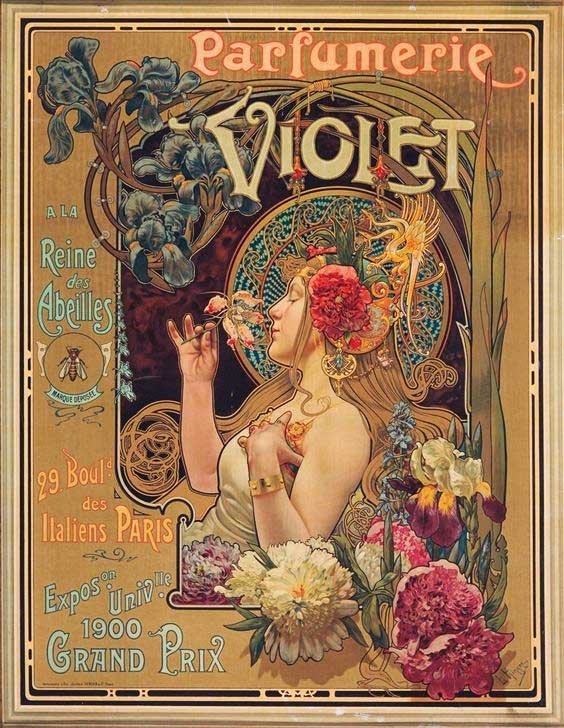
© Louis Théophile HingrePerfume was positioned as a feminine cosmetic by the turn of the 19th and 20th centuries, as seen in this 1901 advertisement for Parfumerie Violet.
Americans had been as reluctant to bathe as Europeans, but by the late 19th century, the United States leapt toward the eradication of dirt and smells, adopting novel cleaning devices like showers and toothbrushes, which were supported by the latest studies on hygiene. In her book, The Dirt on Clean, Katherine Ashenburg points out that America's clean regime was also made possible by the young country's abundant space. "Water mains and sewers were more easily installed in new cities than in ancient ones," she writes. "With abundant, cheap land, houses with ample space for bathrooms became the domestic norm, in contrast to Europe's old, crowded apartments. Because servants were always in short supply in democratic America, labor-saving devices were prized. High on the list was plumbing, and from the 1870s, American plumbing outstripped that of every other country."
Modern economies like that of the United States depended on an increasingly urban population, and as more people lived and worked in close quarters with others, body odor became a social issue. Unlike farm fields, offices and factories provided no respite from the trans-3-methyl-2-hexenoic acid emanating from your sweaty colleague.
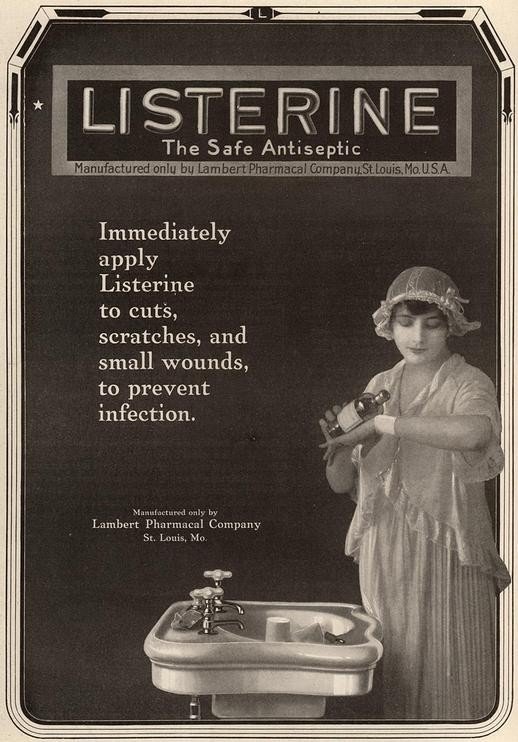
Antiseptics like Listerine caught on as a way to prevent infection, but were eventually applied to specific areas of the human body, including the mouth, armpit, and genitals. The ad above is from 1917.
The earliest successful brand of commercial deodorant was developed in 1888 by an inventor in Philadelphia and dubbed Mum, as in "keeping silent" or "mum's the word." The first patented version of Mum was sold as a waxy cream that quickly inspired imitations, but these cumbersome products were unpleasant to apply and often left a greasy residue on clothing. In 1903, Everdry introduced the world's first antiperspirant, which used aluminum chloride to clog pores and block sweat. Regardless of their success at preventing sweating, early antiperspirants were also highly acidic, meaning they often damaged clothing and left the wearer with a stinging or itching sensation. Despite their unappealing format, many early deodorants and antiperspirants included perfumes to minimize their chemical scents.
In the early 20th century, American marketers were also creating new standards of personal hygiene, like the importance of bathing daily to eliminate odors, with the ultimate goal of selling more products. In 1927, the Association of American Soap and Glycerine Producers created a lobbying arm called the Cleanliness Institute to publish marketing materials under the guise of education. The Institute distributed teacher's curriculum, posters, and books, like 1928's A Tale of Soap and Water: The Historical Progress of Cleanliness, which taught children and teens the value of hygiene throughout the ages. "Most of us want the good and beautiful and worthwhile things of life," the book explained. "Soap and water alone cannot give them to us, but we know that they help."
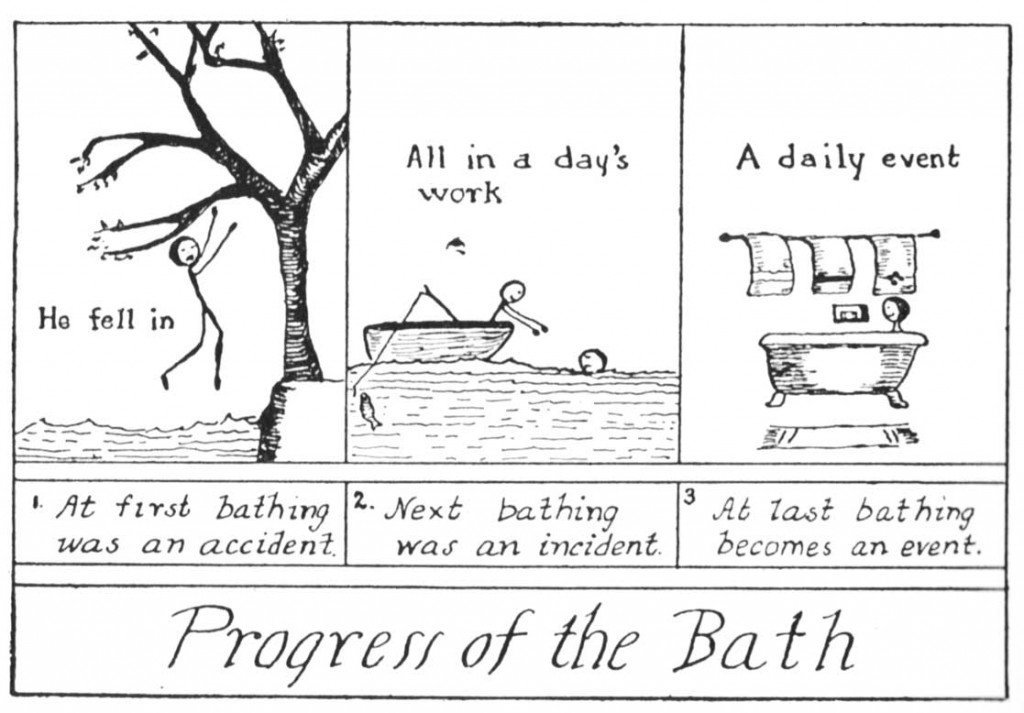
In 1928, “A Tale of Soap and Water” spread the good word of the soap and glycerine industry to schoolchildren via illustrations like this.
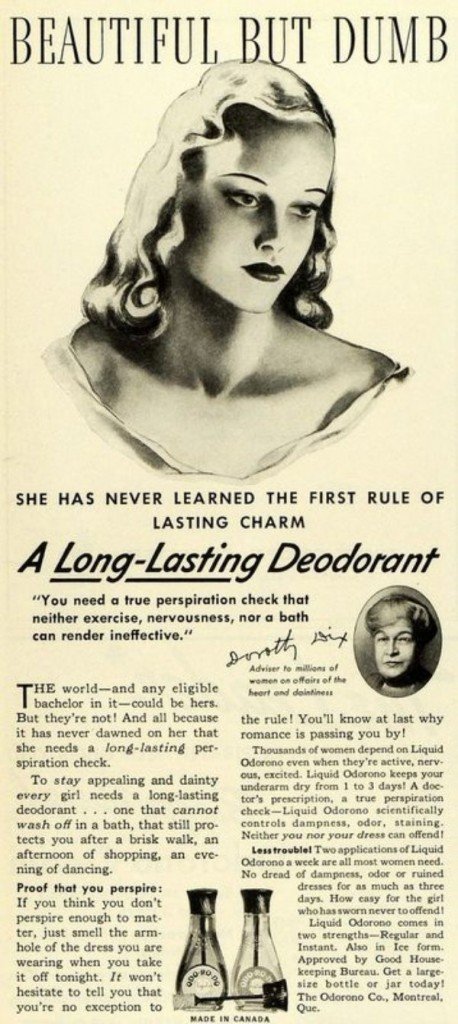
American marketers played on insecurities to make deodorant a must-have product, like with this Odo-Ro-No ad from 1939.
During the 1920s, brands like Lysol began promoting disinfectant douches—long believed to be an abortifacient—as a way to keep women's privates smelling fresh. Eventually, doctors recognized that douching actually disrupted the body's natural pH balance, causing a number of health issues.
By the 1930s, American deodorant companies had secured a female customer base, so they began including subtle advertising copy referencing men's body odor. In 1935, Top-Flite, the first deodorant targeted at men, hit store shelves in its sleek black bottle, followed by other stereotypically male designs, like the Seaforth bottle resembling a miniature whiskey jug. Advertisements for men's deodorant products often focused on financial insecurities, positing that foul body odors might ruin one's career.
Just as manufacturers had gendered deodorant, fragrance companies developed their own parallel language for men's products, using terms like cologne, aftershave, and eau de toilette. Scents for men focused on the enhancement of sexual attraction with "masculine" names like Brut, Centaur, Dante, Old Spice, Macho, English Leather, and Denim.
At this point, manufactured scents were no longer bound to the natural world of essential oils, as chemists developed entirely new man-made compounds. "Today, we're familiar with abstract, man-made scents like Chanel No. 5," Reinarz says. "But people who first smelled that perfume in 1921 must have thought, 'What a bizarre flower,' because the tradition was distilling from nature, and most scents could be identified by naming a single floral ingredient."
Meanwhile, the delivery method of deodorant was shifting from messy creams to more pleasant roll-on sticks, like the 1940s applicator developed by Mum employee Helen Diserens based on the design of a ballpoint pen. In the early 1960s, Gillette introduced Right Guard, the first aerosol antiperspirant. Despite a brief heyday, aerosols lost favor when the FDA banned aluminum zirconium complexes in 1977 and the EPA restricted chlorofluorocarbons (CFCs) in 1978, stemming from concerns for consumer and environmental safety.
In the 1960s, a Swiss company invented a deodorizing spray for female genitalia, adding a layer of specificity to the coy concern of "feminine hygiene." The first American version, named FDS for "feminine hygiene deodorant spray," launched in 1966 and quickly became a hit. Though the sprays fell out of fashion after an FDA ban on hexachlorophene in the 1970s, scented "feminine wipes" are just as popular today.
As with many products before them, advertisers continue to convince women that their natural odor is repellant, and they need to perfume their privates to get laid. Meanwhile, such companies are still suppressing information about the dangerous side effects of their products, as seen with the recent Johnson & Johnson lawsuit over talcum powder.
"Once the ball started rolling, there was no stopping it," Reinarz says. "People felt that eliminating all these smells was the single most effective way to improve public health and make the environment more tolerable for everyone." Today, we're bombarded with a cornucopia of deodorants, antiperspirants, soaps, colognes, perfumes, and douches, all aiming to eradicate smells associated with the human body—even if those odors are the result of healthy processes.
"I think my favorite weird patent was based on baker's yeast," Everts says. "I just don't think I'd want to put baker's yeast in my armpit."



Unavoidable Funking Body 'Pong'!
[A/k/a, The art of 'Masking the Unavoidable and God-fearing Funk of Body 'Pong'!]
Apparently, "pong" is more than:
- #1 an early video game;
- #2 the second part of table tennis' common name, etc., as, apparently, in the UK,
- #3 it's slang for 'odour- particularly an adverse one.' New to this (supposed) 'New World'-er.
I love learning - especially new words.
Well written article, artfully spiced with humor. What I've come to expect from SOTT! {Good link, SOTT Folk.}
R.C.