
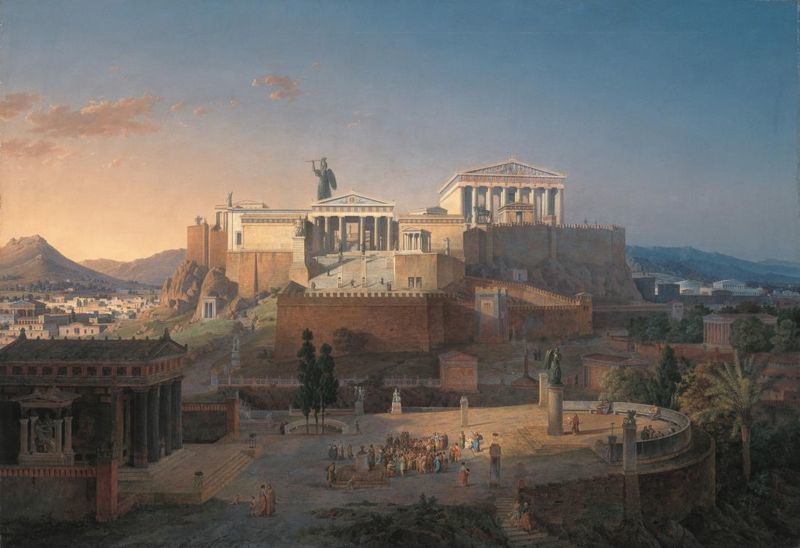
© Public domain/WikiCommonsAn 1864 painting of the Acropolis in Athens, where the pharmakos ritual became an annual event.
But the European neighbors of the Celts, the ancient Greeks, did something even more disturbing: they brutally sacrificed the ugliest among them in order to maintain the common good.
When we think about ancient Greece, usually the first images that come to mind are philosophers wandering in their white robes, enlightened politicians arguing about the bases of democracy, or artists sculpting perfectly proportionate figures in white marble. But there is a darker aspect of Grecian society that is less widely-known—a belief in an underworld populated by daemons, ghosts, and bogeys which personified people's most dreadful and terrifying fears. This morbid side underlies even the ancient Greeks' greatest achievements; many classic plays, for instance, are obsessed with murder and death. And perhaps nothing can introduce us to this hidden and disturbing side of the Grecian's psyche more vividly than the pharmakos ritual, a ceremony that's survived from Greece's darkest ages to the brightest peak of its civilization, roughly from 8th to 5th century BC. The origins and details of this ritual are as mysterious as its purposes: the sources are fragmentary and no one tells us exactly when it began, or why, or how long did it last.
But the surviving evidence points us to a frightful ceremony unknown to many of us.
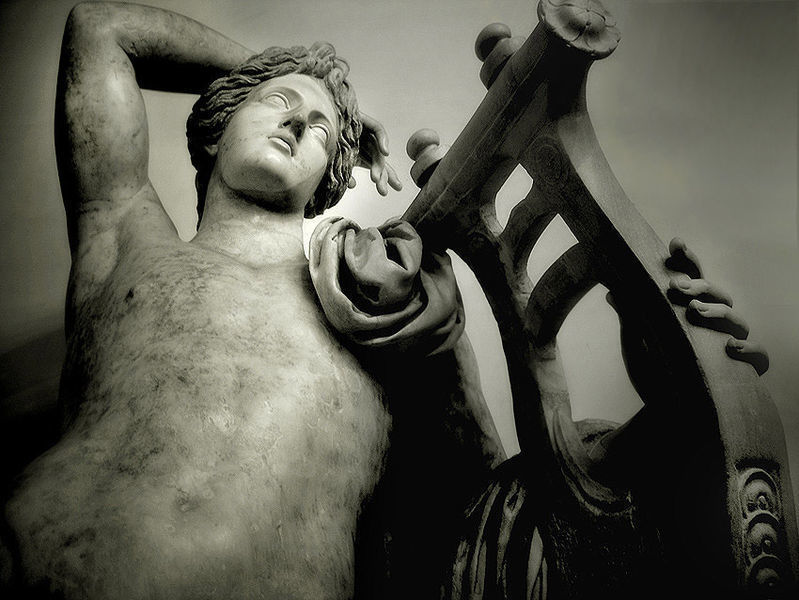
© Ricardo André Frantz/WikiCommons A statue of Apollo. The Thargelia was one of the chief Athenian festivals in honor of the Delian Apollo and Artemis.
How popular was this ritual? In some places, so popular that it became annual. In Athens, for instance, it was celebrated during the yearly Thargelia festival.
Why a society choose to sacrifice its ugliest inhabitant in such a brutal way is complicated. First of all, ancient Greek society was obsessed with purity; those who deviated from institutionalized norms were viewed as a threat. Physical imperfections were seen as corresponding to moral flaws so therefore, disabled children were exposed and abandoned outside the city walls, and the ugly and deformed were suspiciously regarded as tainted beings.
Secondly, Greek mythology frequently suggests that the sacrifice of one individual has the power to save an entire community—a primordial reflection of a pre-civilization time when a herd needed to sacrifice its weakest members to predators in order to survive. The pharmakos ritual, then, acted like a catharsis, a purification of the iniquities of the entire society through the sacrifice of one of its marginal members. The related word pharmakon, which later originated the English word "pharmacy," meant both poison and medicine. This reflects the ambiguous role of the unfortunate pharmakos: he held the guilt for all the evils that had affected society, but he was also its savior. But, at a psychological level, people could not accept their redeemer to be just any scum—therefore, for a period of time, he had to be treated as a very important person. In exceptionally difficult times, this fiction was no longer enough. According to some authors, it had to be the king himself who was sacrificed for the community's sake.
The physical elimination of the pharmakos did not actually make all the town's afflictions disappear. But it relieved the social tensions that had accumulated during those precarious times, and avoided the possibility of a chaotic and uncontrolled bloodshed among the members of the society, while reinforcing the reassuring status of belonging to a group.
This practice might be unthinkable now in most cultures, but it's worth noting that the psychological underpinnings of pharmakos have not gone away. How often does our society blame someone else for its own drawbacks—the indigent, the homeless, the immigrants? How often does someone rejoice at the prospect of punishing a person who represents our darker and upsetting side? Like the Greeks, we tend to project our most terrifying aspects onto someone else. Shame is a powerful, damaging force, even when it's currently more associated with online diatribes than a literal mob.
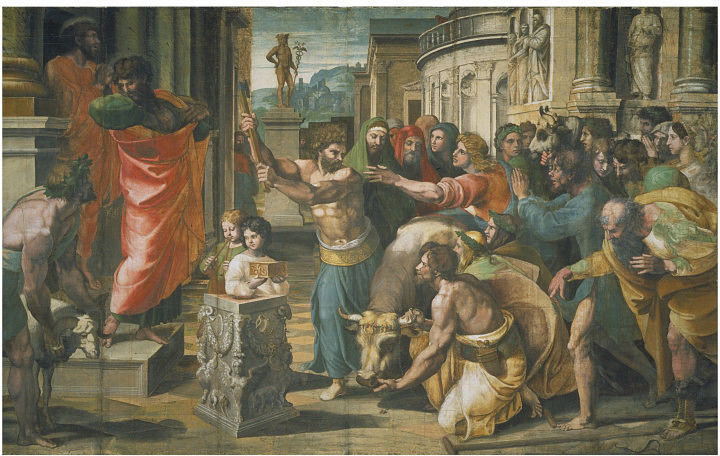
© Public domain/WikiCommonsRaphael's 1515 painting "The Sacrifice at Lystra," showing the sacrifice of a cow.



Other than the introduction re: potential Samhain sacrifices I don't see what Pharmakos has to do with Halloween. Some people do idolize the Greeks and put down the Romans, when ultimately 'like meet like' comes to mind so an enlightening article in that sense and of course about butchery and festival in general but again not specifically Halloween. Pharmakos was carried out as and when they needed it and the Athens ritual in May-June.