

Researchers have used a magnet to deliberately send Eurasian reed warblers (shown) off course
While scientists know the birds use the sun or stars as a 'map,' the idea that birds use magnetic compasses has been difficult to prove.
Now a group of researchers have used a magnet to deliberately send Eurasian reed warblers off course, to show they rely on a geomagnetic map cues to point them in the right direction.
In the experiment, the birds were captured at Rybachy, Russia, during their spring migration.
To test the role of magnetic fields, Dmitry Kishkinev of Queen's University Belfast and Nikita Chernetsov at the Biological Station Rybachy housed caught birds outdoors in wooden and cloth cages so they had a clear view of the sky and their surroundings.
They observed the birds naturally orientated north-east, which matches the chosen direction of migration recorded over the previous decade.
They then generated a magnetic field identical to that found in the town of Zvenigorod near Moscow.
The system allowed them to manipulate the magnetic field without obscuring the birds' ability to pick up on other cues, including the sun, stars, landmarks, and scents, which are also thought to help birds find their way across vast distances.
During the several days that the birds were housed in the magnetic coil system, they were led to 'think' they were in Zvenigorod, some 621 miles (1,000km) away.
Data collected showed the change in magnetic parameters led the birds to re-orient toward their breeding destinations just as they would if they'd been physically displaced, meaning the turned towards the north-west.
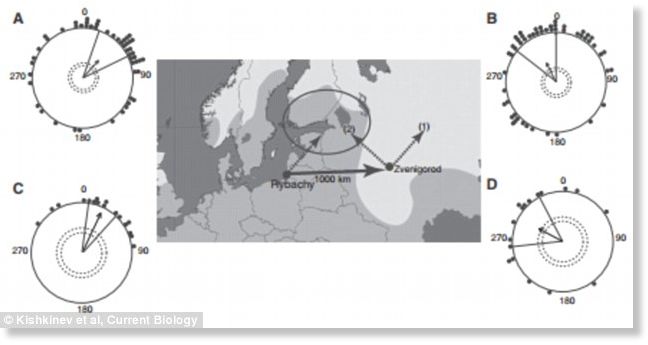
In the experiment, the birds were captured at Rybachy, Russia (marked on the map) during their spring migration. Their naturally orientated north-east. But a magnetic field tricked them into thinking they were in Zvenigorod. Proving the birds use a geomagnetic map to navigate, they adjusted their course north-west
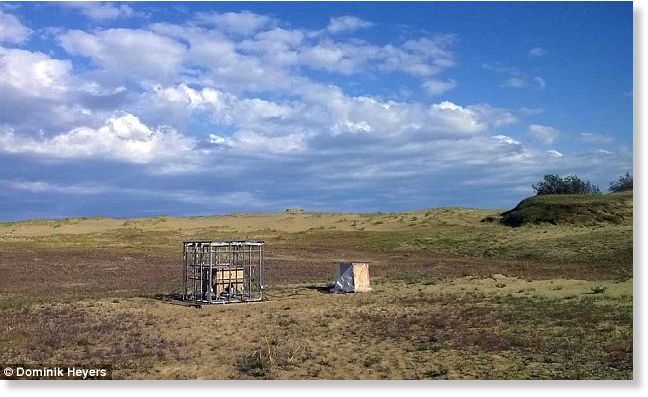
In the experiment, the birds were captured at Rybachy, Russia, during their spring migration. They were housed caught birds outdoors in wooden and cloth cages (pictured) so they had a clear view of the sky
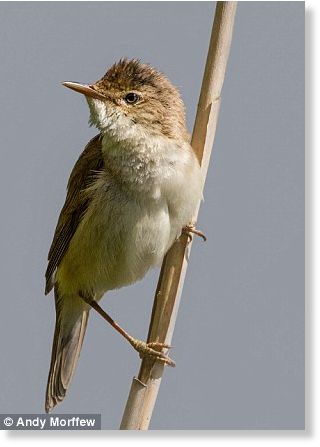
The results suggest that reed warblers (shown) track changes in the geomagnetic fields as they travel during their autumn migration - for example, from the Baltic down to West Africa - to establish certain ‘rules of thumb’
Those rules then guide the birds on future migrations and make it possible for them to re-orient themselves if they find they have taken a wrong turn.
The researchers believe their study, published in Cell's Current Biology journal, provides some of the strongest evidence yet that at least some birds rely on a geomagnetic map for long-distance navigation, as spiny lobsters and sea turtles also do.
Although the idea of magnetic navigation in birds was first proposed back in the 19th century, it has been a challenge to prove.
Further work is needed to understand how birds sense magnetic fields and which portions of the magnetic field are most important to them.
The researchers are also curious to know whether reed warblers rely on their sense of smell, as some seabirds and homing pigeons do.



Reader Comments
to our Newsletter