
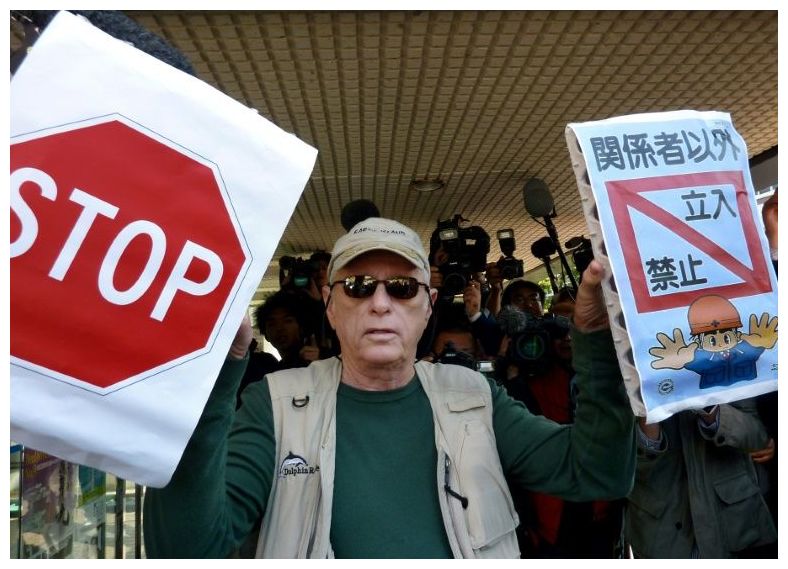
© Shingo Ito/Agence France-PresseUS dolphin activist Ric O'Barry, the central figure in the Oscar-winning documentary The Cove, protests against dolphin hunting in Taiji in Wakayama prefecture, western Japan on November 2, 2010.
But the dolphin-hunt boats returned to Taiji's port -- thrust into the global spotlight in the Oscar-winning 2009 documentary The Cove -- having failed to trap any of the mammals.
"Twelve boats set out for the hunt, but they returned with no catch," a Taiji fisheries spokeswoman told AFP.
They will set sail again on Friday if the weather allows, she added.
The six-month season was due to start Tuesday.
In the annual hunt, people from the southwestern town corral hundreds of dolphins into a secluded bay and butcher them, turning the water crimson red.
The scene was featured in The Cove documentary, drawing unwanted attention to the little coastal community.
Environmental campaigners visit the town every year to watch the gruesome event and authorities have boosted their presence to prevent any clashes between locals and activists.
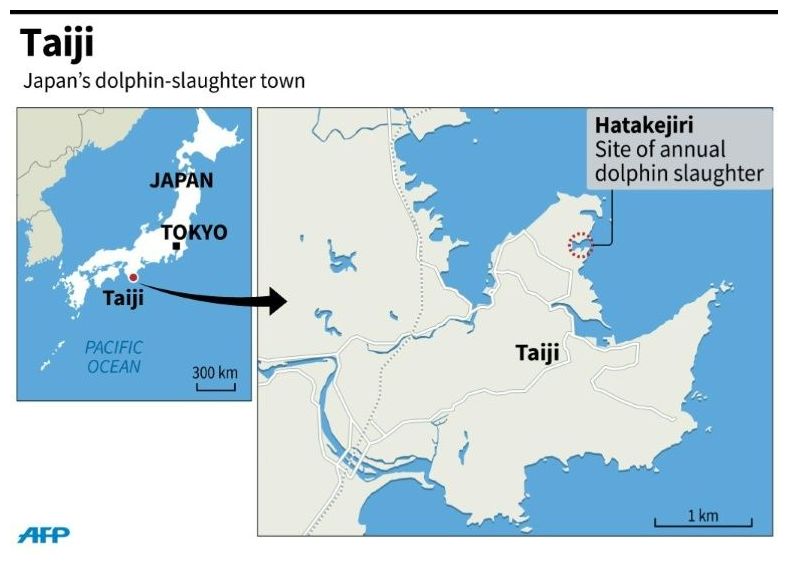
© Agence France-PresseMap of Japan locating the town of Taiji where dolphins are hunted every year.
Defenders of the hunt say it is a tradition and point out that the animals are not endangered, a position echoed by the Japanese government.
On Wednesday, Japanese police said that they had released US animal rights activist Ric O'Barry, who trained dolphins for the TV show Flipper, after he was arrested near Taiji for not carrying his passport.
Separately, Japanese fisheries officials have announced they would start an annual coastal whaling hunt with plans to catch 51 minke whales over the next two months, part of what Tokyo says is research but which has attracted strong criticism abroad.
Four ships will operate within a 50-kilometre (30-mile) radius off Kushiro in Japan's northernmost Hokkaido island, the fisheries agency said.
Tokyo argues that the programme is permitted under the International Convention for the Regulation of Whaling, and is aimed at better understanding whale behaviour.
But Japan's whaling programme -- including another hunt in the Southern Ocean -- has angered Western conservationists and many of its friendly nations, including the United States.
In June, Japan's chief whaling negotiator said ships would return to the Antarctic this year, despite a call by global regulators to provide more evidence that the hunt has a scientific purpose.
Despite international disapproval, Japan has hunted whales in the Southern Ocean under an exemption in the global whaling moratorium that allows for lethal research.
Last year, the highest court of the United Nations, the International Court of Justice, ruled that the annual Southern Ocean expedition was a commercial hunt masquerading as science to skirt the international moratorium.
Source: Agence France-Presse




"Defenders of the hunt say it is a tradition and point out that the animals are not endangered."
Neither are Japanese people an endangered species.
Maybe we should corral a few hundred Japanese into a pen and slit their throats?
There will still be plenty more Japanese where they came from.
What sort of an argument is that? If you have 500 children in an orphanage and murder 2-3 of them because there are plenty more where they came from, is that a justification?
Evil and bloodlust will always find some bullshit argument to excuse itself with.
This is a shameful stain on the Japanese character. They should, all 90 million of them, go crawl under a rock and hide from the sight of humanity.