
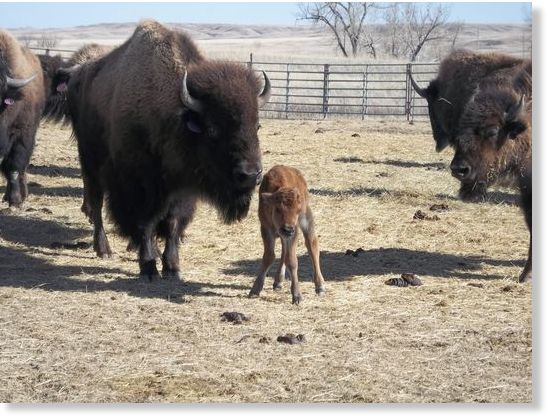
© Richard PetersonThe first calf born to the transferred Yellowstone Park bison herd at the Fort Peck Reservation was born April 22, 2012. Eighteen bison from this original herd were found dead on the Fort Belknap Reservation last Sunday.
Repeated requests for comment from Fort Belknap tribal officials went unanswered Wednesday, however, a Facebook posting by the head of tribe's buffalo management program fleshes out the details of what is known.
"There were 17 head of buffalo that were found dead on Saturday mid-morning," states a post from buffalo wrangler Bronc Speak Thunder, "so between Thursday night and Saturday morning something happened that is yet to be determined. Also, one appeared in good shape and no symptoms of being anything wrong died between the time I left Sunday night to early Monday morning, making it 18 total."
"Precautions were advised by two different vets who took blood samples and sent them to the lab," Speak Thunder's Facebook post continues. "Today (Tuesday, July 7) the results from the lab were good enough to give them up for tissue sample, which were given to the lab by the vet. Test results take three days to come back, therefore, my answer is still I do not know what happened until the test results come back."
Blaine County veterinarian Roger Baxter said he'd spent two days at the pasture where the animals died and had sent tissue samples from the bison to the Montana Department of Livestock's Diagnostic Lab in Bozeman. Baxter declined to speculate on what might have caused the animals deaths.
"We really don't have any accurate information, it's just speculation," he said. "Until we hear back from the lab, and I know that I am right, we don't want to talk about it."
The director of the state diagnostic lab, Dr. A. W. Layton, confirmed that he had received the Fort Belknap bison's tissue samples, but said complete results from a forensic examination would not be ready for another week.
"We'll see what it looks like in two days and see where the tests are going," Layton said. "I'm not going to release any information until the test is completed."
No first-person details on where the bison were discovered, or their physical condition at the time of their discovery have been released. However, the chairman of the Blaine County Commission said he was told the first 17 bodies were found near a water trough in a pasture on the east side of state Highway 66, near where People's Creek flows east under the highway.
"I've known about it since Monday morning," Chairman Frank DePriest said. "I have nothing that is verifiable, but I heard that they were gathered around the water trough. My first thoughts were that they had ran out of water."
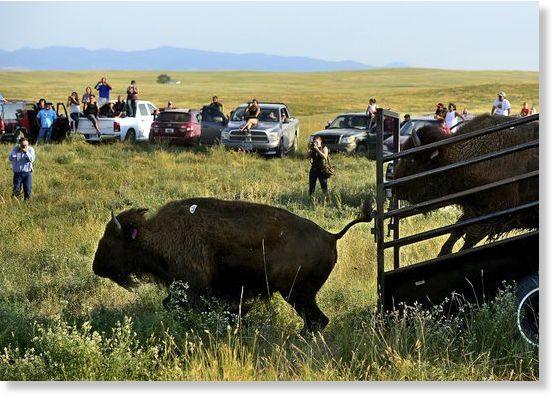
© Rion SandersThirty-four genetically pure bison were released onto a 1,000-acre pasture on the Fort Belknap Reservation.
"The initial anthrax tests were negative or inconclusive," Volesky said of early diagnostic lab test results. "They're also looking at possible water problems — something they drank. It could be a salt problem, it could be an algae problem and hopefully they've got sample information that will lead them through that. Regardless, we'll hopefully know something in a week and can have some more information then."
DePriest said Blaine County has not initiated any type of official inquiry into the bison deaths at this time, but did not rule out the possibility of a future inquiry if evidence points to communicable disease as the cause of death.
"If they're being mistreated that's one thing," DePriest said. "If it's a disease, that's another."
He added that the dead bison were almost certainly members of a larger herd moved out of Yellowstone National Park in 2012.
A collaborative agreement between the Fort Peck Indian Reservation, Montana Fish, Wildlife and Parks and the U.S. Fish and Wildlife Service facilitated the transfer of 90 animals to a pasture near Poplar on the Fort Peck Indian Reservation in 2012. A segment of that herd was subsequently moved to Fort Belknap in 2013.
"They established a new pasture with a new fence and everything," DePriest said. "They drilled a water well — it was drilled specifically for the buffalo and it sits maybe a quarter mile off the highway. Then they got 30-some of them from Fort Peck."



So very sad and discouraging to see all this wildlife loss; especially after many of the bison were transplanted and were not native to the area. Instantly I thought...this was not about "lack of water" since most of the bodies were found at a watering hole, but rather was likely due to the by-product of a particular industry whereby these animals were poisoned (even with one, overnight) by the now "chemically tainted" well water.
A quick search found there are nine (9) currently producing oil (shale fracking) wells in Blaine County, MT (alone) with two directly due East of Fort Belknap...which, underground, may be about a natural outflow of horizontal water seepage that's reached all the way to the bison's new watering hole...no matter how many miles between these seemingly unrelated locations.