
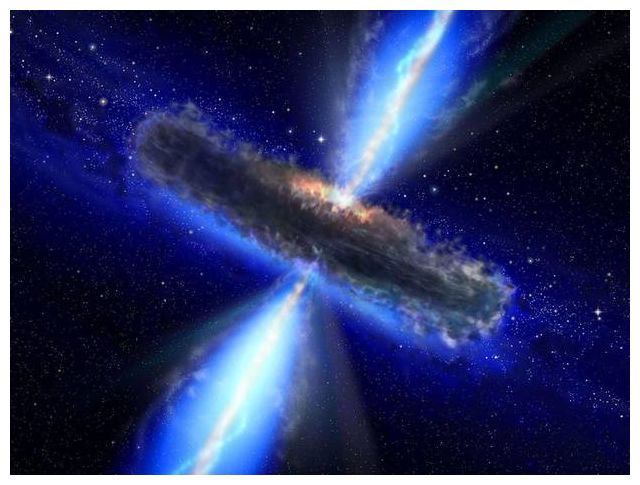
© The Independent, UKThe cosmic masses chew up everything that comes close to them.
A supermassive black hole is a cosmic mass at the centre of most large galaxies with a gravitational pull nothing can escape - not even light.
International scientists led by astronomers at Durham University said the five had been hidden by clouds of dust and gas - and millions more could be similarly hidden.
They were uncovered when the team pointed Nasa's orbiting Nuclear Spectroscopic Telescope Array (NuSTAR) satellite observatory at a collection of nine that are thought to be "extremely active" - emitting high-energy X-rays across space.
The telescope orbits the Earth on a satellite and can pick up much higher energy rays and can see black holes light years away that would not have otherwise been found.
The Royal Astronomical Society says the five holes are much brighter and busier than first thought and "rapidly feasted on surrounding material and emitted large amounts of radiation".
"For a long time we have known about supermassive black holes that are not obscured by dust and gas, but we suspected that many more were hidden," explained the study's lead author George Lansbury, a postgraduate student in the Centre for Extragalactic Astronomy at Durham University.
"Thanks to NuSTAR for the first time we have been able to clearly see these hidden monsters that are predicted to be there, but have previously been elusive.
"Although we have only detected five, when we extrapolate across the whole universe then the predicted numbers are huge."
The findings, in the Astrophysical Journal, will be presented on Monday at the Royal Astronomical Society's National Astronomy Meeting in north Wales.



Reader Comments
So....
Messrs. Daniel Stern and George Landsbury claim to have found five supermassive
black holes, one in each of five galaxies, using NASA’s NuSTAR orbiting observatory:
"Astronomers discover 'monster black holes’ " [Link] [Link]
Stern in particular is a serial fantasiser of black holes - he sees them all over
the Cosmos, even though none are there. He and Landsbury are in the same position
as Professor Gerardus ‘t Hooft, Nobel Laureate:
BUT: if you are interested in debugging your 'system' from the the mainstream rubbish
and providing it with correct/honest information, I strongly recommend you read the very
recent, thoughtful scientific (peer reviewed!) publication by an excellent Australian mathematician Stephen Crothers in "American Journal of Space Science" [Link]
An excellent antidote against the above mentioned BS !
... critical in the above context [Link] , so beware of what you read/believe!
A Few Things You Need to Know to Tell if a Nobel Laureate is Talking Nonsense
[Link]