
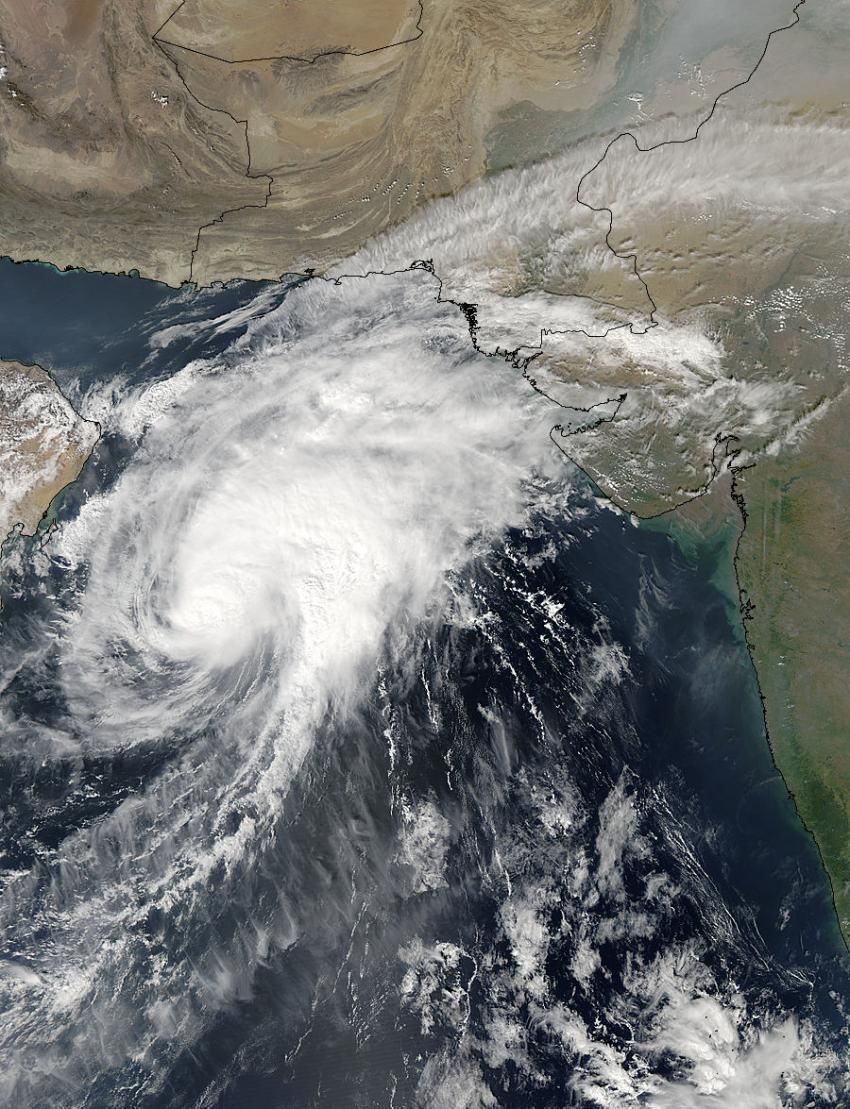
© NASA Goddard MODIS Rapid Response TeamNASA's Aqua satellite captured this image on Oct. 29 at 09:00 UTC (5 a.m. EDT) as Tropical Cyclone Nilofar moved through the Arabian Sea toward a landfall in northwestern India.
The Moderate Resolution Imaging Spectroradiometer aboard NASA's Aqua satellite captured an image of Tropical Cyclone Nilofar on Oct. 29 at 09:00 UTC (5 a.m. EDT). Tropical Cyclone Nilofar is moving through the Arabian Sea. The image shows that clouds were being pushed to the northeast of the center of the storm, from strong southwesterly wind shear.
On Oct. 29 at 1500 UTC (11 a.m. EDT), Nilofar had maximum sustained winds near 90 knots (103.6 mph/166.7 kph) and slow weakening is expected over the next couple of days. Nilofar was centered near 19.5 north latitude and 62.5 east longitude, about 205 nautical miles (236 miles/380 km) east-southeast of Masirah Island. Nilofar was moving to the north-northeast at 6 knots (6.9 mph/11.1 kph).
India's Regional Specialized Meteorological Service or RSMC forecast said Cyclone Nilofar is expected to move northeastward and cross north Gujarat and the adjoining Pakistan coast around Naliya by the night time hours on Oct. 31, but as it approaches the Gujarat Coast it is expected to weaken to a depression.
Although one of the computer forecast models calls for dry air to move into the system and possible dissipate it over the ocean, the consensus suggests a landfall. The Joint Typhoon Warning Center forecast calls for Nilofar to weaken to a tropical storm and make landfall near the India/Pakistan border late on Oct. 31 (UTC).



Reader Comments
to our Newsletter