
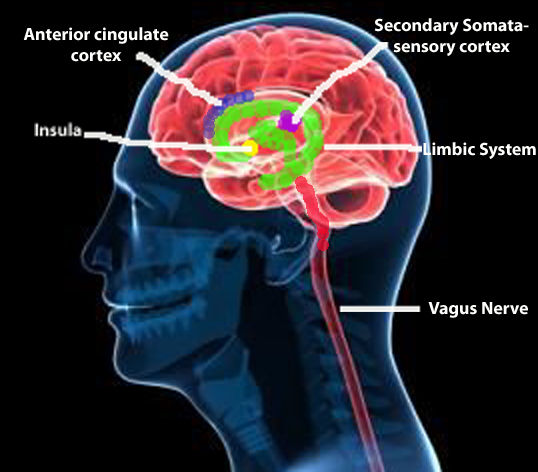
Most graphically represented cross-sections of the brain do not include the all-important Vagus Nerve leading down from it, unfortunately. For more on this read the comment at the end of the article.
Comment: From the author's prior article she states:
Stress affects the size and thickness of a few different regions of your brain - the one we'll focus on here is the amygdala, an almond-shaped structure located deep within your brain. During acute stressors, the amygdala helps orchestrate the brain's rapid fight or flight response (3). This response can be adaptive in some settings, but repeated, excessive, or prolonged stress responses are thought to place people at risk for stress-related diseases (4,5). The amygdala has been shown to be a key player in mental and emotional health, with abnormal amygdala function identified in depression, anxiety, posttraumatic stress disorder, phobias, and panic disorders (6 - 8). Higher levels of perceived stress in a large sample of community adults have been associated with increased size of the amygdala (9). Moreover, some recent work suggests that reductions in perceived stress are associated with reduced amygdala density (10).
Under stress, specific functional neural changes have been observed in amygdala to prefrontal cortex (a higher order "thinking" area) circuitry, with the amygdala activating stress pathways that result in impaired prefrontal functions such as attention and working memory (3). Essentially, stress is changing how different brain regions "talk" to each other. This occurs even when your brain is at rest - it is reflected in baseline patterns of brain activity, where changes in neural functional connectivity have been shown between the amygdala and frontal brain regions in people with stress-related disorders (11 - 13).
While it's important to know what these changes are, most people are understandably more interested in what they can do to combat some of these negative effects.
There's a two-part answer to this question: you can (a) reduce your stress levels, (b) try to reverse the negative effects of stress, or ideally, (c) - a combination of both. There are a number of stress-reduction techniques that neuroscientists have studied, including guided relaxation and breathing techniques, mindfulness and meditation, biofeedback, and physical activity. I'd like to divide these into two categories: what can be thought of as "direct brain training" (mindfulness, guided imagery, attention training, etc.), and physiological training methods that have downstream effects on your brain (e.g. exercise, biofeedback). Let's start with the former:
The science of training your brain
Maybe you've heard of or read about mindfulness lately - once perceived by many as a "fringe" or largely "alternative" therapy that perhaps conjures images of Zen masters, mindfulness has recently hit the mainstream - largely thanks to a growing body of research to back up its benefits for both physical and mental health.
Mindfulness is defined as conscious awareness of moment-to-moment internal and external experience - paying attention to sensations and thoughts as they arise (with both focused attention and open monitoring), and acknowledging these thoughts and sensations in an accepting, non-judgmental way. It can be something you already have innately, at least to some degree ("dispositional" or "trait" mindfulness), and it can also be trained through various mental exercises.
Mindful traits (measured with a pen and pencil questionnaire, such as the Mindful Attention and Awareness Scale) as well as mindfulness-based interventions (such as the clinically validated Mindfulness Based Stress Reduction 8-week program) have been associated with increased measures of overall well-being and decreased incidence of depression, anxiety, mood disorders, and psychopathology (1,2). Additionally, mindfulness is linked to better outcomes in a number of clinical conditions, including chronic pain, HIV, cancer, cardiovascular disease, and fibromyalgia (3,4). Despite an increasing number of studies reporting positive associations between mindfulness and physical and mental well-being, the neurobiological processes that underlie the health benefits of increased mindfulness are just beginning to be understood.

Want to see your level of trait mindfulness? Test with the Mindful Attention and Awareness Scale: http://www.ppc.sas.upenn.edu/mindfulnessscale.pdf
Interested in trying out mindfulness training? Guided 10 - 45 minute mp3's from UC San Diego's MBSR program are available for free here: http://health.ucsd.edu/specialties/mindfulness/mbsr/Pages/audio.aspx
1. Hofmann SG, Sawyer AT, Witt AA, Oh D. The effect of mindfulness-based therapy on anxiety and depression: A meta-analytic review. J Consult Clin Psychol. 2010;78(2):169 - 83.
2. Baer RA. Mindfulness training as a clinical intervention: A conceptual and empirical review. Clin Psychol Sci Pract. 2003;10(2):125 - 43.
3. Brown KW, Ryan RM, Creswell JD. Mindfulness: Theoretical foundations and evidence for its salutary effects. Psychol Inq. 2007;18(4):211 - 37.
4. Smith JE, Richardson J, Hoffman C, Pilkington K. Mindfulness-Based Stress Reduction as supportive therapy in cancer care: systematic review. J Adv Nurs. 2005;52(3):315 - 27.
5. Brefczynski-Lewis JA, Lutz A, Schaefer HS, Levinson DB, Davidson RJ. Neural correlates of attentional expertise in long-term meditation practitioners. Proc Natl Acad Sci. 2007 Jul 3;104(27):11483 - 8.
6. Tang Y-Y, Ma Y, Wang J, Fan Y, Feng S, Lu Q, et al. Short-term meditation training improves attention and self-regulation. Proc Natl Acad Sci. 2007 Oct 23;104(43):17152 - 6.



Comment: Another way to foster mindfulness and counteract the harmful effects of stress on the brain (and the rest of your body for that matter) is to learn and practice the techniques explained in the Éiriú Eolas Stress Control, Healing and Rejuvenation Program. In particular, one will learn about the tenth cranial nerve or Vagus Nerve and how it's stimulation, through an easy technique called pipe-breathing, can induce the production of pro-social hormones like oxytocin, reduce bodily inflammation, and increase cognitive function.
You can see the video presentation of Éiriú Eolas here.