
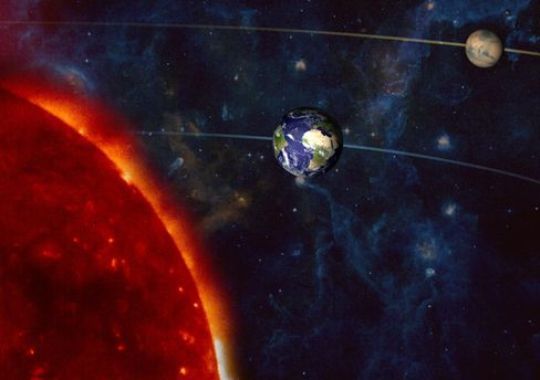
© NASAAn artist's conception of a previous Mars opposition from a few years ago. The distances between the sun, the planets and the distant nebula are not to scale.
Every two years, Mars reaches a point in its orbit called "opposition," when the planet lies directly opposite the sun in Earth's sky, according to Astronomy magazine.
This means Mars rises near sunset and remains visible all night long as it moves nearly overhead across the night sky. It will be a bright burnt orange color, NASA's Mars Exploration Program reports, and almost 10 times brighter than the brightest stars in the sky.
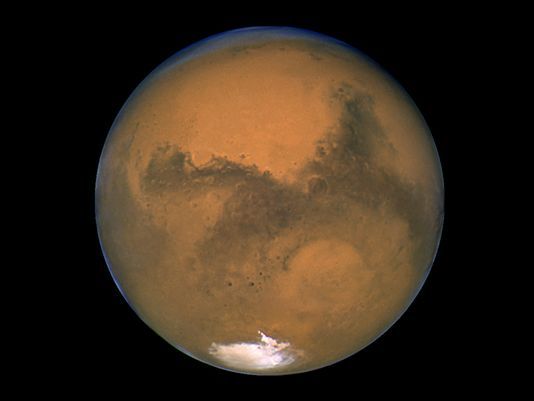
© APMars will be visible throughout the night as it traverses across the sky from east to west.
With no big storms forecast Tuesday night, according to the National Weather Service, Mars should be visible in most areas.
At their closest point next week, Mars and Earth will "only" be about 57 million miles apart. Another treat awaits April 14, when the full moon also will appear near Mars.
Mars won't appear this big and bright again until its next "opposition" on May 22, 2016, Astronomy reports.



The Mars Oppositions cycle is 15-17 years. Mars orbit is very elliptical compared to Earths.
About every 2 years we pass Mars, and each pass is either closer than the last, or longer.
August 2003 was a closest possible pass.
The next closest possible pass is August 2018, when we will once again pass Mars when it is in the part of it's orbit closest to Earths.
But 2014 is a midway between closest and longest possible passes.