
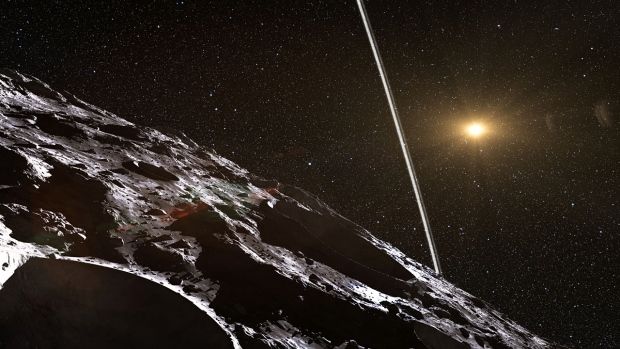
© Nick Risinger/L. Calçada/ESOThis artist's impression shows how the rings might look from close to the surface of Chariklo. They are 1,000 times closer than the moon is to Earth, but are each just a few kilometres wide.
The asteroid Chariklo, which is also considered a minor planet, appears to be encircled by two narrow rings, reported an international team of scientists in a paper published online Wednesday in the journal Nature.
"We weren't looking for a ring and didn't think small bodies like Chariklo had them at all," said Felipe Braga-Ribas of the Observatório Nacional/MCTI in Rio de Janeiro, Brazil, lead author of the report, in a statement.
"So the discovery - and the amazing amount of detail we saw in the system - came as a complete surprise!"
Chariklo is the largest of the Centaurs, a group of asteroids orbiting between Saturn and Uranus. Its diameter is about 250 kilometres. In comparison, Lake Ontario is 310 kilometres long and Prince Edward Island is 224 kilometres long.
Chariklo is named after a nymph who was the wife of the centaur Chiron in Greek mythology.
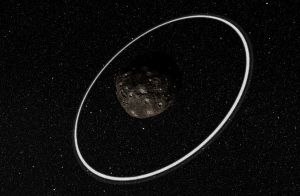
© L. Calçada/M. Kornmesser/Nick Risinger/ESOThe two rings, shown in an artist's impression, have been nicknamed Oiapoque and Chui after rivers near the northern and southern ends of Brazil.
A comparison of the data from the different telescopes and some calculations revealed that the dips were caused by two rings, one seven and one three kilometres wide, with a nine-kilometre gap in-between. They have been nicknamed Oiapoque and Chuí, two rivers near the northern and southern ends of Brazil
The rings sit 1,000 times closer to Chariklo than the moon does to Earth, said study co-author Uffe Grae Jorgensen of the University of Copenhagen, in a news release from the European Southern Observatory. The ESO runs two of the telescopes used in the study.
The researchers think the rings formed from debris left over from a collision of an object with Chariklo or between two objects orbiting it. That debris was shaped into rings by one or more undiscovered small "shepherd" moons - about a kilometre across - embedded in the rings themselves.
"What we are witnessing is perhaps the unveiling of an object that is in the middle of the same stage of development as the Earth and the moon 4.5 billion years ago, when there was a giant collision between Earth and another planet," Jorgensen said in a news release from the University of Copenhagen.
He added that if the rings eventually gather up into a single moon, it will be about two kilometres in diameter.
Only four other objects in the solar system are known to have rings: The giant planets Jupiter, Saturn, Uranus and Neptune.



Comment: The astronomers are disappointed because it's another nail in the coffin of their theories about how the Universe works.
SOTT Talk Radio: The Electric Universe - An interview with Wallace Thornhill