
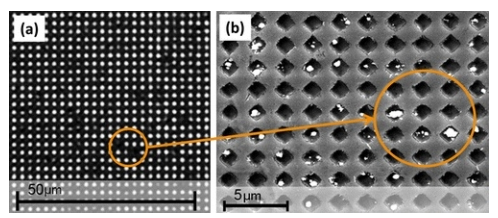
© unknownLeft: Pathogens and silver particles, blocking holes to detect the presence of bacteria. Right: A close-up of blocked holes
That price is bold, especially for a technique so involved beneath the surface. The process centers around a glass slide covered in light-sensitive material, and evaporated gold with tiny holes that allow light to pass through them. Disease antibodies are placed into the holes of the slide, sticking to the glass. If a biological sample contains that disease, those molecules will bond with the antibodies in the holes. This isn't enough to completely cover the holes, so another layer of antibodies is placed on top, along with enzymes that evoke silver production. After a short period of time, the slide can be rinsed again and the silver produced will be enough to block light from coming through the holes.
It's a complicated process, but researchers are convinced it could be distilled into a small device, such as an attachable lens, that can be read by a smartphone's camera and flash. The system isn't fool-proof yet, especially since researchers still need to figure out a way to ensure that the bacteria can reach the surface of the slide to get the most accurate reading. But if this concept becomes reality, it could help medical professionals during emergency situations and when diagnosing a large group of people quickly. Not to mention let smartphone users to see if they have the signs of a cold before consulting a doctor.



Comment: Are we so dense that we need a phone to tell us when we're sick?