

Depressive disorders by country. Graphic from the 'Burden of Depressive Disorders by Country, Sex, Age, and Year: Findings from the Global Burden of Disease Study 2010' research paper
According to the researchers, who gathered pre-existing data on clinical diagnoses up to 2010, Algeria, Libya, Syria and Afghanistan fared worse for the cumulative number of years their citizens lived with the disability of depression (YLD). (For the Middle East countries, bear in mind that this relates to data gathered before the Arab spring turned lives upside down).
Comment: Libya, Syria and Afghanistan, all war torn countries devastated by the U.S. empire, hardly any surprise then, that the inhabitants are 'depressed'.
Japan fared the best, along with Australia and New Zealand. The researchers caveated their work by acknowledging that data is patchy from some parts of the world. Intriguingly, the UK and US - countries in which reporting on mental illness and cultural reflections of depression are rapidly multiplying - appear to be far less badly afflicted than parts of Africa and eastern Europe.
The second interesting breakdown (no pun intended) of the data concerns age.
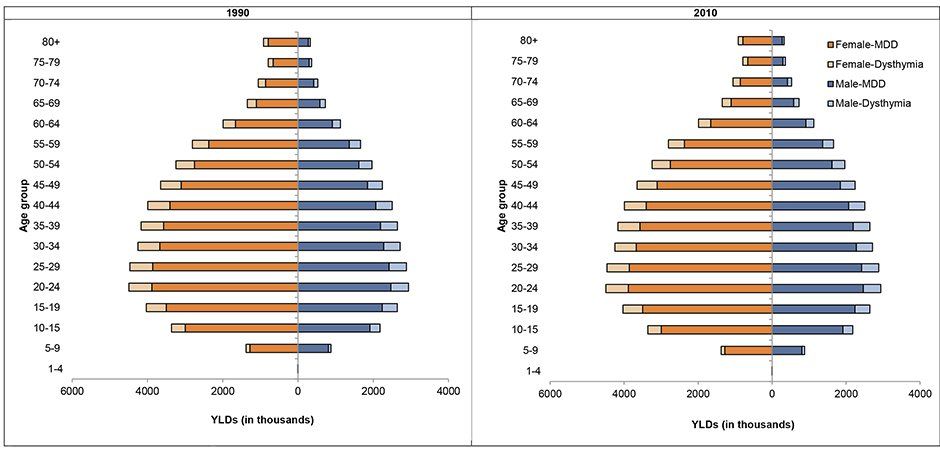
YLDs by age and sex for major depressive disorder and dysthymia (milder depression) in 1990 and 2010.
So is depression on the rise? Again, you would think so from the proliferation of reporting and analysis about the disease. The researchers say yes and no: depressive illness is the disease with the second heaviest burden on society, with around one in 20 people suffering. But if it is getting worse, they say, it may be down to demographics.
"Whilst burden increased by 37.5% between 1990 and 2010, this was due to population growth and ageing," they say. "Contrary to recent literature on the topic, our findings suggest that the epidemiology of both major depressive disorder and dysthymia (milder depression) remained relatively stable over time."
Source: plosmedicine.org




Japan has one of the highest suicides rates in the world, hardly a marker for faring the best. Any claims involving comparing people around the world speaking different langues, living in different cultures is highly suspect.