
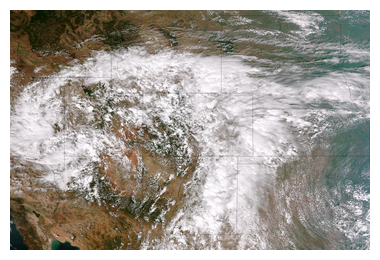
© NOAAThis image from the Suomi NPP satellite's VIIRS sensor from the evening of September 11, 2013, shows the storm system that has devastated towns in the foothills of the Rockies in central Colorado.
Such floods have a 1 percent and 0.1 percent chance of occurring, respectively, during any given year. While those odds make them rare events, they are the result of natural larger-scale weather and climate patterns, with perhaps an assist from climate change.
Still, some Internet users have voiced alternative views, suggesting that the destructive rainstorms were more directly human-induced, the result of Colorado's cloud-seeding program.
Cloud seeding, in which tiny silver iodide particles are sprayed into clouds to provide a core for ice crystals to form around, falls within the Colorado Weather Modification Program that is overseen by the Colorado Water Conservation Board and is used primarily by ski resorts to increase the snowpack during the winter.
The program - which has been reported to increase the snowpack by 10 to 15 percent each year - remains controversial among those concerned about the unknown repercussions of manipulating weather in this way.
But Andrew Heymsfield, senior research scientist at the National Center for Atmospheric Research in Boulder, Colo., (which was shut down by the floods) says that there is no scientific basis for the argument that cloud seeding could have caused the recent destructive storms.
"You would have to be seeding over massive areas continuously for this to happen," Heymsfield told LiveScience. "You cannot create the precipitation we had by cloud seeding. There is no way that man can do that."
Aside from being physically unfeasible on the scale that the storms occurred, Heymsfield said, cloud seeding in Colorado also takes place predominately in the western part of the state, where the large ski resorts are located. The weather system responsible for the flooding blew northward from the south, further ruling out any association with cloud seeding in the western part of the state, Heymsfield said.
Even if the weather modification program were able to produce the storms that occurred within the past week, they would not be doing so at this time of year, since few, if any, ski resorts have begun cloud seeding this early in the season, Heymsfield said.




To me, this seems a bit short sighted. Why don't we fast forward a couple of months till another natural occurrence of severe weather strikes while the seeding program is in high gear.
They may be skiing in August 2014.