
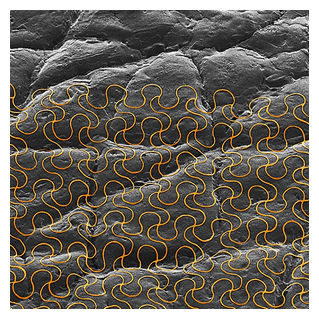
© MIT Technology ReviewElectronic tattoo: The image shows a colorized micrograph of an ultrathin mesh electronic system mounted on a skin replica.
So-called "epidermal electronics" were demonstrated previously in research from the lab of John Rogers, a materials scientist at the University of Illinois at Urbana-Champaign; the devices consist of ultrathin electrodes, electronics, sensors, and wireless power and communication systems.
In theory, they could attach to the skin and record and transmit electrophysiological measurements for medical purposes. These early versions of the technology, which were designed to be applied to a thin, soft elastomer backing, were "fine for an office environment," says Rogers, "but if you wanted to go swimming or take a shower they weren't able to hold up."
Now, Rogers and his coworkers have figured out how to print the electronics right on the skin, making the device more durable and rugged.
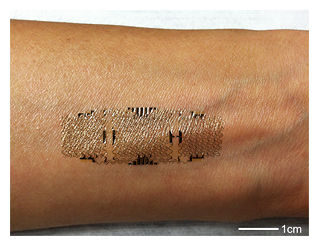
© MIT Technology ReviewSkin signals: This device, applied directly to the skin, can record useful medical information.
Eliminating the elastomer backing makes the device one-thirtieth as thick, and thus "more conformal to the kind of roughness that's present naturally on the surface of the skin," says Rogers. It can be worn for up to two weeks before the skin's natural exfoliation process causes it to flake off.
During the two weeks that it's attached, the device can measure things like temperature, strain, and the hydration state of the skin, all of which are useful in tracking general health and wellness. One specific application could be to monitor wound healing: if a doctor or nurse attached the system near a surgical wound before the patient left the hospital, it could take measurements and transmit the information wirelessly to the health-care providers.
Rogers says his lab is now focused on developing and refining wireless power sources and communication systems that could be integrated into the system. He says the technology could potentially be commercialized by MC10 (see "Making Stretchable Electronics"), a company he cofounded in 2008. If things go as planned, says Rogers, in about a year and half the company will be developing more sophisticated systems "that really do begin to look like the ones that we're publishing on now."



Reader Comments
to our Newsletter