
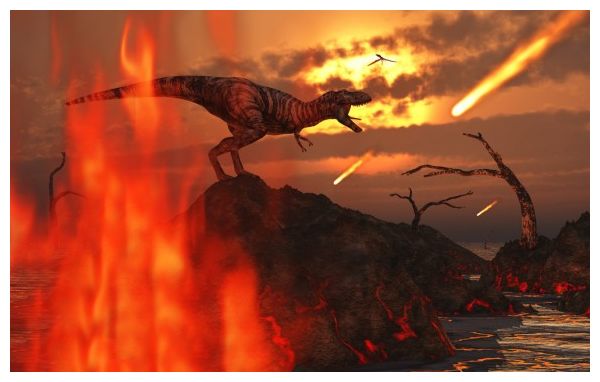
© MasPix/deviantartAn artist’s sketch of asteroids striking the Earth 65 million years ago during the reign of the Dinosaurs. Humanity will face potentially dangerous impactors, both large and small, from space in the (distant/near?) future. It is inevitable.
The geological and biological records attest to the fact that some impactors have played a major role in altering the evolution of life on Earth, particularly when the underlying terrestrial material at the impact site contains large amounts of carbonates and sulphates. The dating of certain large impact craters (50 km and greater) found on Earth have matched events such as the extinction of the Dinosaurs (Hildebrand 1993, however see also G. Keller's alternative hypothesis). Ironically, one could argue that humanity owes its emergence in part to the impactor that killed the Dinosaurs.
Only rather recently did scientists begin to widely acknowledge that sizable impactors from space strike Earth.
"It was extremely important in that first intellectual step to recognize that, yes, indeed, very large objects do fall out of the sky and make holes in the ground," said Eugene Shoemaker. Shoemaker was a co-discoverer of Shoemaker-Levy 9, which was a fragmented comet that hit Jupiter in 1994 (see video below).
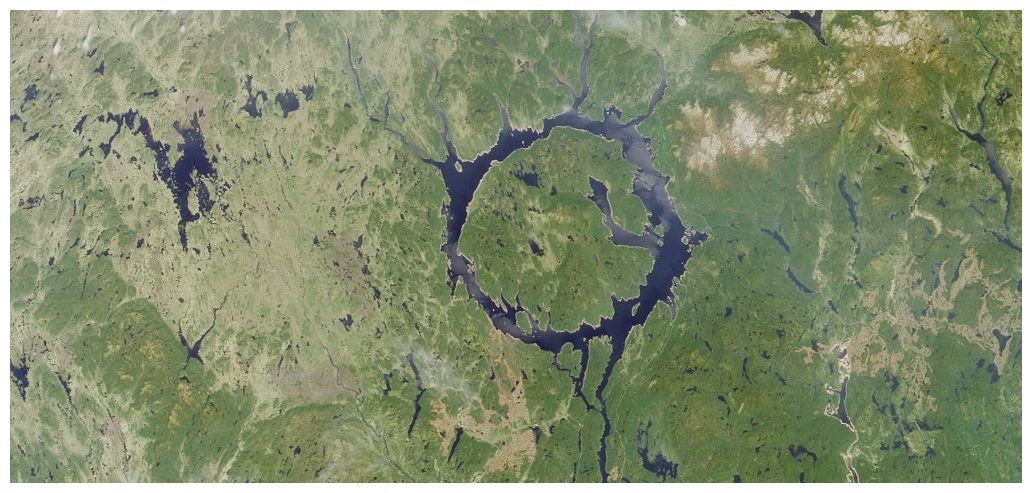
© NASAMore than a dozen known impactors created 50 km sized craters (and larger) on Earth. One such example is the Manicouagan crater in Quebec, Canada. The crater is 215 million years old, and exhibits an 85 km diameter.
Beyond the asteroid that struck Mexico 65 million years ago and helped end the reign of the dinosaurs, there are numerous lesser-known terrestrial impactors that also appear destructive given their size. For example, at least three sizable impactors struck Earth ~35 million years ago, one of which left a 90 km crater in Siberia (Popigai). At least two large impactors occurred near the Jurassic-Cretaceous boundary (Morokweng and Mjolnir), and the latter may have been the catalyst for a tsunami that dwarfed the recent event in Japan (see also the simulation for the tsunami generated by the Chicxulub impactor below).
Glimsdal et al. 2007 note, "it is clear that both the geological consequences and the tsunami of an impact of a large asteroid are orders off magnitude larger than those of even the largest earthquakes recorded."
However, in the CNN interview Neil deGrasse Tyson remarked that we'll presumably identify the larger impactors ahead of time, giving humanity the opportunity to enact a plan to (hopefully) deal with the matter. Yet he added that often we're unable to identify smaller objects in advance, and that is problematic. The meteor that exploded over the Urals a few weeks ago is an example.
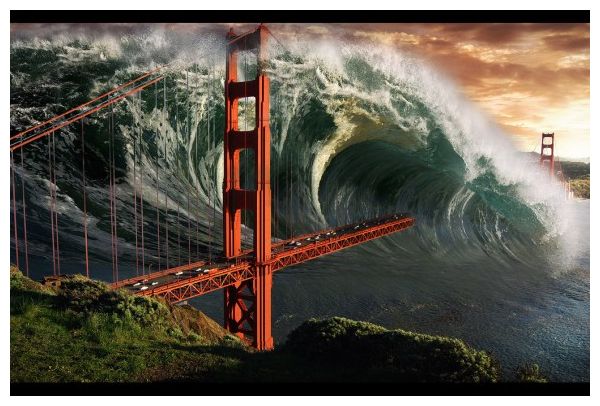
© binouse49/deviantartAn artist’s sketch of a tsunami which can be potentially generated by an asteroid/comet impactor.
Mark Boslough, a scientist who studied Tunguska noted, "That such a small object can do this kind of destruction suggests that smaller asteroids are something to consider ... such collisions are not as improbable as we believed. We should be making more efforts at detecting the smaller ones than we have till now."
Neil deGrasse Tyson hinted that humanity was rather lucky that the recent Russian fireball exploded about 20 miles up in the atmosphere, as its energy content was about 30 times larger than the Hiroshima explosion. It should be noted that the potential negative outcome from smaller impactors increases in concert with an increasing human population.
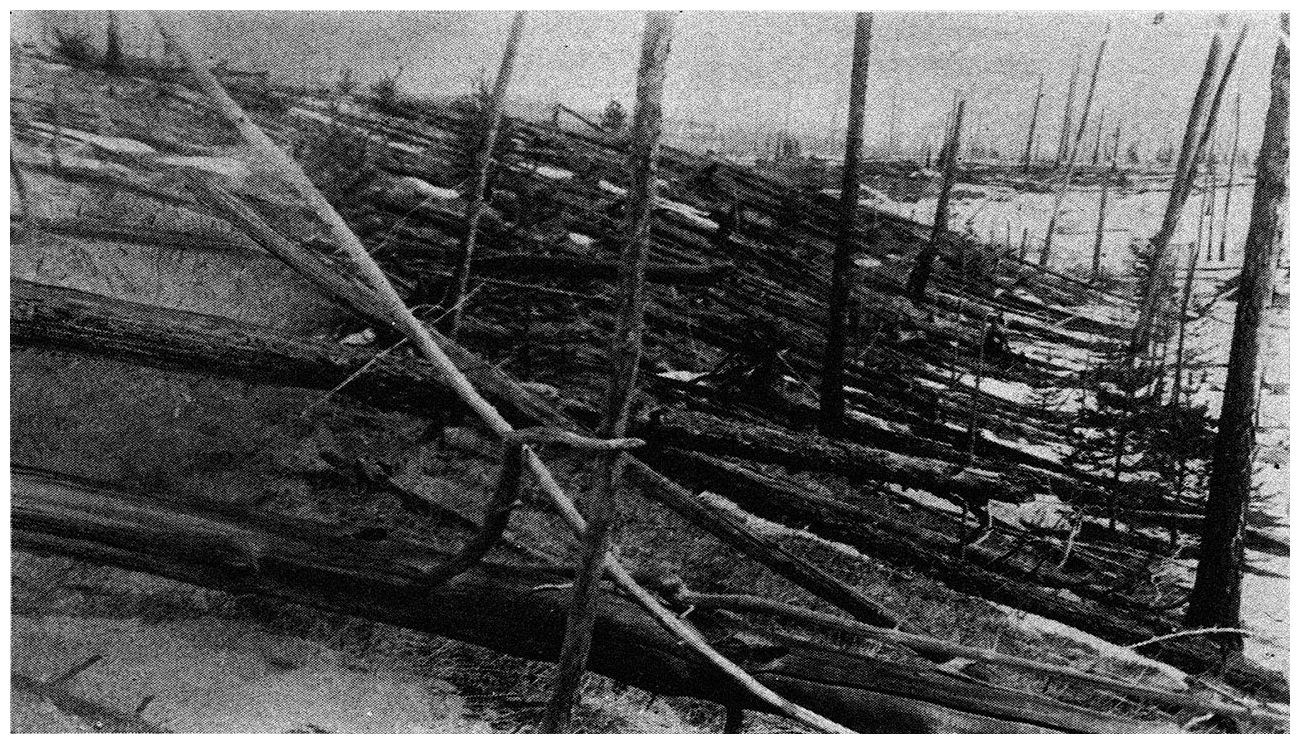
© KulikIn 1908 the Tunguska impactor toppled millions of trees in a rather remote part of Siberia. Had the object exploded over a city, the effects may have been catastrophic.
The putative periodicity (i.e., the Shiva hypothesis) is often linked to the Sun's vertical oscillations through the plane of the Milky Way as it revolves around the Galaxy, although that scenario is likewise debated (as is many of the assertions put forth in this article). The Sun's motion through the denser part of the Galactic plane is believed to trigger a comet shower from the Oort Cloud. The Oort Cloud is theorized to be a halo of loosely-bound comets that encompasses the periphery of the Solar System. Essentially, there exists a main belt of asteroids between Mars and Jupiter, a belt of comets and icy bodies located beyond Neptune called the Kuiper belt, and then the Oort Cloud. A lower-mass companion to the Sun was likewise considered as a perturbing source of Oort Cloud comets (The Nemesis Affair by D. Raup).
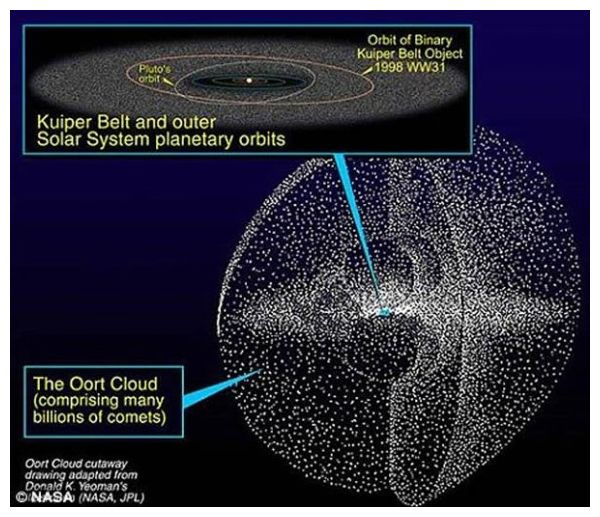
© NASA/JPLA halo of comets designated the Oort Cloud is theorized to encircle the periphery of the Solar System, and reputedly acts as a reservoir for objects that may become terrestrial impactors.
Indeed, if an asteroid in the belt were to breakup (e.g., collision) near a resonance, it would send numerous projectiles streaming into the inner solar system. That may help partly explain the potential presence of asteroid showers (e.g., the Boltysh and Chicxulub craters both date to near 65 million years ago). In 2007, a team argued that the asteroid which helped end the reign of the Dinosaurs 65 million years ago entered an Earth-crossing orbit via resonances. Furthermore, they noted that asteroid 298 Baptistina is a fragment of that Dinosaur exterminator, and it can be viewed in the present orbiting ~2 AU from the Sun. The team's specific assertions are being debated, however perhaps more importantly: the underlying transport mechanism that delivers asteroids from the belt into Earth-crossing orbits appears well-supported by the evidence.
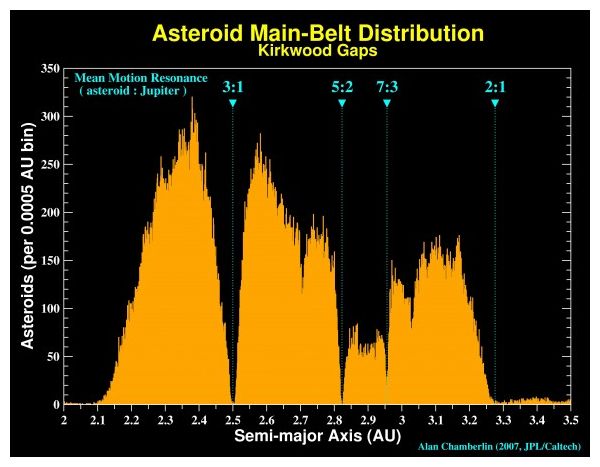
© Alan Chamberlain, JPL/CaltechA histogram featuring the number of asteroids as a function of their average distance from the Sun. Regions depleted of asteroids are often coincident with orbital resonances, the latter being a mechanism by which objects in the belt can be scattered into enter Earth-crossing orbits.
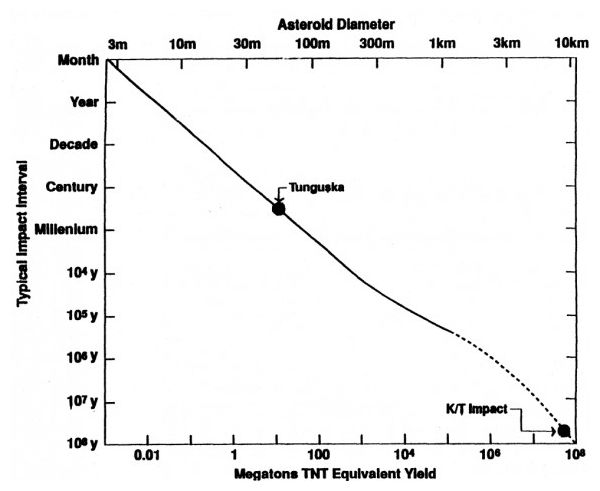
© Fig. 2 from Rampino and Haggerty 1996, NASA ADS/SpringerEstimated frequency of impactors as a function of diameter, energy yield, and typical impact interval. Results assume an impact speed of 20 km/s and density of 3 g/cm^3.
Is discussion of this topic fear mongering and alarmist in nature? The answer should be obvious given the fireball explosion that happened recently over the Ural mountains, the Tunguska event, and past impactors. Given the stakes excessive vigilance is warranted.
Fareed Zakharia's discussion with Neil deGrasse Tyson is below.
The interested reader desiring additional information will find the following pertinent: the Earth Impact Database, Hildebrand 1993, Rampino and Haggerty 1996, Stothers et al. 2006, Glimsdal et al. 2007, Bottke et al. 2007, Jetsu 2011, G. Keller's discussion concerning the end of the Dinosaurs, "T. rex and the Crater of Doom" by W. Alvarez, "The Nemesis Affair" by D. Raup, Collision Earth! The Threat from Outer Space by P. Grego. **Note that there is a diverse spectrum of opinions on nearly all the topics discussed here, and our understanding is constantly evolving. There is much research to be done.





When mainstream media sounds like you, and vise versa, there is something important missing.