
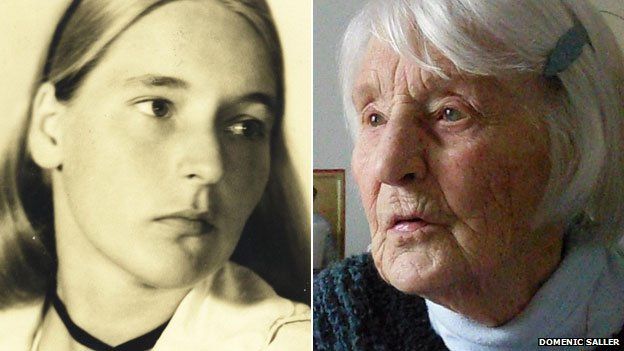
In 1943, World War II was at its height - but in Munich, the centre of Nazi power, a group of students had started a campaign of passive resistance.
Liselotte Furst-Ramdohr, already a widow at the age of 29 following her husband's death on the Russian front, was introduced to the White Rose group by her friend, Alexander Schmorell.
"I can still see Alex today as he told me about it," says Furst-Ramdohr, now a spry 99-year-old. "He never said the word 'resistance', he just said that the war was dreadful, with the battles and so many people dying, and that Hitler was a megalomaniac, and so they had to do something."
Schmorell and his friends Christoph Probst and Hans Scholl had started writing leaflets encouraging Germans to join them in resisting the Nazi regime.
With the help of a small group of collaborators, they distributed the leaflets to addresses selected at random from the phone book.
Furst-Ramdohr says the group couldn't understand how the German people had been so easily led into supporting the Nazi Party and its ideology.
"They must have been able to tell how bad things were, it was ridiculous," she says.
The White Rose delivered the leaflets by hand to addresses in the Munich area, and sent them to other cities through trusted couriers.
Furst-Ramdohr never delivered the leaflets herself but hid them in a broom cupboard in her flat.
She also helped Schmorell make stencils in her flat saying "Down with Hitler", and on the nights of 8 and 15 February, the White Rose graffitied the slogan on walls across Munich.
Furst-Ramdohr remembers the activists - who were risking their lives for their beliefs - as young and naive.
One of the best-known members of the group today is Hans Scholl's younger sister Sophie, later the subject of an Oscar-nominated film, Sophie Scholl: The Final Days. Furst-Ramdohr remembers that Sophie was so scared that she used to sleep in her brother's bed.
"Hans was very afraid too, but they wanted to keep going for Germany - they loved their country," she says.
On 18 February, Hans and Sophie Scholl set off on their most daring expedition yet. They planned to distribute copies of their sixth - and as it would turn out, final - leaflet at the University of Munich, where students would find them as they came out of lectures.
The siblings left piles of the leaflets around the central stairwell. But as they reached the top of the stairs, Sophie still had a number of leaflets left over - so she threw them over the balcony, to float down to the students below.
She was seen by a caretaker, who called the Gestapo. Hans Scholl had a draft for another leaflet in his pocket, which he attempted to swallow, but the Gestapo were too quick.
The Scholl siblings were arrested and tried in front of an emergency session of the People's Court. They were found guilty and executed by guillotine, along with their friend and collaborator Christoph Probst, on 22 February 1943.
Hans Scholl's last words before he was executed were: "Long live freedom!"
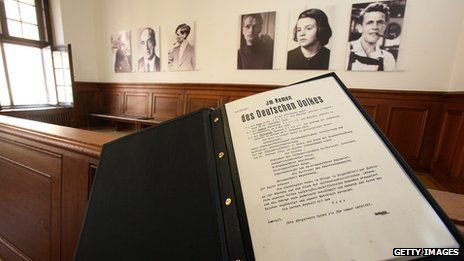
The Scholls were tried at the People's Court of Law, now Munich's district court
Returning to Munich, he was captured after a former girlfriend recognised him entering an air raid shelter during a bombing raid. He was arrested, and later executed.
Lilo Furst-Ramdohr was herself arrested on 2 March. "Two Gestapo men came to the flat and they turned everything upside down," she says.
"They went through my letters, and then one of them said 'I'm afraid you'll have to come with us'.
"They took me to the Gestapo prison in the Wittelsbach Palais on the tram - they stood behind my seat so I couldn't escape."
Furst-Ramdohr spent a month in Gestapo custody. She was regularly interrogated about her role in the White Rose, but eventually released without charge - a stroke of luck she puts down to her status as a war widow, and to the likelihood that the Gestapo was hoping she would lead them to other co-conspirators. After her release she was followed by the secret police for some time.
She then fled Munich for Aschersleben, near Leipzig, where she married again and opened a puppet theatre.
The final White Rose leaflet was smuggled out of Germany and intercepted by Allied forces, with the result that, in the autumn of 1943, millions of copies were dropped over Germany by Allied aircraft.
Since the end of the war, the members of the White Rose have become celebrated figures, as German society has searched for positive role models from the Nazi period.
But Furst-Ramdohr doesn't like it. "At the time, they'd have had us all executed," she says of the majority of her compatriots.
She now lives alone in a small town outside Munich, where she continued to give dancing lessons up to the age of 86.
Her friend Alexander Schmorell was made a saint by the Russian Orthodox church in 2012.
"He would have laughed out loud if he'd known," says Furst-Ramdohr. "He wasn't a saint - he was just a normal person."
Lucy Burns interviewed Liselotte Furst-Ramdohr for the BBC World Service programme Witness. Listen via BBC iPlayer or browse the Witness podcast archive.





On the 15/16 December the RAF carried out its first area bombing attack (destroying 45%) on the city of Mannheim).
In 1942, the goals of the British attacks were defined: the primary goal was the so-called "morale bombing", to weaken the will of the civil population to resist. Following this directive intensive bombing of highly populated city centers and working class quarters started. On 30 May 1942, the RAF Bomber Command launched the first "1,000 bomber raid" when 1,046 aircraft bombed Cologne in Operation Millennium, dropping over 2,000 tons of high explosive and incendiaries on the medieval town and burning it from end to end. 411 civilians and 85 soldiers were killed, more than 130,000 had to leave the city.[citation needed]
Two further 1,000 bomber raids were executed over Essen and Bremen, but to less effect than the destruction at Cologne. The effects of the massive raids using a combination of blockbuster bombs and incendiaries created firestorms in some cites. The most extreme examples were caused by the bombing of Hamburg in Operation Gomorrah (45,000 dead), and the bombings of Kassel (10,000 dead), Darmstadt (12,500 dead), Pforzheim (21,200 dead), Swinemuende (23,000 dead), and Dresden (25,000 dead[18]).[citation needed]
When genocidal arsonists were slaughtering their countrymen, these " idealists" sided with the enemy.