
The solar plasma eruption, which NASA scientists nicknamed a "Dragon Tail," rose up from the sun's surface today (Jan. 31) and was spotted by the agency's Solar Dynamics Observatory, a powerful spacecraft that constantly records the sun's weather in different wavelengths of light.
A video of the Dragon Tail solar eruption shows a tendril of solar plasma, which scientists call a "filament," extending across the northeastern face of the sun over the course of four hours. Near the end of the event, the filament begins to break apart.
"Some of the plasma was released into space but not all could escape the gravitational pull of the sun," SDO mission officials explained in a video description. "It's not surprising that plasma should fall back to the sun. After all, the sun's gravity is powerful. "
Filaments are plasma formations on the sun sculpted by the star's intense magnetic field, with one end anchored to the sun's surface. The other end can extend through the sun's outer atmosphere, called the corona, hundreds of thousands of miles into space.
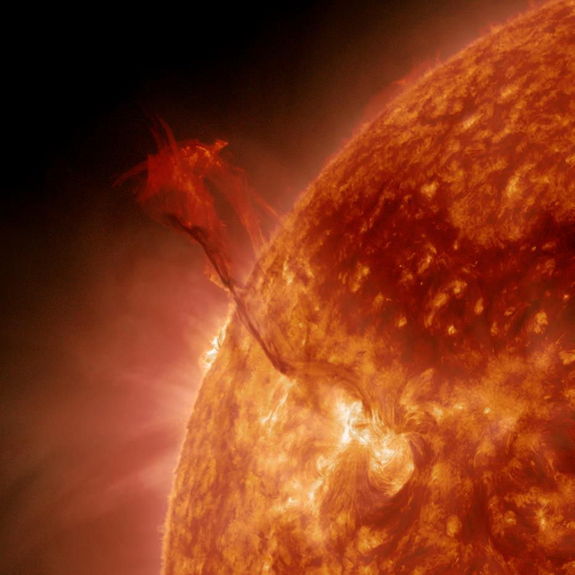
© NASA SDO (via Facebook as NASA Solar Dynamics Observatory (Little SDO))A huge filament of super-hot plasma, nicknamed the "Dragon Tail," erupts from the sun on Jan. 31, 2013.
NASA's Solar Dynamics Observatory is one of several spacecraft constantly monitoring the sun for signs of solar flares, eruptions and other space weather events. The sun is currently in an active phase of its 11-year solar weather cycle and is expected to reach its peak activity period in 2013. The current sun weather cycle is known as Solar Cycle 24.





Where our double star is located.
What is the electrical model of the interaction between the stars.
How long is the "Great Cycle"
What are precursors to completing a "great Cycle" revolution.
What to expect during and after the transition ( Golden Age ).
Connection to myths and religion.
And more.
The introduction is located here:
"We live in a double star system"
[Link]
you can get involved