
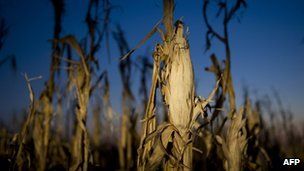
A severe drought in the US has led to many farmers having to abandon their 2012 harvest
The bank said that a US heatwave and drought in parts of Eastern Europe were partly to blame for the rising costs.
The price of key grains such as corn, wheat and soybean saw the most dramatic increases, described by the World Bank president as "historic".
The bank warned countries importing grains will be particularly vulnerable.
From June to July this year, corn and wheat prices each rose by 25% while soybean prices increased by 17%, the World Bank said. Only rice prices decreased - by 4%.
In the United States, the most severe, widespread drought in half a century has wreaked havoc on the corn and soybean crops while in Russia, Ukraine and Kazakhstan, wheat crops have been badly damaged.
The World Bank said that the use of corn to produce ethanol biofuel - which represents 40% of US corn production - was also a key factor in the sharp rise in the US maize price.
Overall, the World Bank's Food Price Index - which tracks the price of internationally traded food commodities - was six percent higher than in July of last year, and one percent over its previous peak, in February 2011.
'Lifetime of perils'
The organisation is urging governments to bolster programmes to protect their most vulnerable communities from the increase in the cost of food.
"We cannot allow these historic price hikes to turn into a lifetime of perils as families take their children out of school and eat less nutritious food to compensate for the high prices," World Bank President Jim Yong Kim said.
He said countries in North and Sub-Saharan Africa and the Middle East were among those most exposed to such price increases because much of their food was imported and food bills make up a large proportion of average household spending.
Already, the bank said, maize prices had increased by 113% over the past quarter in Mozambique, while sorghum had risen 220% in South Sudan.
Although the bank said that it did not foresee the kind of price increases which led to riots in many countries in 2008 there were, it said, other potential risks which could push grain prices higher.
These included exporters pursuing panic policies, a severe El Nino, disappointing Southern hemisphere crops and strong increases in energy prices.
The G20 group of leading economies has said it will not take any decision on joint action until after the US agriculture department's September estimate of this year's harvest.
But aid charity Oxfam said it was not acceptable for governments to delay acting on food prices until the situation had deteriorated further.
"This 'wait and see' attitude is unacceptable," Colin Roche said.
"Oxfam is already seeing the devastating impact of food price volatility in developing countries that rely on food imports."



"If push comes to shove." American idiom meaning: The point at which a situation compels forceful action.
It is arriving. Our complacency, our inaction, our unwillingness to prepare have combined to create a situation in which someone will have to decide to allow whole populations to starve.
"Conspiracy theorists" think that it has come this far because that's where someone wants it to be. Someone wants a "kill switch" that they can throw and blame on "bad luck."
If the planet survives this, I hope we can learn from it. We are in a time where ancient patterns could actually be changed. Where societies could be built on freedom, honor, ingenuity and hard work instead of deceit. We maybe still have that chance on earth. But maybe not.
I am calmed, but not complacent, in the knowledge than a few beings, at least, now exist who know what really needs to be done, and are willing to carry on in an honest, if somewhat forceful, manner in that direction. I wish there were many many more such beings!