
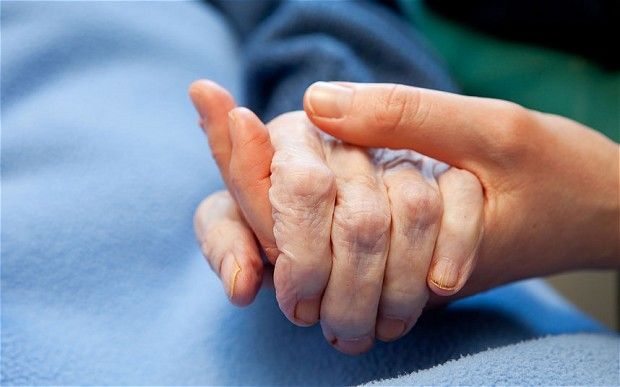
© AlamySupporters of the Liverpool Care Pathway, which allows medical staff to withhold fluid and drugs in a patient's final days, claim it is the kindest way of letting them slip away Photo:
Tens of thousands of patients with terminal illnesses are placed on a "death pathway" to help end their lives every year. However, in a letter to The Daily Telegraph, six doctors warn that hospitals may be using the controversial scheme to reduce strain on hospital resources.
Supporters of the Liverpool Care Pathway, which allows medical staff to withhold fluid and drugs in a patient's final days, claim it is the kindest way of letting them slip away. But the experts say in their letter that natural deaths are often freer of pain and distress.
Informed consent is not always being sought by doctors, who fail to ask patients about their wishes while they are still in control of their faculties, warn the six. This has led to an increase in patients carrying cards informing doctors that they do not wish to be put on the pathway in the last few days of their lives.
The six doctors are experts in elderly care and wrote the letter in conjunction with the Medical Ethics Alliance, a Christian medical organisation. They say that many members of the public have contacted them with examples of inappropriate use of the pathway, which is implemented in up to 29 per cent of hospital deaths.
They warn that there is no "scientific way of diagnosing imminent death." They write: "It is essentially a prediction, and it is possible that other considerations may come into reaching such a decision, not excluding the availability of resources."
The Liverpool Care Pathway, so called because it was developed at the Royal Liverpool Hospital in the 1990s, aims to ensure that patients who are close to death can die without being subjected to unnecessary interference by staff. In addition to the withdrawal of fluid and medication, patients can be placed on sedation until they die.
Dr Gillian Craig, a retired geriatrician and former vice-chairman of the Medical Ethics Alliance, is one of the six signatories to The Daily Telegraph letter.
"If you are cynical about it, as I am, you can see it as a cost-cutting measure, if you don't want your beds to be filled with old people," she said. She advised that those who did not want to be put on the pathway should carry cards made by Dr Rosalind Bearcroft, a consultant psychiatrist from Kent, and another signatory.
Last year The Daily Telegraph reported that the numbers being put on the pathway had doubled in just two years, with tens of thousands of patients now involved. But up to half of families are not being informed of clinicians' decision to put a relative on the pathway, the report by the Royal College of Physicians found. Advocates point out that the Liverpool Care Pathway has been approved by the National Institute for Health and Clinical Excellence (Nice) and is backed by the Department of Health.
A Department of Health spokesperson said: "People coming to the end of their lives should have a right to high quality, compassionate and dignified care.
"The Liverpool Care Pathway (LCP) is not about saving money. It is an established and respected tool that is recommended by NICE and has overwhelming support from clinicians at home and abroad.
"The decision to use the pathway should involve patients and family members, and a patient's condition should be closely monitored. If, as sometimes happens, a patient improves, they are taken off the LCP and given whatever treatments best suit their new needs. To ensure the LCP is used properly, it is important that staff receive the appropriate training and support."


Six doctors who obviously want to throw 'everything they've got' at a dying patient to keep them alive for... how long? And at what cost? obviously DON'T represent the large number of people who deal with dying people every day. You may even be surprised if they 'see' the person as dying at all.... we can save them, we can save them and they die in 3-4 days. Shoot.
The LAST thing a dying person wants is food. It is cruel, undignified and most of all, disrespectful to try and force a dying person to eat. This is the LAST thing they are interested in (although in many cultures, this is not at all understood as it is assumed that food keeps the person alive). Hydration is good, but nutrition is not when the body is in the process of shutting down. This is a NATURAL process. Its like the body has a heirachy of things and I'm afraid that the gut is most likely last on the body's list. Heart, respiratory function and kidneys perhaps first? Basic functions only.
Palliative care is mandatory for people who live in countries that don't have euthanasia laws (as if there is another choice?). Perhaps what the dying patient wants, (and their families) are to be 'hit with a magic stick' and cured. No doubt they are afraid of dying. To some people, the word 'palliative' fills them with fear and terror, as does dying. No doubt, they might feel the same about the Liverpool pathway.
People have weird ideas about death. Some seek to avoid it at any cost. And dealing with it in a dignified manner can sometimes be challenging for some people. People fear what they don't understand. And journalists tend to need a good beat up story. Six doctors? Oh really? What's their evidence?
I wonder what is going to become of these six doctors?