
It turns out that they do, sort of, and a NASA-funded researcher at the University of Iowa has figured out how to find them.
"We call them X-points or electron diffusion regions," explains plasma physicist Jack Scudder of the University of Iowa. "They're places where the magnetic field of Earth connects to the magnetic field of the Sun, creating an uninterrupted path leading from our own planet to the sun's atmosphere 93 million miles away."
Observations by NASA's THEMIS spacecraft and Europe's Cluster probes suggest that these magnetic portals open and close dozens of times each day. They're typically located a few tens of thousands of kilometers from Earth where the geomagnetic field meets the onrushing solar wind. Most portals are small and short-lived; others are yawning, vast, and sustained. Tons of energetic particles can flow through the openings, heating Earth's upper atmosphere, sparking geomagnetic storms, and igniting bright polar auroras.
NASA is planning a mission called "MMS," short for Magnetospheric Multiscale Mission, due to launch in 2014, to study the phenomenon. Bristling with energetic particle detectors and magnetic sensors, the four spacecraft of MMS will spread out in Earth's magnetosphere and surround the portals to observe how they work.
Just one problem: Finding them. Magnetic portals are invisible, unstable, and elusive. They open and close without warning "and there are no signposts to guide us in," notes Scudder.
Actually, there are signposts, and Scudder has found them.
Portals form via the process of magnetic reconnection. Mingling lines of magnetic force from the sun and Earth criss-cross and join to create the openings. "X-points" are where the criss-cross takes place. The sudden joining of magnetic fields can propel jets of charged particles from the X-point, creating an "electron diffusion region."
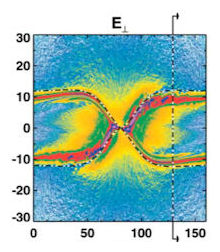
© Science@NASAData from NASA's Polar spacecraft, circa 1998, provided crucial clues to finding magnetic X-points.
"In the late 1990s, NASA's Polar spacecraft spent years in Earth's magnetosphere," explains Scudder, "and it encountered many X-points during its mission."
Because Polar carried sensors similar to those of MMS, Scudder decided to see how an X-point looked to Polar. "Using Polar data, we have found five simple combinations of magnetic field and energetic particle measurements that tell us when we've come across an X-point or an electron diffusion region. A single spacecraft, properly instrumented, can make these measurements."
This means that single member of the MMS constellation using the diagnostics can find a portal and alert other members of the constellation. Mission planners long thought that MMS might have to spend a year or so learning to find portals before it could study them. Scudder's work short cuts the process, allowing MMS to get to work without delay.
It's a shortcut worthy of the best portals of fiction, only this time the portals are real. And with the new "signposts" we know how to find them.
The work of Scudder and colleagues is described in complete detail in the June 1 issue of the Physical Review Letters.



...to make light of our attempts to understand our universe.
If the ones who "know" are going to be so stingy with their information, who can blame the rest of us for trying to figure it out on our own?
The opening paragraph to this piece is an excellent example of this patronizing demagoquery. Such attitudes are part of what turned me off about going to college. I want no part in this snobbish, sneering approach to people who are just trying to understand, and to develop some technologies that might be useful or helpful.
If Science wants me to take it seriously it can get off its high horse and start getting into real communication.