

© NASA/JPL-Caltech/Space Science InstituteSaturn's northern storm marches through the planet's atmosphere in the top right of this false-color mosaic from NASA's Cassini spacecraft.
"It is the singular distinction of being in orbit, and able to turn a scrutinizing eye wherever it is needed, that has allowed us to be present to witness this extraordinary phenomenon," said Carolyn Porco, the Cassini Imaging Team Leader. "The storm has spread to become a planet-encircling colossus, a wide kaleidoscopic band of commingled waves, vortices, and eddies, all in continuous swirling motion .... a mesmerizing display of snaking, sensuous, churning, turning, chaotic, roiling atmospheric turmoil."
If Porco sounds like she's waxing poetic, she has good reason. The images put out by the Cassini imaging team today are a "sublime visual extravaganza," and both true and false color images are gorgeous to behold.

© NASA/JPL-Caltech/Space Science InstituteThis is nearly true-color view by Cassini of the storm.
"Seven years of chasing such opportunities across the solar system's most magnificent planetary system have already made Cassini one of the most scientifically productive planetary missions ever flown," said Porco on the CICLOPS website. "And with any luck, there'll be a great deal more to come."
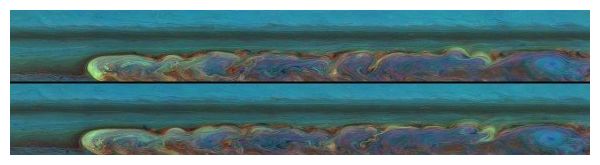
© NASA/JPL-Caltech/Space Science InstituteThese false-color mosaics from NASA's Cassini spacecraft chronicle the changing appearance of the huge storm that developed from a small spot in Saturn's northern hemisphere. Here Cassini captures the changes over the short time span of one Saturn day; the two images were taken 11 hours apart.
Other instruments on Cassini have detected the storm's electrical activity and revealed it to be a convective thunderstorm. Its active convecting phase ended in late June, but the turbulent clouds it created linger in the atmosphere today.
"The Saturn storm is more like a volcano than a terrestrial weather system," said Andrew Ingersoll, a Cassini imaging team member at the California Institute of Technology in Pasadena, Calif. "The pressure builds up for many years before the storm erupts. The mystery is that's there's no rock to resist the pressure - to delay the eruption for so many years."
This storm's 200-day active period makes it the longest-lasting planet-encircling storm ever seen on Saturn. The previous record holder was an outburst sighted in 1903 which lingered for 150 days. The large disturbance imaged 21 years ago by NASA's Hubble Space Telescope was comparable in size to the current storm. That 1990 storm lasted for only 55 days.
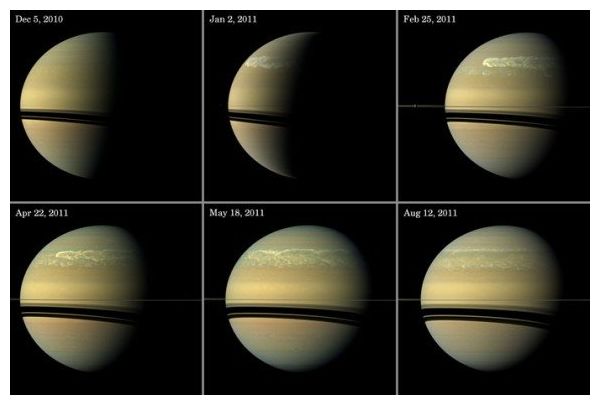
© NASA/JPL-Caltech/Space Science InstituteThis series of images from NASA's Cassini spacecraft shows the development of the largest storm seen on the planet since 1990.



Reader Comments
to our Newsletter