
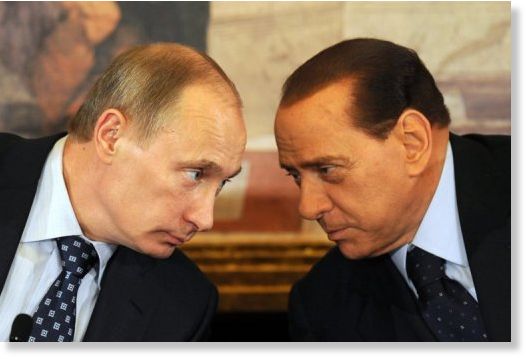
© Agence France-PresseRussian Prime Minister Vladimir Putin (left) and his Italian counterpart Silvio Berlusconi talk during a joint press conference at the Villa Gernetto in 2010. Putin has made light of the sex scandals surrounding Berlusconi, saying critics were simply jealous of his sexual prowess
"However much they nag Signor Berlusconi for his special attitude to the beautiful sex, and by the way they nag him mainly because of jealousy, he has shown himself as a responsible statesman," Putin said at an international investment forum in Sochi, quoted by the state RIA Novosti news agency.
He was speaking in praise of Berlusconi's financial belt-tightening to battle Italy's economic woes.
Berlusconi is facing charges of paying for sex with a 17-year-old girl and eight people were charged Thursday with procuring prostitutes for his parties in an attempt to curry favour.
Putin and Berlusconi have repeatedly talked of their close relationship and have visited each others' holiday residences.
Putin's comments go down well at home, but often cause shock abroad.
In 2006, he was overheard praising the then Israeli President Moshe Katsav who was at the time charged with multiple rapes, later to be convicted on two counts.
"He turned out to be a very mighty man! He raped 10 women. I would never have expected this from him. He surprised us all -- we all envy him!" Putin was quoted as saying in comments later described as a joke by the Kremlin.



And per websites such as Soldier-Statemsmen.org it is a noble and illustrious calling. [Link]
In many cultural traditions, the general is to be respected for his conquests, whether territorial or otherwise.
Putin's bravado clearly points out what should be obvious to all of us: This approach to the challenges of leadership is alive and well, and always has been. I would in fact prefer men with this approach to those who try to hide their membership in this culture behind a business suit or a law degree.
If we say we want truth, then this may be part of that process. And if Putin continues to have a loose mouth, perhaps it will eventually occur to us that this is a subject we need to confront. Many politicians and statesmen around the world evidently consider this to be part of the payoff for taking the risks involved in accepting a public leadership role.
Should we consider this attitude acceptable or is it too immoral to produce a truly outstanding leader? Do we condemn leaders if they admit to sleeping around, or do we judge them by their effectiveness as leaders?
Does the cleric or commentator who would condemn such men to infamy really have the best interests of the group in mind?
These are not easy questions to answer!