
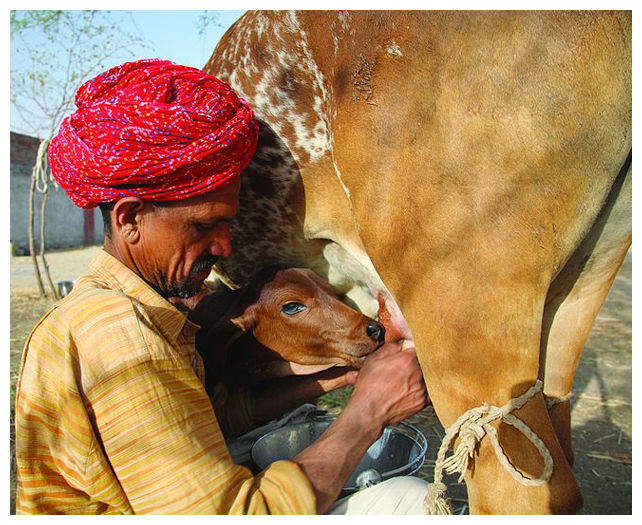
© Wikipedia CommonsA man and a calf share a cow's milk in India.
Like a milk mustache that just won't go away, a shared genetic signature marks many Europeans and Indians as descendants from a common milk-drinking ancestor within the last 7,500 years.
The majority of Europeans and Indians who can drink milk share the mutation known as -13910T. Scientists already knew that the mutation was what allowed most European adults to drink milk.
"To our surprise we found that the -13910T mutation was also common in India - especially in those populations with a tradition of milk drinking," said Toomas Kivisild of Cambridge University, senior author of the study, in a press release.
"Not only that, but by looking at nearby genetic regions we could show that the Indian -13910T has the same origin as that found in Europeans; that it could lead back to the same few people who may have migrated between Europe and India," said Kivisild.
All human babies can drink milk because they produce an enzyme called lactase, which breaks down milk sugar or lactose. But only about a third of the world's adults can drink milk without suffering abdominal pain, bloating, nausea, diarrhea, and other symptoms of lactose intolerance.
The genetic mutation that allows adults to drink milk, called lactase persistence, seems to have evolved separately in Europe, Africa, and the Middle East. But until now, the source of lactase persistence in India, the world's largest drinker and producer of milk, was a mystery.
"India was an unknown quantity. But since lactase persistence had evolved independently in the Middle East and Africa, and because cattle had been domesticated independently in India around seven or eight thousand years ago, we were expecting to see uniquely Indian genetic causes," said lead author, Cambridge's Irene Gallego Romero.
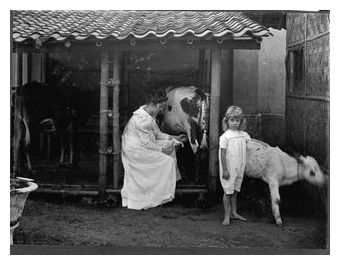
© Wikimedia CommonsEuropean emigrants tend their cows in Tjimahi, West Java.
"Genetic data doesn't support some sort of large migration of people from Europe to India in the last 10,000 years. What's more likely is that just a few migrants carried this mutation to India, and then it spread quickly," said co-author Mark Thomas of University College London.
The mutation was only found in certain segments of the Indian population. People with no history of pastoralism (raising cattle, goats, or sheep) didn't have the -13919T mutation. The researchers also suggested that social barriers like caste, tribe, and religion may have inhibited the gene's spread.



Reader Comments
Casein is making far more damage to the body. Lactose is the " easy " part because in most cases you get sick and you know that you should not drink milk. But you will the eat the fermented milk products that don't have lactose but are rich in casein. Then you think that now its OK and i can eat this because its lactose free. In the most of the cases people don't notice some problems while consuming casein but its not so good for eating.There are lot of articles here on this page about this. Lactose in only one, smaller part of this problem. I don't mean to offend anybody here, its good article but i just want to mention the casein problem once more because i know people who suffer from this problem.