
National Hurricane Centre spokesman Dennis Feltgen urged south Florida residents to monitor the storm carefully, to double check their supplies of food and fuel and to review their hurricane plans.
Forecasters say because of its track, the mountains of Hispaniola will probably do little to weaken the storm that is projected to hit the U.S. mainland on Thursday or Friday.
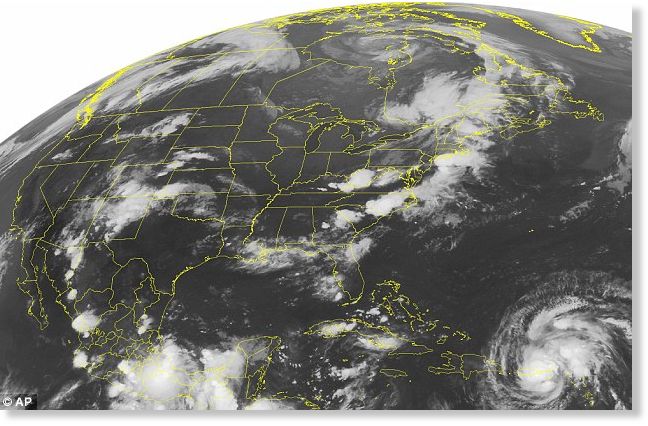
© Associated PressHeading inland: A national Oceanic and Atmospheric Administration satellite image from 1.45am EDT shows patches of dense cloud from Tropical Storm Irene heading towards Puerto Rico
The heavily-populated south east Florida coast is in the direct line of numerous forecast cones.
However, the National Hurricane Centre (NHC) stressed Irene's path still remains uncertain and it could make landfall anywhere from the Florida Keys to the Carolinas.
Stacy Stewart, a senior hurricane specialist at the NHC, said late Monday morning: 'Irene has become much better organized during the past six hours despite its interaction with the mountainous terrain of Puerto Rico, and a ragged eye has become apparent in imagery from the Federal Aviation Administration terminal Doppler weather radar.'
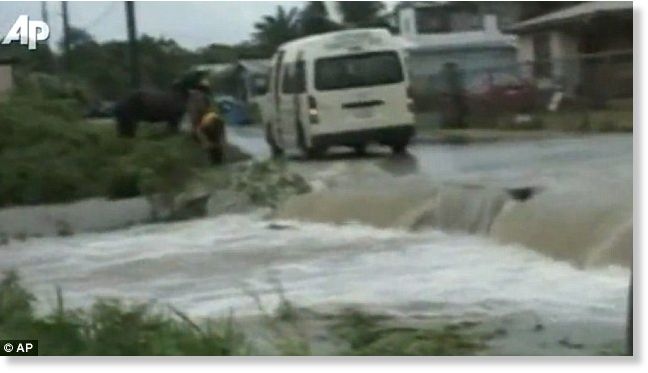
© Associated PressWater everywhere: Five rivers in Puerto Rico burst their banks on Monday morning as Irene was upgraded from a tropical storm to a hurricane
Warm sea water is also expected to fuel the storm.
Kristina Pydynowski, a meteorologist with State College, Pennsylvania-based AccuWeather Inc., said it could even become a Category 3 hurricane with sustained winds of at least 111 mph.
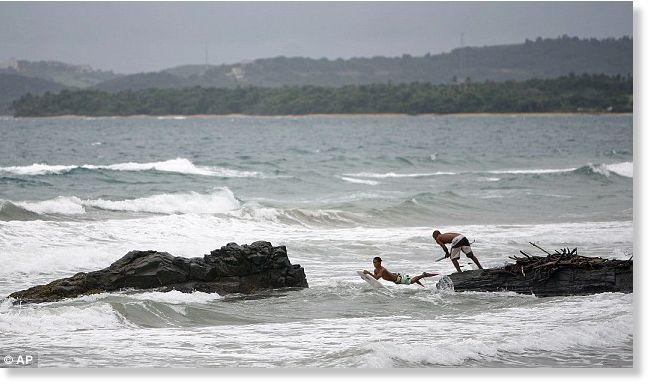
© Associated PressPlaying with death: Body boarders defy advice to stay indoors and make the most of the rough conditions in Puerto Rico
The NHC says a storm of this magnitude would cause 'devastating damage' with a 'high risk of injury or death.'
Puerto Rico took a pounding Monday morning with at least five rivers bursting their banks.
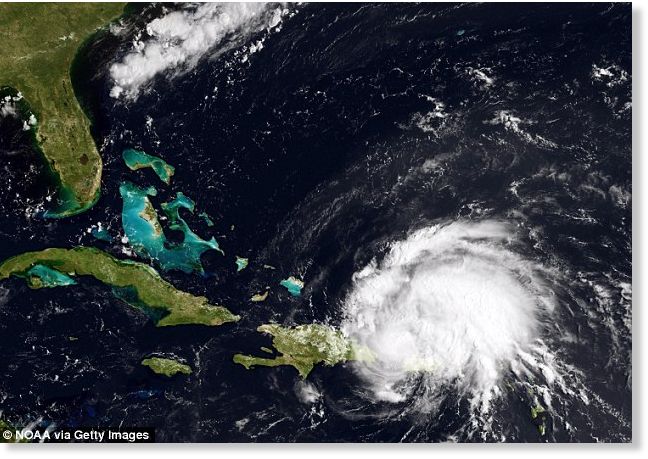
© NOAA via Getty ImagesOn its way: National Oceanic and Atmospheric Administration (NOAA) satellite image as Irene made it to hurricane strength over Puerto Rico as it makes its way to the east coast of the U.S.
The fast-changing storm has downed trees and caused widespread power cuts in the U.S. Virgin Islands as it shifted north over Caribbean territory.
After hitting Puerto Rico, forecasters believe Irene will move towards Hispaniola, the island shared by the Dominican Republic and Haiti.
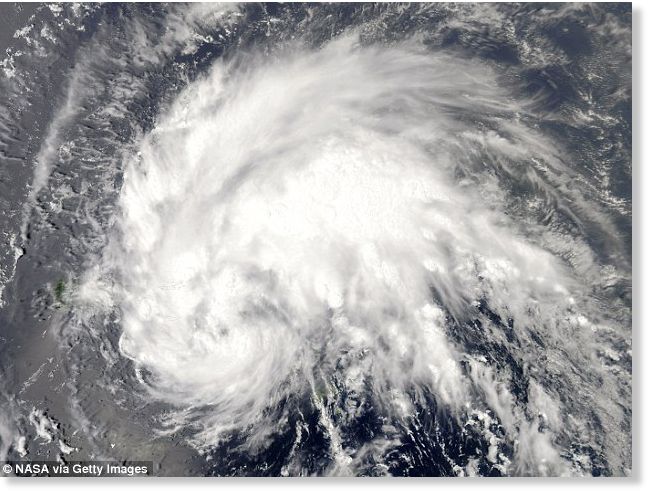
© NASA via Getty ImagesFull force: NASA Goddard Space Flight Centre satellite image shows Irene ripping through Puerto Rico
Residents of Antigua reported rains, strong squalls and surf as the storm passed the Leeward Islands in the northeast corner of the Caribbean.
Hurricane watches and warnings were in effect in the U.S. Virgin Islands, Puerto Rico and the Dominican Republic.
Tropical storm warnings were in effect for most of the northeastern Caribbean islands, and for Haiti.
In San Juan, dozens of people sought emergency shelter ahead of Irene, which is expected to dump up to 10in (25cm) of rain in Puerto Rico.
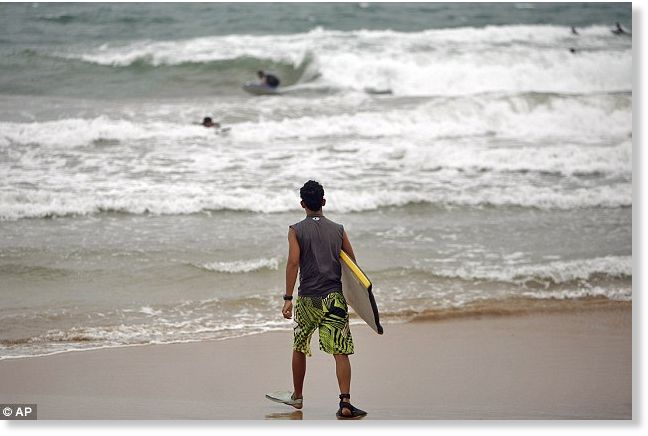
© Associated PressOn edge: A surfer inspects the windy conditions as Tropical Storm Irene approaches Luquillo, Puerto Rico
She said: 'You can hear the wind, the gusts are relentless, she said. I can't see anything because I've closed everything.'
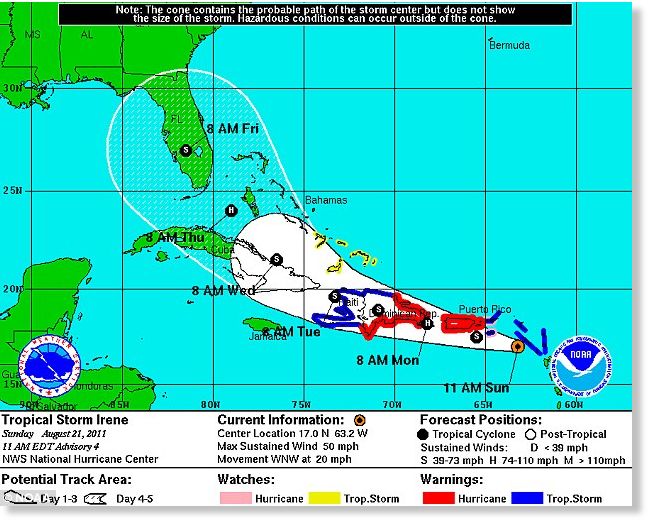
© NOAAOn its way: Tropical storm Irene is expected to develop into a hurricaine and arrive in Florida in the next few days
Strong winds and rain were battering the outlying Puerto Rican islands of Culebra and Vieques, where 150 tourists were evacuated, according to Governor Luis Fortuno. At least 120,000 people were without power and another 13,000 without water as the storm approached.
All schools and nearly all government offices in Puerto Rico would remain closed today, Mr Fortuno said.
The U.S. hurricane centre said the main impediment to the storm's progress over the next couple of days will be interaction with land.
If Irene passes over Hispaniola's mountains or over parts of eastern Cuba, the storm could weaken more than currently expected.
In the US Virgin Islands, Governor John deJongh declared a state of emergency in order to impose storm curfews.
Governors spokesman Jean Greaux said: 'We've got what appears to be a direct hit on St Croix.'
Residents of Cuba, the Turks and Caicos Islands, the Bahamas and the southeastern United States were urged to monitor Irene's progress as the storm headed their way.
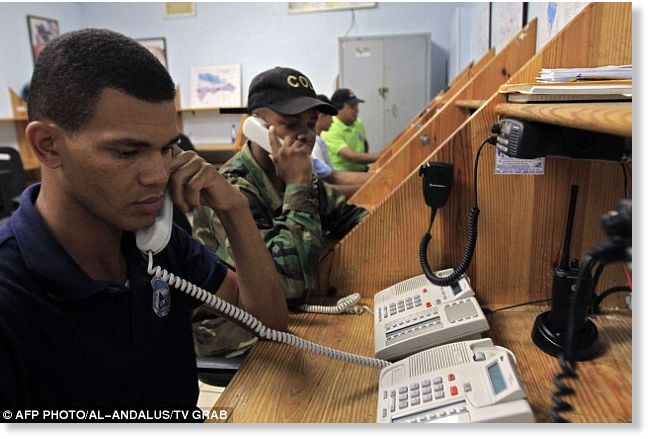
© AFP photo/Al-Andalus/TV grabEmergency measures: Workers at the Emergency Center in Santo Domingo, Dominican Republic, answer calls after authorities declared red alert in preparation for Tropical Storm Irene
Depending on its eventual path and possible turns, Irene might still pose a threat to U.S. oil and gas installations in the Gulf of Mexico, but forecasters say it is too early to predict with certitude.
An early northward turn would bring it near the Georgia-South Carolina coast late in the week. But a later turn could keep it over the warm Caribbean waters until it reached the Gulf of Mexico, which could make it a much more powerful hurricane.
Tropical Storm Harvey, which hit the coast of Belize in Central America on Saturday, weakened earlier on Sunday to a tropical depression.
But the hurricane center said it was still producing heavy rains over Guatemala and southeastern Mexico. It was expected to dissipate by Monday.
Mudslides and flooding could affect agricultural output in Central America, but this year's coffee and sugar harvests are largely complete.



That ain't no "surfer"on the beach - it's a sponger - a "boogie boarder."
R.C.