
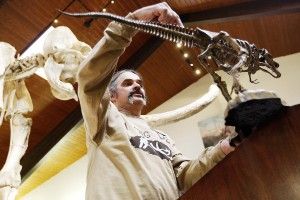
© Tim Kupsick/Casper Star-TribuneJ.P. Cavigelli, field operations specialist for the Tate Museum
Well, now he consists of about 20 bones collected from private land north of Lusk. But think of what he could be.
With more digging, this Tyrannosaurus rex has the potential to be among the most complete T-rexes ever discovered. Someday, he'll move into the Tate Geological Museum at Casper College, gracing the same hall as Dee the Mammoth, the largest Columbian mammoth mounted in North America. If the two were ever to be displayed side by side, Lee Rex would be just a bit bigger.
The Tate introduced Lee on Wednesday at a press conference underneath Dee's right tusk. The T-rex will give the museum another chance to "display a fossil found in Wyoming that will stay in Wyoming," said Walter Nolte, Casper College president.
Only about 50 T-rex specimens have ever been found, five of those in Wyoming. Only 15 T-rexes are fairly complete.
"I hope that this discovery will be the best T-rex from Wyoming," said JP Cavigelli, the Tate's field operations specialist.
Lee's vertebrae from the pelvis area and some pelvis bones appear to be pretty well articulated - that is, the bones are lined up as they would have been if the dinosaur was still alive. In other words, the leg bones are connected to the hip bones.
The articulated pelvic region makes Lee pretty darned special, Cavigelli said, even if no more of him is found.
Evidence suggests that there will be.
Cavigelli discovered Lee in the summer of 2005 while digging on the Lusk ranch. A team of paleontologists and pay-to-diggers was working on Frill Hill, a small mound named for its many pieces of Triceratops frill. Cavigelli needed a break and took a walk, just exploring. He noticed a few bones sticking out of a hard rock in the grass, spotting maybe four or five vertebrae, exposed for who knows how long.
He didn't know what he had found, but didn't investigate further. He kept the site in the back of his mind, even as teams returned to Frill Hill several more summers.
"We just put the thing on the back burner because it was in a very hard rock," Cavigelli said. Frill Hill rocks are soft, making for easier digs.
Last summer, a five-person team went to the rock, digging for three days. They uncovered a slab 18 feet long and 8 feet wide. They found three fossilized articulated vertebrae from the tailbone at one end of the rock. They also found three long rib bones, pelvic bones and others.
After the first day, Cavigelli told the rancher: " 'I'm 90 percent sure we have a T-rex.' She was pretty excited, and she told her husband. He thought we were pulling his leg."
By the end of the third day, Cavigelli was certain. They had uncovered chevrons, a series of bones on the underside of reptile tails. On a T-rex, these are distinctly shaped, resembling paddles.
As the guy who discovered the bones, Cavigelli won the naming rights. He named Lee Rex after the rancher who owns the land and who donated the specimen to the Tate. Plus, Lee rhymes with both "T" and Dee.
Who wouldn't want to go see Lee the Dinosaur alongside Dee the Mammoth? It has the Tate ring to it.
Lee lived 65 million to 67 million years ago, in the late Cretaceous. What is now Wyoming would have been a lot more wooded, a lot more tropical, Cavigelli said. Our mountains would have just been rising, depositing rocks and debris into the relatively flat basins. An ocean's edge would have been somewhere in western Kansas or Nebraska.
While the articulation makes Lee special, several prospects could make him even more special.
That hard slab of rock is the right kind of rock for skin impressions. If those were found, it would be a first for a T-rex specimen and would make Lee unique.
Also, other bones were found in the soft shale around the rock, including cervical ribs attached to the second vertebra. These are small rib bones that stick out of the neck vertebrae of most reptiles. They are found right behind the head.
"This basically gives us high hopes that there's a lot more in shale," Cavigelli said.
Maybe even a skull.
Lee Rex will be excavated for four to six weeks this summer, beginning June 13. It will be a slow attack, especially through the shale where the bones uncovered could be quite fragile. For example, while some dinosaur skulls can be uncovered relatively intact, many come out in small, puzzlelike pieces.
Cavigelli doesn't know what to expect.
"This is pure exploration," Cavigelli said. "Either we could find something really cool or we could get totally skunked."



Reader Comments
to our Newsletter