
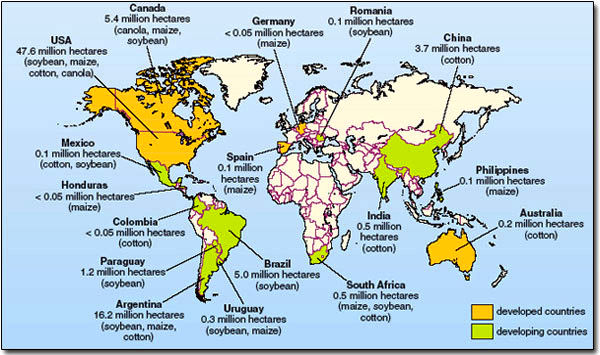
© freewebs.comThe map shows the status of GM Crops in 2004
These so-called biotech crops, often bred with genes that allow them to tolerate weed killers or generate their own insecticides, now cover 10% of the world's farmland, up from nothing just 15 years ago.
The figures are in this year's International Service for the Acquisition of Agri-biotech Applications report, out Tuesday. Of the four most commonly planted biotech crops, a rising percentage of the total of all plantings are biotech. In 2010, 81% of all soybeans, 64% of cotton, 29% of corn and 23% of canola globally were from biotech seeds, the ISAAA says.
The most common modification is herbicide tolerance, where plants are given a gene that allows farmers to spray them with the weed killer glyphosate, known to most home gardeners as Roundup, without harming them. Sixty-one percent of biotech crops carry this gene.
The other commonly used trait is the addition of a gene from a soil bacteria called Bacillus thuringiensis that allows plants to produce their own insecticide. About 17% of biotech crops carry this trait. About 22% contained both genes.
Genetically engineered crops have been commercially planted since 1996. Major crops are soy, corn, cotton and canola, then small amounts of sugar beets, alfalfa, papaya, summer squash, poplar, potato, tomato and sweet pepper.
Biotech crops
Genetically engineered crops covered 10% of the world's farm acreage in 2010, from less than 1% just 15 years ago when the first commercial biotech crop varieties were introduced. Here are the currently planted biotech crops, in order of acerage worldwide.
Soybean: 181 million acres: herbicide tolerant.
Corn: 115 million acres: herbicide tolerant, insect resistant, modified to yield more animal feed and also ethanol for biofuel production.
Cotton: 51 million acres: herbicide tolerant, insect resistant.
Canola (rapeseed oil): 17 million acres: herbicide tolerant.
Sugar beets: 1.2 million acres: herbicide tolerant (only grown in the United States and Canada).
Alfalfa: 247,000 acres : herbicide tolerant.
Papaya: 17,300 acres: resistant to the papaya ringspot-virus, 60% of all papaya in Hawaii and 99% of all papaya in China.
A total of 29 countries worldwide now plant GM crops, with the United States planting the most, at 165 million acres, Brazil with 63 million acres,and Argentina with 56 million. But debate over use of these crops continues. Genetically engineered seed can cost more than conventional seed, but for many farmers, especially larger and more technologically savvy ones, the savings they represent in time and diminished insecticide and pesticide use makes them economical. Opponents, such as the Union of Concerned Scientists, charge that the crops could represent unknown hazards to animals and humans who eat them, including possibly adding new allergens and toxins to foods.
The so-called "Roundup Ready" crops that can tolerate glyphosate are a problem because they're so popular, says the Union's Doug Gurian-Sherman. He says it's destroying the efficacy of Roundup, an important herbicide because it's "effective, breaks down quickly and is inexpensive." Resistant weeds are beginning to emerge, he says, in part because "we're not managing it well," he says.
Comment: For more information about 'Roundup Resistant Super Weeds' read:
Monsanto's Superweeds Come Home to Roost: 11 Million U.S. Acres are Infested
The Escalating Chemical War on Weeds
Other groups feel the biotech crops favor richer farmers over poor ones because of their costs and are a threat to biodiversity. The crops have been enthusiastically embraced by farmers in the United States, Canada, Brazil, Argentina and China. Much of Europe is opposed to them.
Others, looking towards 2050, when the world's population is expected to peak at 9 billion, see the promise of higher yields from biotech varieties as key to dealing with the shrinking availability of land to feed those two billion more mouths.
Genetic modification will be crucial as the world's climate changes, says Clive James, chair of ISAAA's board.
"Speeding the breeding as you get more frequent and more severe changes in climate, whether it's temperature or water level, we need a technology that allows you to develop improved varieties more rapidly."
Comment: Genetic Modification is not the answer to feeding a hungry world in the midst of severe changes in climate and weather. For more information read the following:
Genetically Modified Foods and the Monsanto Initiative
According to the World Bank and the United Nations Food and Agriculture Organization, "1.02 billion people are undernourished, a sizable increase from its 2006 estimate of 854 million people," which indicates a combination of insufficient food, low incomes, and inadequate distribution of food. This is the largest number of hungry humans ever recorded in history. Likewise, reports from numerous other international organizations and reputable scientific researchers confirm the existence of these serious food supply problems. In the face of these realities, the U.S. Government will have us believe it that we NEED GM foods to meet the demands of a modern world.7 Reasons Food Shortages Will Become a Global Crisis
Arguments for the research into and implementation of GM foods claim to support the initiatives to combat these problems. Proponents tell us that GMO foods bring higher crop yields, allow farmers to use less pesticides and fertilizers thereby decreasing environmental impact and allow the growth of crops in harsh environments. Though these all seem like ideal solutions to our present, global dilemma, opponents tell us that these claims do not agree with much of the scientific research on the issue and are only creating an increased danger to consumers. It seems that the biggest concern stemming from the GM process is generated mainly by ignorance of the process and the mounting threats that independent researchers say it poses to public health.
Global food shortages have forced emergency meetings at the U.N. Food and Agriculture Organization where they claim "urgent action" is needed. They point to extreme weather as the main contributing factor to the growing food shortages. However, commodity speculation has also been targeted as one of the culprits.GMO Seeds: 'Multinational Corporations Gaining Total Control Over Farming'
It seems that the crisis would also present the perfect opportunity and the justification for the large GMO food companies to force their products into skeptical markets like in Europe and Japan, as recently leaked cables suggest. One thing is for sure; food shortages will likely continue to get worse and eventually become a full-scale global food crisis.
Food security campaigners are now more concerned than ever that farmers are turning dependent on large multinational corporations (MNCs) for seeds, fertilizers, pesticides and other inputs while also becoming more vulnerable to pressures to produce genetically engineered crops.
...There has been a growing recognition among campaigners that a broader view of the agrichemical and agribusiness challenge is necessary to take into consideration the new power structures in farming and more aggressive and assertive marketing techniques.
One of the biggest challenges facing campaigners is the corporate takeover of agriculture through a process of 'vertical integration'. This involves the taking over of the entire food production cycle from the development of proprietary strains of DNA and the sales of seeds to farmers right down to the distribution and retail sales of food products in supermarkets and hypermarkets.
Some who feel genetic engineering can be positive worry that the benefits won't be used to help the poorest farmers.
Peggy Lemaux, at the University of California, Berkeley's Department of Plant and Microbial Biology, says "because of the expenses involved, creating engineered crops for developing countries requires humanitarian contributions by philanthropists like (Bill) Gates and the Rockefeller Foundation, or perhaps by companies who see value in such endeavors."
Comment: To learn more about 'Philanthropists' like Bill Gates and the Rockefellar Foundation and their 'humanitarian contributions' read the following:
"Doomsday Seed Vault" - Bill Gates, Rockefeller and the GMO giants know something we don't?
Africa is the next target in the US-government campaign to spread GMO worldwide. Its rich soils make it an ideal candidate. Not surprisingly many African governments suspect the worst from the GMO sponsors as a multitude of genetic engineering and biosafety projects have been initiated in Africa, with the aim of introducing GMOs into Africa's agricultural systems. These include sponsorships offered by the US government to train African scientists in genetic engineering in the US, biosafety projects funded by the United States Agency for International Development (USAID) and the World Bank; GMO research involving African indigenous food crops.Global elites push to starve the world and control all food
The Rockefeller Foundation has been working for years to promote, largely without success, projects to introduce GMOs into the fields of Africa. They have backed research that supports the applicability of GMO cotton in the Makhathini Flats in South Africa.
Monsanto, who has a strong foothold in South Africa's seed industry, both GMO and hybrid, has conceived of an ingenious smallholders' programme known as the 'Seeds of Hope' Campaign, which is introducing a green revolution package to small scale poor farmers, followed, of course, by Monsanto's patented GMO seeds.
The bottom line is that Monsanto and other UN controlled global elite groups, must have the world food supply controlled to grow their tyranny and control over the countries of the world. That means forcibly manipulating even worldwide famines and life expectancies by causing us all to die more quickly due to depleted and manipulated food we are forced to eat.


Reader Comments
to our Newsletter