
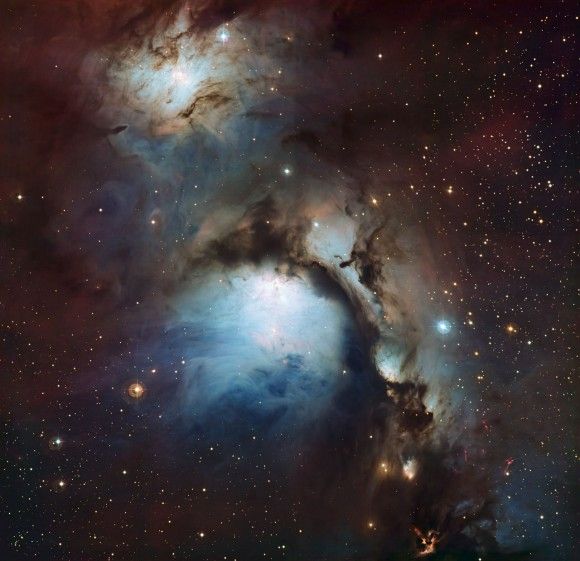
© ESO and Igor ChekalinA new image from ESO of the reflection nebula Messier 78.
This beautiful image was the overall winner of ESO's Hidden Treasures 2010 astrophotography competition created by Igor Chekalin, who won with his image of this stunning object.
Messier 78 can easily be observed with a small telescope, being one of the brightest reflection nebulae in the sky. It lies about 1350 light-years away in the constellation of Orion (The Hunter) and can be found northeast of the easternmost star of Orion's belt.
For those of you who want to take a look on your own:
Right Ascension: 05:46.7This image contains many other striking features apart from the glowing nebula. A thick band of obscuring dust stretches across the image from the upper left to the lower right, blocking the light from background stars. In the bottom right corner, many curious pink structures are also visible, which are created by jets of material being ejected from stars that have recently formed and are still buried deep in dust clouds.
Declination: +00:03
Distance: 1.6 (kly)
Visual Brightness: Magnitude 8.3
Two bright stars, HD 38563A and HD 38563B, are the main powerhouses behind Messier 78. However, the nebula is home to many more stars, including a collection of about 45 low mass, young stars (less than 10 million years old) in which the cores are still too cool for hydrogen fusion to start, known as T Tauri stars. Studying T Tauri stars is important for understanding the early stages of star formation and how planetary systems are created.
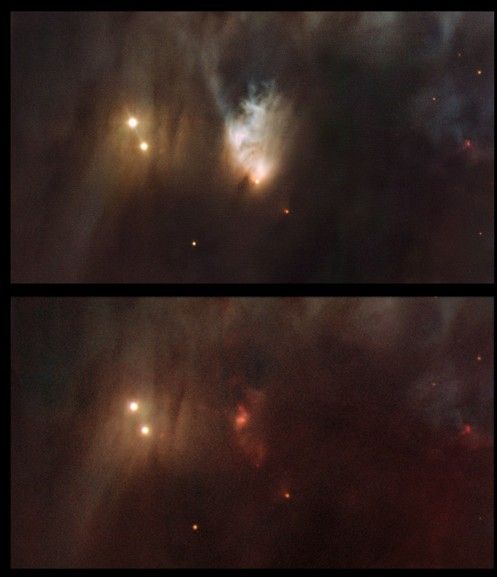
© ESO/T. A. Rector/University of Alaska Anchorage, H. Schweiker/WIYN and NOAO/AURA/NSF and Igor ChekalinMessier 78 region taken in 2006 (below) with the 4-metre Mayall telescope at Kitt Peak, Arizona with a new image from ESO.
But this object has changed significantly in the last ten years. In February 2004 the experienced amateur observer Jay McNeil took an image of this region with a 75 mm telescope and was surprised to see a bright nebula - the prominent fan shaped feature near the bottom of this picture - where nothing was seen on most earlier images. This object is now known as McNeil's Nebula and it appears to be a highly variable reflection nebula around a young star.
This color picture was created from many monochrome exposures taken through blue, yellow/green and red filters, supplemented by exposures through an H-alpha filter that shows light from glowing hydrogen gas. The total exposure times were 9, 9, 17.5 and 15.5 minutes per filter, respectively.


Reader Comments
to our Newsletter