
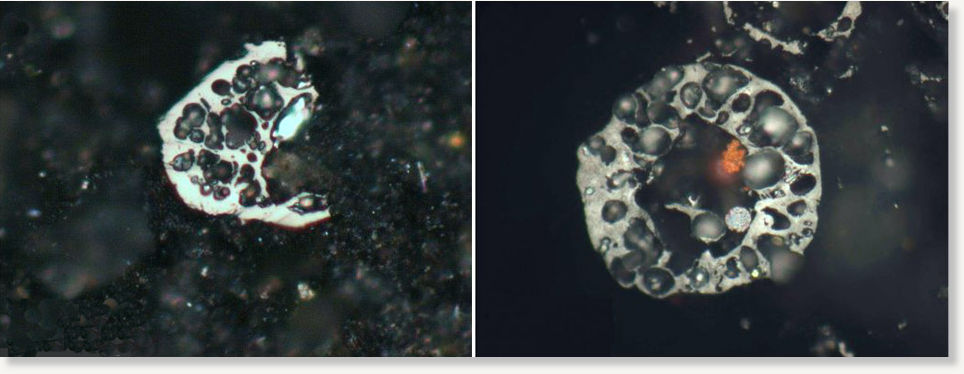
© Grasby et al., Nature Geoscience Spark. The tiny, frothy particles found in ancient Canadian rocks (left), which are similar to the particles of fly ash from today's coal-fired power plants (right), might have helped trigger the mass extinction that struck Earth 250 million years ago.
The die-off, which occurred worldwide about 250 million years ago at the end of the Permian period, was even more extensive than the one that wiped out the dinosaurs. More than 90% of marine species went extinct, and land-based ecosystems suffered almost as much. Scientists have long debated the reasons. Favorite hypotheses include an asteroid impact, massive volcanic eruptions in Siberia, and toxic oceans. Geochemist Stephen Grasby of the Geological Survey of Canada in Calgary and colleagues report online today in Nature Geoscience a new twist on the volcano notion.
Rocks that now make up the northernmost islands of the Canadian Arctic formed millions of years ago as seafloor sediments off the northwestern coast of a supercontinent called Pangaea. When Grasby and his team analyzed rocks from just before the Permian mass extinction, they noticed unusual microscopic particles. Besides the usual miniscule clumps of organic matter, they also found tiny bubble-filled particles called cenospheres. These frothy little blobs form only when molten coal spews into the atmosphere, the researchers say. Today, the fly ash produced by coal-fired power plants brims with cenospheres, but they are largely trapped by pollution-control equipment before they escape the smokestack. Millions of years ago, they must have been created when massive amounts of molten rock - more than 1 trillion metric tons - erupted through overlying coal deposits in Siberia to form lava deposits known as the Siberian Traps.
Because the late Permian cenospheres are approximately the same size and likely about the same weight as the smallest particles of volcanic ash, they could have easily risen to an altitude of about 20 kilometers in the atmosphere and then been swept around the world by jet stream winds. And like coal ash produced today, the particles would have been loaded with toxic metals such as chromium and arsenic. When the ancient cenospheres eventually dropped into the seas, they would have converted surface waters into a toxic soup, the researchers speculate. Then, they say, after most life died, decomposition would have robbed the water of its dissolved oxygen, smothering many of the survivors.
"The evidence is pretty compelling," says Gregory Retallack, a geologist at the University of Oregon, Eugene. Geophysicist Norman Sleep of Stanford University in Palo Alto, California, agrees. The team's findings "are an extremely major discovery," he says. As the ecological consequences piled up, he notes, the chain of events set in motion by the massive Siberian eruptions "went from something bad for life to a complete disaster." Finding cenospheres in late Permian rocks worldwide would bolster the notion that the tiny particles played a major role in causing the extinction, says Grasby.



This article reminded me of a trip we took a trip out to Colorado with kids back in '95, and took a detour to Ashfall, NE to check out the site we read about in a brochure. It's way out in the middle of nowhere, but it was well worth the detour.
Home page link: [Link]
From this link: [Link], the following:
"About 12 million years ago, a volcano in southwest Idaho spread a blanket of ash over a very large area. One or two feet of this powdered glass covered the flat savannah-like grasslands of northeastern Nebraska.
Most of the animals which lived here survived the actual ashfall, but as they continued to graze on the ash covered grasses, their lungs began to fill up with the abrasive powder. Soon their lungs became severely damaged and they began to die.
The smaller animals died first (smaller lung capacities) and finally, after perhaps three to five weeks, the last of the rhinos perished.Their bodies were quickly covered by the blowing and drifting ash.
Undisturbed except by an occasional scavenging meat-eater, the skeletons of these animals are preserved in their death positions, complete with evidence of their last meals in their mouths and stomachs and their last steps preserved in the sandstone below. "
"Facts about Ashfall Fossil Beds State Historical Park and the Hubbard Rhino Barn
* Ashfall Fossil Beds State Historical Park is the only known site in the world where entire three-dimensional skeletons of large prehistoric animals are preserved.
* The volcanic ash from a volcano in what is today Idaho killed hundreds of animals, including rhinos, camels, three-toed horses, and birds, among others, and preserved their remains in exquisite detail.
* The fossil site was discovered in 1971 when Mike Voorhies, emeritus professor and curator of vertebrate paleontology, discovered the skull of a baby rhinoceros eroding from the wall of a ravine at the edge of a cornfield on Melvin Colson's farm in northern Antelope County.
* Nebraska's newest state park, Ashfall Fossil Beds State Historical Park opened to the public June 1, 1991. Located 6 miles north of U.S. Highway 20 between Royal and Orchard, the park is a joint project of the University of Nebraska State Museum and the Nebraska Game and Parks Commission.
* More than 350 full skeletons and 25,000 isolated fossil specimens have been documented at the site. Paleontologists are certain many more will be located in coming years inside the new Hubbard Rhino Barn.
* Of the approximately half-dozen enclosed fossil sites in North America, Ashfall Fossil Beds is the only facility where paleontologists continue to unearth large skeletons that resemble real animals.
* A portion of the large fossil bed was enclosed in 1991, giving the general public a firsthand look at the extinct animals preserved exactly as they died. All excavations at Ashfall Fossil Beds are carried out in full view of the visiting public. "
Another interesting finding on their geology page was the thick layer of sandstone below and above the ash layer, which makes me wonder if the area might have been part of a shoreline rather than a watering hole(?)