

© NRG Solar/SunPowerA map of the planned 250 MW solar power plant, showing preserved land (green) and installation area (blue).
As does a new 250 MW installation in San Luis Obispo County, California which was formally announced this week. Construction on the new plant will commence next year and is expected to create 350 construction jobs.
San Luis Obispo is a coastal county that is relatively rural and lightly populated by Californian standards. It's roughly halfway between Los Angeles and San Francisco, two of the state's biggest cities.
The new plant will be a joint venture between NRG Solar, Inc. and SunPower Corp. -- two veteran solar power firms (SunPower, alone, will have installed over 1.5 GW of solar power by the year's end). NRG Solar is expected to pitch in $450M USD over the four year launch period. NRG will own the plant, it is basically contracting SunPower to design, build, and operate the plant.
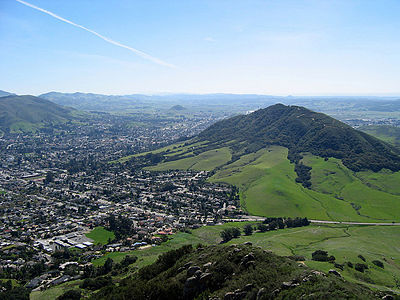
© WikipediaThe plant will be located roughly halfway between San Francisco and Los Angeles, just south of California's Bay Area.
The new plant is named the "California Valley Solar Ranch".
NRG Solar is seeking government loans from the U.S. Department of Energy to initially finance the construction. While U.S. President Barack Obama recently handed out $1.85B USD in grants to solar power projects, the new installation likely will not receive any of this money.
Securing a government loan is critical to the NRG and SunPower's plan. States Howard Wenger, president of the utility and power plants business group at SunPower, "The DOE is playing a critical leadership role in supporting renewable energy that provides economic and environmental benefits, as well as a secure, stable energy supply in the U.S."
The project has been in the works for the last two years. It is expected to be operational for at least 25 years.
Challenges to the plant's success remain. Currently environmental activists in California are vigorously resisting large solar and wind installations, which they fear will damage fragile ecosystems. They have filed lawsuits to try to block similar projects.
The California Valley Solar Ranch project may placate these critics, thanks to the 2,399 acres it sets aside as a wildlife habitat. The plant and associated facilities are expected to occupy 1,966 acres of land.
An even greater challenge may be the underlying economics. While the California Public Utilities Commission has agreed to buy 25 years worth of power from the installation, likely at an inflated price, it remains to be seen exactly how much money the plant will make. Coal power costs around $0.06-$0.08 USD per kilowatt-hour, so an equivalent coal plant would only make about $153.4M USD over its operating lifetime (taking a cost of $0.07 and lifespan of 25 years) -- about a third of the planned investment.
Still, it's common knowledge that you have to invest up front to gain access to new technology. And with large scale installations like this new one in California and the currently developing one in Arizona, the cost per kilowatt hour of solar power in the U.S. should fall over the next few years.






250 MW on that huge amount of land is a joke. One small combined cycle power plant that is very efficient can do 500 MW.
Also, this is in a sunny area, if done on a less sunny area expect much less output. Plus there is no real way to store power to use during peak times like evenings. Not to mention that since solar power can go out, there still needs to be 250 MW of power ready to go online quickly in case the solar plant loses power (clouds etc). The plants that can come online quickly (term: reserve power) are NOT efficient. The efficient plants can do it too, but they have to use fuel to keep spinning (spinning reserve). Power that is not very reliable still costs a lot of fuel!